 Back
Cellular Respiration, Metabolism, and Energy Transformation: Study Notes for General Biology
Study Guide - Smart Notes
 Tailored notes based on your materials, expanded with key definitions, examples, and context.
Energy Flow and Chemical Recycling in Ecosystems
Photosynthesis and Cellular Respiration
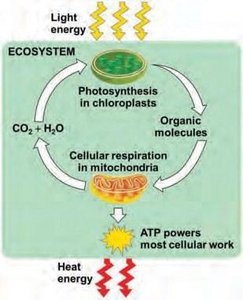
Photosynthesis and cellular respiration are fundamental processes that drive energy flow and chemical recycling in ecosystems. Photosynthesis in chloroplasts converts light energy into chemical energy, producing organic molecules from carbon dioxide and water. Cellular respiration in mitochondria breaks down these organic molecules to release energy in the form of ATP, which powers most cellular work.
Photosynthesis: Converts CO2 and H2O into organic molecules using light energy.
Cellular Respiration: Breaks down organic molecules to produce ATP, releasing CO2 and H2O as byproducts.
ATP: The main energy currency of the cell, used for cellular work.
Major Steps of Cellular Respiration
Glycolysis
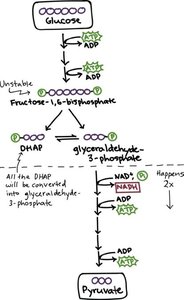
Glycolysis is the first step in cellular respiration, occurring in the cytosol. It breaks down glucose into two molecules of pyruvate, generating a net gain of 2 ATP and 2 NADH.
Glucose: The starting molecule for glycolysis.
Fructose-1,6-bisphosphate: An unstable intermediate that splits into two three-carbon molecules.
Glyceraldehyde-3-phosphate: The molecule that continues through glycolysis, producing NADH and ATP.
End Products: 2 pyruvate, 2 ATP (net), 2 NADH.
Pyruvate Oxidation
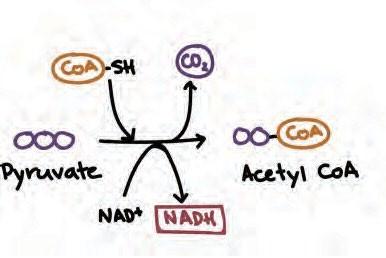
After glycolysis, pyruvate is transported into the mitochondria and oxidized to acetyl CoA. This process produces NADH and releases CO2.
Pyruvate: The product of glycolysis.
Acetyl CoA: Formed from pyruvate, enters the citric acid cycle.
Byproducts: NADH and CO2.
Citric Acid Cycle (Krebs Cycle)
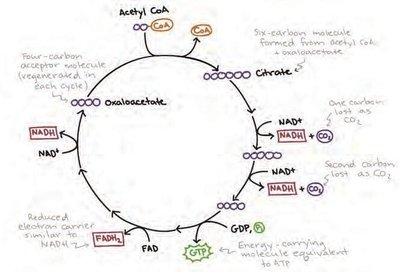
The citric acid cycle occurs in the mitochondrial matrix and completes the breakdown of glucose. Acetyl CoA combines with oxaloacetate to form citrate, which is then processed to regenerate oxaloacetate. The cycle produces NADH, FADH2, ATP (or GTP), and CO2.
Acetyl CoA: Enters the cycle and combines with oxaloacetate.
NADH and FADH2: Electron carriers generated during the cycle.
ATP/GTP: Energy molecule produced.
CO2: Waste product released.
Electron Transport Chain and Oxidative Phosphorylation
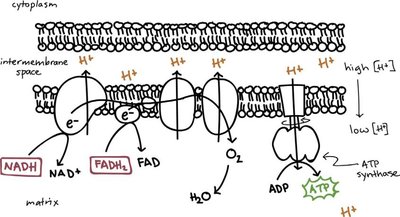
The electron transport chain (ETC) is located in the inner mitochondrial membrane. NADH and FADH2 donate electrons to the ETC, which powers the pumping of protons (H+) across the membrane, creating a gradient. Oxygen is the final electron acceptor, forming water. ATP synthase uses the proton gradient to synthesize ATP from ADP and inorganic phosphate.
Electron Carriers: NADH and FADH2 deliver electrons to the ETC.
Proton Gradient: Drives ATP synthesis via chemiosmosis.
ATP Synthase: Enzyme responsible for ATP production.
Water: Formed when electrons combine with oxygen.
ATP Synthase and Chemiosmosis
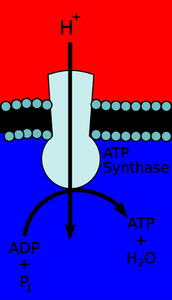
ATP synthase is a membrane-bound enzyme that uses the energy from the proton gradient to convert ADP and inorganic phosphate into ATP. The movement of protons through ATP synthase is essential for ATP production.
ADP + Pi: Substrates for ATP synthesis.
ATP: Main product, used for cellular work.
Importance: Accumulation of protons on one side of the membrane is necessary for ATP synthase function.
Fates of Pyruvate: Aerobic vs. Anaerobic Respiration
Pyruvate Pathways
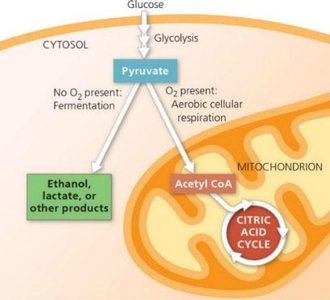
After glycolysis, pyruvate can follow two main pathways depending on oxygen availability. In the presence of oxygen, pyruvate enters the mitochondria for aerobic respiration. Without oxygen, pyruvate undergoes fermentation in the cytosol.
Aerobic Respiration: Pyruvate is converted to acetyl CoA and enters the citric acid cycle.
Anaerobic Respiration (Fermentation): Pyruvate is converted to ethanol, lactate, or other products.
Regulation and Feedback Inhibition in Cellular Respiration
Regulation of Glycolysis
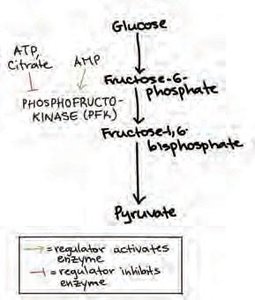
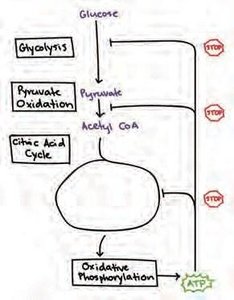
Cellular respiration is tightly regulated by feedback inhibition. Phosphofructokinase (PFK) is a key regulatory enzyme in glycolysis, activated by AMP and inhibited by ATP and citrate.
Phosphofructokinase (PFK): Regulates glycolysis based on cellular energy needs.
AMP: Activates PFK when energy is low.
ATP and Citrate: Inhibit PFK when energy is abundant.
Feedback Inhibition Pathways
Multiple steps in cellular respiration are regulated by feedback inhibition to prevent overproduction of ATP and maintain metabolic balance.
Glycolysis, Pyruvate Oxidation, Citric Acid Cycle, Oxidative Phosphorylation: Each step can be inhibited by high levels of ATP.
Fermentation: Anaerobic Energy Production
Alcohol Fermentation
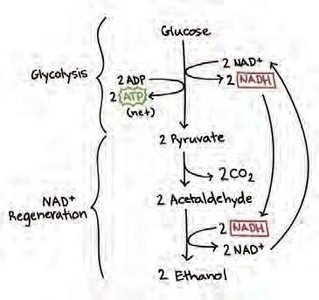
In yeast and some bacteria, pyruvate is converted to ethanol and CO2 during alcohol fermentation. NAD+ is regenerated, allowing glycolysis to continue.
End Products: Ethanol, CO2, NAD+.
Importance: Regeneration of NAD+ is essential for continued ATP production in the absence of oxygen.
Lactic Acid Fermentation
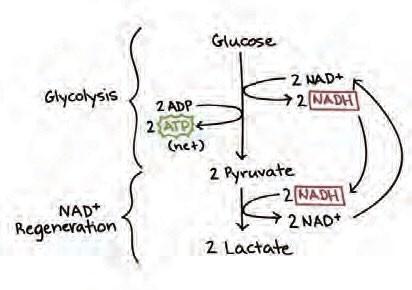
In humans and other animals, pyruvate is converted to lactate during lactic acid fermentation. NAD+ is regenerated, supporting glycolysis under anaerobic conditions.
End Products: Lactate, NAD+.
Importance: Allows cells to produce ATP when oxygen is scarce.
Summary Table: ATP and Electron Carrier Production
ATP and Electron Carrier Yield by Pathway
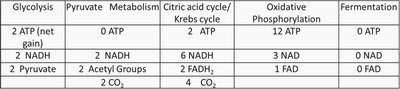
The following table summarizes the ATP, NADH, FADH2, and CO2 produced at each step of cellular respiration and fermentation.
Glycolysis | Pyruvate Metabolism | Citric Acid Cycle/Krebs Cycle | Oxidative Phosphorylation | Fermentation |
|---|---|---|---|---|
2 ATP (net gain) | 0 ATP | 2 ATP | 12 ATP | 0 ATP |
2 NADH | 2 NADH | 6 NADH | 3 NAD | 0 NAD |
2 Pyruvate | 2 Acetyl Groups | 2 FADH2 | 1 FAD | 0 FAD |
2 CO2 | 2 CO2 | 4 CO2 |
Additional info:
Oxidation and Reduction: Oxidation is the loss of electrons, while reduction is the gain of electrons. In cellular respiration, glucose is oxidized and oxygen is reduced.
NAD+: Functions as an electron shuttle, accepting electrons during glycolysis and the citric acid cycle and delivering them to the electron transport chain.
Fermentation: Necessary when oxygen is unavailable, allowing cells to regenerate NAD+ and continue producing ATP via glycolysis.
Metabolic Pathways: Catabolic pathways break down macromolecules to release energy; anabolic pathways build macromolecules from monomers.
Role of Metals: Cofactors such as iron and magnesium are essential for enzyme function in cellular respiration.
