 Back
BackCellular Respiration: Obtaining Energy from Food
Study Guide - Smart Notes
 Tailored notes based on your materials, expanded with key definitions, examples, and context.
Cellular Respiration: Obtaining Energy from Food
Introduction to Cellular Respiration
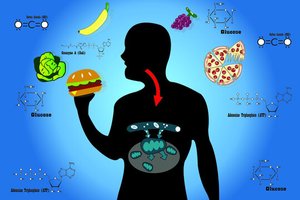
Cellular respiration is the process by which cells extract energy from food molecules, primarily glucose, to produce adenosine triphosphate (ATP), the main energy currency of the cell. This process is essential for all eukaryotic life and involves a series of metabolic pathways that convert biochemical energy from nutrients into ATP, releasing waste products in the process.
Glucose is the primary fuel for cellular respiration, but other organic molecules such as fats and proteins can also be used.
Cellular respiration is an aerobic process, requiring oxygen.
The main function is to generate ATP for cellular work.
Energy Flow and Chemical Cycling in the Biosphere
All life requires energy, which in most ecosystems originates from the sun. Plants and other autotrophs convert solar energy into chemical energy through photosynthesis, producing organic molecules that serve as food for themselves and for heterotrophs (consumers).
Autotrophs (Producers): Organisms that synthesize their own organic molecules from inorganic substances (e.g., plants, algae).
Heterotrophs (Consumers): Organisms that obtain organic molecules by consuming other organisms (e.g., animals, fungi).
Photosynthesis and cellular respiration are interconnected processes that cycle chemical ingredients and energy through ecosystems.
Chemical Cycling Between Photosynthesis and Cellular Respiration
Photosynthesis and cellular respiration are linked by the exchange of chemical ingredients and energy:
Photosynthesis uses carbon dioxide (CO2) and water (H2O) to produce glucose and oxygen.
Cellular respiration uses glucose and oxygen to produce ATP, releasing CO2 and H2O as waste products.
Equation for Cellular Respiration:
This equation shows the rearrangement of atoms from glucose and oxygen into carbon dioxide, water, and energy (ATP).
Stages of Cellular Respiration
Cellular respiration consists of three main stages:
Glycolysis: Occurs in the cytoplasm; splits glucose into two molecules of pyruvic acid, producing a small amount of ATP and NADH.
The Citric Acid Cycle (Krebs Cycle): Occurs in the mitochondrial matrix; completes the breakdown of glucose, releasing CO2, and generating ATP, NADH, and FADH2.
Electron Transport Chain: Occurs in the inner mitochondrial membrane; uses electrons from NADH and FADH2 to generate a large amount of ATP and forms water as a by-product.
Glycolysis
Glycolysis is the first stage of cellular respiration and does not require oxygen. It splits one molecule of glucose (6 carbons) into two molecules of pyruvic acid (3 carbons each).
Requires an initial investment of 2 ATP molecules.
Produces 4 ATP molecules (net gain of 2 ATP).
Generates NADH by transferring electrons from glucose to NAD+.
The Citric Acid Cycle
Before entering the citric acid cycle, pyruvic acid is converted to acetyl CoA. The cycle completes the oxidation of glucose, releasing CO2 and capturing high-energy electrons in NADH and FADH2.
Each turn of the cycle produces ATP, NADH, FADH2, and CO2.
The cycle regenerates the four-carbon acceptor molecule, allowing the process to continue.
Electron Transport Chain and ATP Synthesis
The electron transport chain (ETC) is a series of protein complexes embedded in the inner mitochondrial membrane. Electrons from NADH and FADH2 are transferred through the chain, releasing energy used to pump protons and generate ATP via ATP synthase.
Oxygen acts as the final electron acceptor, forming water.
The ETC produces the majority of ATP during cellular respiration (up to 32 ATP per glucose molecule).
Fermentation: Anaerobic Harvest of Food Energy
When oxygen is not available, cells can produce ATP through fermentation. This process relies on glycolysis and regenerates NAD+ by transferring electrons to pyruvic acid, producing lactic acid (in animals) or ethyl alcohol (in yeast).
Fermentation yields only 2 ATP per glucose molecule.
Lactic acid fermentation occurs in muscle cells during intense exercise.
Alcoholic fermentation occurs in yeast and some bacteria.
Evolutionary Significance of Glycolysis
Glycolysis is a universal metabolic pathway found in nearly all organisms, indicating its ancient evolutionary origin. It does not require membrane-bound organelles and likely evolved before the rise of atmospheric oxygen.
Glycolysis provides a foundation for both aerobic and anaerobic energy production.
Summary Table: Comparison of Aerobic Respiration and Fermentation
Process | Oxygen Required? | ATP Yield (per glucose) | End Products |
|---|---|---|---|
Aerobic Respiration | Yes | ~32 | CO2, H2O |
Fermentation (Lactic Acid) | No | 2 | Lactic Acid |
Fermentation (Alcoholic) | No | 2 | Ethyl Alcohol, CO2 |
Major Themes Illustrated
Pathways that Transform Energy and Matter: Cellular respiration and photosynthesis are interconnected metabolic pathways that cycle energy and matter through ecosystems.
Structure and Function: The structure of mitochondria (folded inner membranes) is closely related to their function in ATP production.
Interactions within Biological Systems: Multiple metabolic pathways interact to maintain cellular and organismal homeostasis.
