 Back
Chapter 9: Cellular Respiration
Study Guide - Smart Notes
 Tailored notes based on your materials, expanded with key definitions, examples, and context.
Cellular Respiration: Overview
Introduction to Cellular Respiration
Cellular respiration is a fundamental metabolic pathway that enables cells to extract energy from organic molecules, primarily glucose, to produce ATP. This process is essential for all aerobic organisms and connects energy and carbon cycling within ecosystems.
Ultimate Source of Energy: Sunlight is the primary energy source in ecosystems. Plants convert solar energy into chemical energy via photosynthesis, producing glucose.
Energy and Carbon Cycling: Energy flows from sunlight to producers (plants) and then to consumers (animals). Carbon cycles as CO2 is fixed by plants and released by cellular respiration.
Cellular Respiration: A catabolic pathway that breaks down glucose to release energy, producing CO2 and H2O as waste products.
Aerobic Process: Requires oxygen as the final electron acceptor.
Overall Equation: Glucose + Oxygen → Carbon dioxide + Water + Energy (ATP)
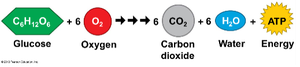
Oxidation and Reduction: Glucose is oxidized (loses electrons), oxygen is reduced (gains electrons).
Role of NAD+ and FAD: These coenzymes accept electrons during redox reactions and carry them to the electron transport chain.
ATP Synthesis: Occurs via substrate-level phosphorylation (direct transfer of phosphate) and oxidative phosphorylation (driven by electron transport and chemiosmosis).
Major Stages: Glycolysis, Citric Acid Cycle, Oxidative Phosphorylation.
Catabolic Pathways and Redox Reactions
Redox Reactions in Cellular Respiration
Cellular respiration involves a series of oxidation-reduction (redox) reactions, where electrons are transferred from fuel molecules to oxygen, releasing energy.
Oxidation: Loss of electrons (and hydrogen) from a molecule.
Reduction: Gain of electrons (and hydrogen) by a molecule.
Redox Reactions: Essential for energy release and ATP synthesis.
NAD+ and FAD: Coenzymes that shuttle electrons; NAD+ is reduced to NADH, FAD is reduced to FADH2.
Electron Transport Chain: Series of proteins (including cytochromes) that transfer electrons, culminating in the reduction of oxygen to water.
Stages of Cellular Respiration
Glycolysis
Glycolysis is the first stage of cellular respiration, occurring in the cytoplasm. It breaks down glucose into two molecules of pyruvate, generating ATP and NADH.
Location: Cytoplasm
Inputs: Glucose, 2 ATP, 2 NAD+
Outputs: 2 Pyruvate, 4 ATP (net gain 2 ATP), 2 NADH
Energy Investment Phase: 2 ATP used to activate glucose.
Energy Payoff Phase: 4 ATP produced, 2 NADH generated, pyruvate formed.
Oxygen Requirement: Glycolysis can occur without oxygen.
Pyruvate Oxidation and Citric Acid Cycle
Pyruvate oxidation links glycolysis to the citric acid cycle. In the mitochondrial matrix, pyruvate is converted to acetyl-CoA, which enters the citric acid cycle.
Pyruvate Oxidation: Produces acetyl-CoA, NADH, and CO2.
Citric Acid Cycle: Completes glucose oxidation, producing CO2, ATP, NADH, and FADH2.
Cycle Turns: Twice per glucose molecule.
Net Production (per glucose): 4 CO2, 2 ATP, 6 NADH, 2 FADH2
Location: Mitochondrial matrix
CO2 Production: Occurs during pyruvate oxidation and citric acid cycle.
Oxidative Phosphorylation
Oxidative phosphorylation is the final stage, where most ATP is produced. It involves the electron transport chain and chemiosmosis.
Electron Transport Chain: Located in the inner mitochondrial membrane; electrons from NADH and FADH2 are transferred through protein complexes.
Oxygen: Final electron acceptor, forming water.
Chemiosmosis: H+ gradient drives ATP synthesis via ATP synthase.
ATP Yield: Up to 32 ATP per glucose molecule.
Efficiency: About 34% of glucose energy is converted to ATP; the rest is lost as heat.
Fermentation and Anaerobic Respiration
Fermentation
Fermentation allows cells to produce ATP without oxygen, using glycolysis and reactions that regenerate NAD+.
Types: Alcohol fermentation (produces ethanol and CO2), lactic acid fermentation (produces lactate).
ATP Yield: Only 2 ATP per glucose (from glycolysis).
Obligate Anaerobes: Cannot survive in oxygen; rely on fermentation or anaerobic respiration.
Facultative Anaerobes: Can use either fermentation or aerobic respiration.
Lactic Acid: Not responsible for muscle fatigue; can be converted back to glucose in the liver.
Metabolic Pathways Integration
Connecting Metabolic Pathways
Cellular respiration is interconnected with other metabolic pathways, allowing the breakdown and synthesis of various biomolecules.
Proteins: Digested to amino acids; after deamination, can enter glycolysis or citric acid cycle.
Fats: Digested to glycerol (enters glycolysis) and fatty acids (broken down by beta oxidation to acetyl-CoA).
Beta Oxidation: Process by which fatty acids are converted to acetyl-CoA, NADH, and FADH2.
ATP Yield: Fats produce more ATP per gram than carbohydrates.
Metabolic Control: Feedback inhibition regulates pathway activity; excess ATP and citrate inhibit glycolysis.
Key Terms and Concepts
Aerobic/Anaerobic: Aerobic requires oxygen; anaerobic does not.
Cellular Respiration: Catabolic pathway for ATP production.
Redox Reactions: Electron transfer reactions.
NAD+ & NADH, FAD & FADH2: Electron carriers.
Glycolysis, Citric Acid Cycle, Oxidative Phosphorylation: Major stages of cellular respiration.
Substrate-level Phosphorylation: Direct ATP synthesis.
Electron Transport Chain, Chemiosmosis: Mechanisms for ATP production.
Fermentation: Anaerobic ATP production.
Obligate/Facultative Anaerobes: Oxygen requirements for metabolism.
Beta Oxidation: Fatty acid breakdown.
Summary Table: Stages of Cellular Respiration
Stage | Location | Inputs | Outputs | ATP Produced |
|---|---|---|---|---|
Glycolysis | Cytoplasm | Glucose, 2 ATP, 2 NAD+ | 2 Pyruvate, 2 NADH, 4 ATP (net 2 ATP) | 2 |
Pyruvate Oxidation | Mitochondrial Matrix | 2 Pyruvate, 2 NAD+, 2 CoA | 2 Acetyl-CoA, 2 NADH, 2 CO2 | 0 |
Citric Acid Cycle | Mitochondrial Matrix | 2 Acetyl-CoA, 6 NAD+, 2 FAD, 2 ADP | 4 CO2, 6 NADH, 2 FADH2, 2 ATP | 2 |
Oxidative Phosphorylation | Inner Mitochondrial Membrane | NADH, FADH2, O2 | H2O, ATP | ~28 |
Key Equations
Overall Cellular Respiration Equation:
NAD+ Reduction:
FAD Reduction:
Additional info: These notes expand on the outline and study guide, providing academic context and explanations for each stage and concept. The summary table and equations are inferred from standard biology textbooks for completeness.
