 Back
Cellular Respiration: Pathways for Energy Harvesting
Study Guide - Smart Notes
 Tailored notes based on your materials, expanded with key definitions, examples, and context.
Cellular Respiration
Overview of Cellular Respiration
Cellular respiration is the process by which cells extract energy from food molecules and convert it into a usable form, primarily ATP (adenosine triphosphate). This process involves a series of catabolic reactions that release energy by oxidizing organic fuels, such as glucose. The cell uses enzymes to lower the activation energy of these reactions, making the process efficient and controlled.
Catabolic reactions: Break down molecules to release energy.
ATP: The main energy currency of the cell, used to power cellular work.
Enzymes: Catalyze reactions, reducing the energy required to initiate them.
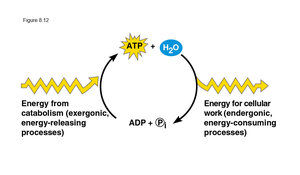
ATP: The Energy Currency of the Cell
ATP stores and transfers energy within the cell by donating or accepting phosphate groups. The hydrolysis of ATP to ADP and inorganic phosphate releases energy that can be used for cellular work, while the phosphorylation of ADP to ATP stores energy derived from catabolic reactions.
Phosphorylation:
Hydrolysis:
Energy in food: Stored in C-H and C-C bonds, released during respiration.
Redox Reactions in Respiration
Most reactions in cellular respiration are oxidation-reduction (redox) reactions, involving the transfer of electrons. Oxidation is the loss of electrons, while reduction is the gain of electrons. In aerobic respiration, oxygen serves as the final electron acceptor, making the process highly efficient.
Oxidation: Loss of electrons from a molecule.
Reduction: Gain of electrons by a molecule.
Aerobic respiration: Occurs in mitochondria (eukaryotes) or cytoplasm (prokaryotes).
Chemical Overview of Aerobic Respiration
The overall equation for aerobic respiration is:
This process is the reverse of photosynthesis.
Electrons are transferred from C-H bonds in glucose to oxygen, forming water.
Energy is released in a controlled manner through a series of steps.
Coenzymes: Non-protein molecules like NAD+ and FAD that assist enzymes in electron transfer.
Stages of Cellular Respiration
Glycolysis
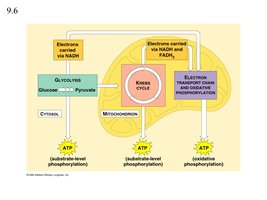
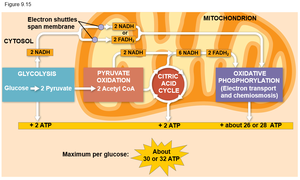
Glycolysis is the first step of cellular respiration and occurs in the cytoplasm. It does not require oxygen and splits one molecule of glucose (6C) into two molecules of pyruvate (3C each). The process yields a net gain of 2 ATP and 2 NADH molecules.
Location: Cytoplasm
Oxygen requirement: None
Net products: 2 pyruvate, 2 ATP, 2 NADH
Energy Investment and Payoff Phases
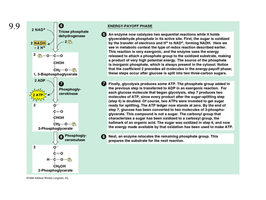
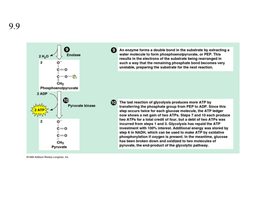
Glycolysis consists of 10 enzyme-catalyzed steps, divided into two phases:
Energy investment phase: 2 ATP are consumed to phosphorylate glucose and its intermediates.
Energy payoff phase: 4 ATP are produced by substrate-level phosphorylation, and 2 NAD+ are reduced to 2 NADH.
Net ATP gain: 2 ATP per glucose molecule.
Krebs Cycle (Citric Acid Cycle)
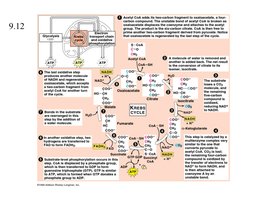
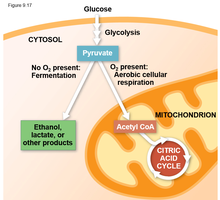
The Krebs cycle occurs in the mitochondrial matrix (eukaryotes) and completes the oxidation of glucose derivatives. Pyruvate is first converted to acetyl-CoA, which enters the cycle. Each turn of the cycle releases CO2, generates NADH and FADH2, and produces a small amount of ATP.
Location: Mitochondrial matrix
Preparatory step: Pyruvate is oxidized to acetyl-CoA, releasing CO2 and generating NADH.
Products per glucose: 6 NADH, 2 FADH2, 2 ATP, 4 CO2
Electron Transport Chain and Oxidative Phosphorylation
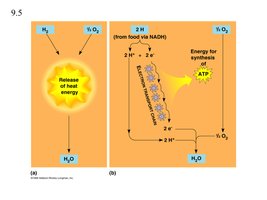
The electron transport chain (ETC) is located in the inner mitochondrial membrane. Electrons from NADH and FADH2 are transferred through a series of protein complexes, ultimately reducing oxygen to water. The energy released is used to pump protons (H+) across the membrane, creating a proton gradient. ATP synthase uses this gradient to synthesize ATP from ADP and inorganic phosphate—a process called chemiosmosis.
Location: Inner mitochondrial membrane
Final electron acceptor: Oxygen (O2)
ATP yield: About 28–30 ATP per glucose
Total ATP Yield from Cellular Respiration
The complete oxidation of one glucose molecule by aerobic respiration yields approximately 30–32 ATP molecules, making it a highly efficient process.
Stage | ATP Produced |
|---|---|
Glycolysis | 2 |
Krebs Cycle | 2 |
Electron Transport Chain | 26–28 |
Total | 30–32 |
Anaerobic Pathways
Fermentation
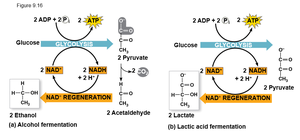
Fermentation is an anaerobic process that allows cells to regenerate NAD+ from NADH, enabling glycolysis to continue in the absence of oxygen. It does not involve an electron transport chain and yields much less ATP than aerobic respiration.
Location: Cytoplasm
Types: Alcoholic fermentation (produces ethanol and CO2), lactic acid fermentation (produces lactate)
ATP yield: 2 ATP per glucose (from glycolysis only)
Anaerobic Respiration
Some organisms use an electron transport chain with a final electron acceptor other than oxygen (e.g., sulfate or nitrate). This process is less efficient than aerobic respiration but more efficient than fermentation.
Final electron acceptors: Sulfate, nitrate, or other inorganic molecules
Organisms: Many bacteria and archaea
Metabolism: Catabolism and Anabolism
Metabolism encompasses all chemical reactions in a cell, including both catabolic (energy-yielding) and anabolic (energy-consuming) pathways. Catabolic reactions break down molecules to release energy, while anabolic reactions use energy to build complex molecules.
Catabolism: Exergonic, releases energy (e.g., cellular respiration)
Anabolism: Endergonic, requires energy (e.g., biosynthesis of macromolecules)
Summary Table: Key Steps and Products of Cellular Respiration
Stage | Location | Main Reactants | Main Products | ATP Yield |
|---|---|---|---|---|
Glycolysis | Cytoplasm | Glucose, 2 NAD+, 2 ADP | 2 Pyruvate, 2 NADH, 2 ATP | 2 |
Pyruvate Oxidation | Mitochondrial Matrix | 2 Pyruvate, 2 NAD+ | 2 Acetyl-CoA, 2 NADH, 2 CO2 | 0 |
Krebs Cycle | Mitochondrial Matrix | 2 Acetyl-CoA, 6 NAD+, 2 FAD, 2 ADP | 4 CO2, 6 NADH, 2 FADH2, 2 ATP | 2 |
Electron Transport Chain | Inner Mitochondrial Membrane | NADH, FADH2, O2 | H2O, NAD+, FAD, ATP | 26–28 |
