 Back
BackCellular Respiration: Pathways for Harvesting Chemical Energy
Study Guide - Smart Notes
 Tailored notes based on your materials, expanded with key definitions, examples, and context.
Catabolic Pathways and Cellular Respiration
Overview of Cellular Respiration
Cellular respiration is a series of metabolic pathways that extract energy from organic molecules, primarily glucose, to produce ATP, the main energy currency of the cell. This process involves the oxidation of fuel molecules and the transfer of electrons, ultimately reducing oxygen to water and releasing energy.
Energy Flow: Energy enters ecosystems as sunlight, is stored in organic molecules by photosynthesis, and is released by cellular respiration.
ATP Production: ATP is generated through substrate-level phosphorylation and oxidative phosphorylation.
Waste Products: CO2 and H2O are produced and recycled in photosynthesis.
Catabolic Pathways and ATP Production
Exergonic Reactions: Organic compounds with high potential energy undergo exergonic reactions, releasing energy.
Enzymes: Catalyze the breakdown of complex molecules, facilitating energy release.
Fermentation: Partial degradation of sugars without oxygen.
Aerobic Respiration: Most efficient pathway, using O2 as the final electron acceptor.
Anaerobic Respiration: Uses electron acceptors other than O2.
Combustion Analogy: Aerobic respiration is analogous to the combustion of gasoline, producing CO2 and H2O.
Redox Reactions: Oxidation and Reduction
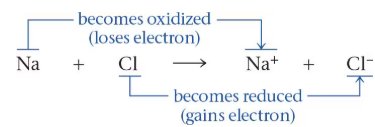
Redox reactions are central to cellular respiration, involving the transfer of electrons from one molecule to another.
Oxidation: Loss of electrons.
Reduction: Gain of electrons.
Reducing Agent: Electron donor.
Oxidizing Agent: Electron acceptor.
Example: Sodium and chlorine react to form NaCl via electron transfer.
Methane Combustion: Methane is oxidized, oxygen is reduced.
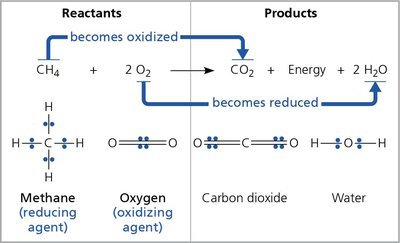
Cellular Respiration: Glucose is oxidized, oxygen is reduced.

NAD+ and NADH: Electron Carriers
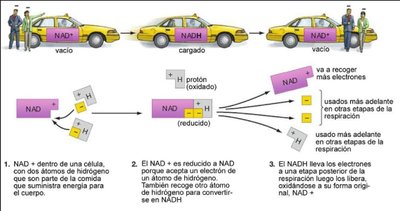
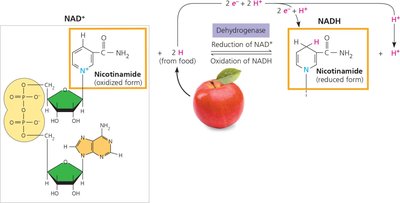
NAD+ (nicotinamide adenine dinucleotide) acts as an electron carrier, cycling between oxidized (NAD+) and reduced (NADH) forms. Dehydrogenase enzymes transfer electrons from fuel molecules to NAD+, forming NADH, which stores energy for ATP synthesis.
Electron Transport Chain (ETC)
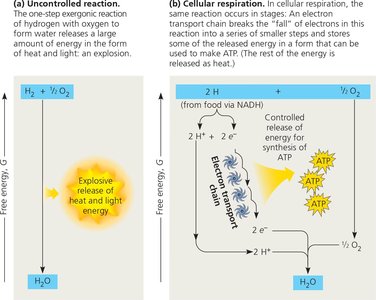
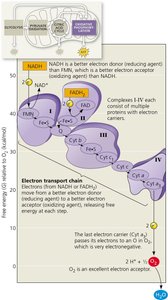
The ETC is a series of protein complexes in the inner mitochondrial membrane (eukaryotes) or plasma membrane (prokaryotes) that transfer electrons from NADH and FADH2 to oxygen, releasing energy in steps to synthesize ATP.
Energy Release: Electrons lose energy as they move down the chain, which is used to pump protons and generate a proton gradient.
Final Electron Acceptor: Oxygen captures electrons and protons to form water.
The Stages of Cellular Respiration
Overview of the Three Main Stages
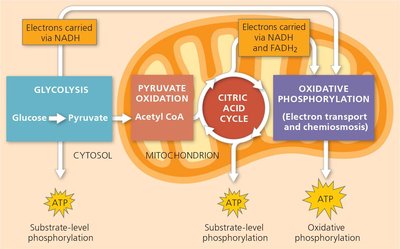
Cellular respiration consists of glycolysis, pyruvate oxidation and the citric acid cycle, and oxidative phosphorylation. Each stage occurs in a specific cellular location and is catalyzed by enzymes.
Glycolysis: Cytosol; breaks down glucose to pyruvate, producing ATP and NADH.
Pyruvate Oxidation & Citric Acid Cycle: Mitochondrial matrix; completes glucose oxidation, generating NADH, FADH2, ATP, and CO2.
Oxidative Phosphorylation: Inner mitochondrial membrane; uses ETC and chemiosmosis to produce most ATP.
Substrate-Level vs. Oxidative Phosphorylation
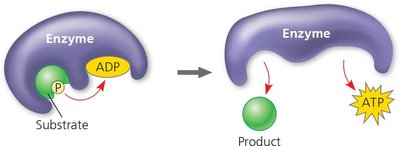
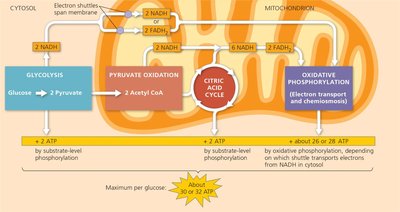
Substrate-Level Phosphorylation: Direct transfer of a phosphate group to ADP from an intermediate substrate, occurs in glycolysis and the citric acid cycle.
Oxidative Phosphorylation: ATP synthesis powered by redox reactions in the ETC and chemiosmosis, accounts for ~90% of ATP production.
Glycolysis
Phases and Key Steps
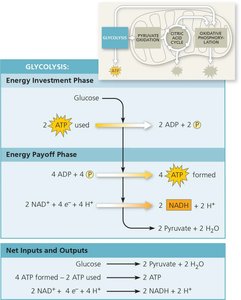
Glycolysis splits glucose (6C) into two pyruvate (3C) molecules in the cytosol. It consists of two phases:
Energy Investment Phase: 2 ATP are used to phosphorylate glucose and its intermediates.
Energy Payoff Phase: 4 ATP (net gain 2 ATP) and 2 NADH are produced.
Key Enzymes: Hexokinase, phosphofructokinase, aldolase, triose phosphate dehydrogenase, phosphoglycerokinase, enolase, pyruvate kinase.
Net Reaction: Glucose + 2 NAD+ + 2 ADP + 2 Pi → 2 Pyruvate + 2 NADH + 2 ATP + 2 H2O
Pyruvate Oxidation and the Citric Acid Cycle
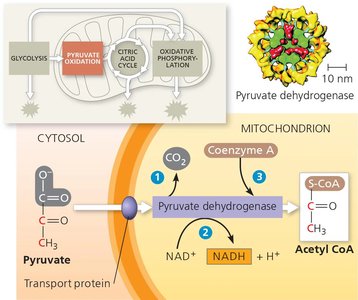
Pyruvate Oxidation
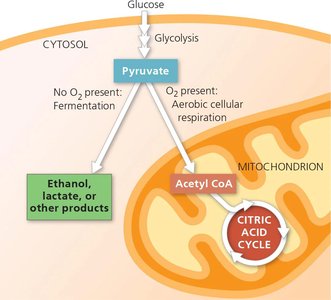
Pyruvate is transported into the mitochondrion and converted to acetyl CoA by a multienzyme complex. This links glycolysis to the citric acid cycle.
1 CO2 is released per pyruvate.
NAD+ is reduced to NADH.
Coenzyme A attaches to the two-carbon fragment, forming acetyl CoA.
The Citric Acid Cycle (Krebs Cycle)
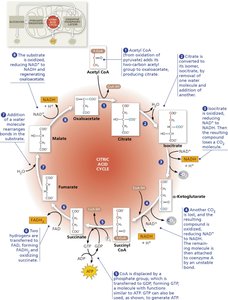
The citric acid cycle completes the oxidation of organic fuel derived from pyruvate. Each turn of the cycle processes one acetyl CoA, generating:
2 CO2
3 NADH
1 FADH2
1 ATP (or GTP)
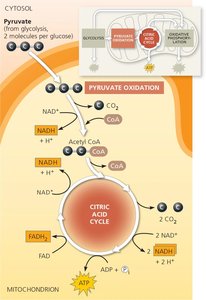
Total per glucose: 6 NADH, 2 FADH2, 2 ATP
Oxidative Phosphorylation and Chemiosmosis
Electron Transport Chain (ETC)
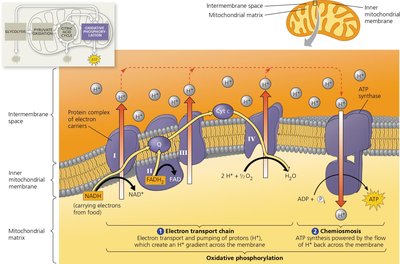
The ETC is a series of protein complexes (I-IV) in the inner mitochondrial membrane. Electrons from NADH and FADH2 are transferred through the chain, releasing energy used to pump protons and create a proton gradient.
Chemiosmosis and ATP Synthase
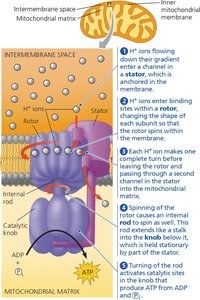
Protons flow back into the mitochondrial matrix through ATP synthase, driving the phosphorylation of ADP to ATP. This process is called chemiosmosis.
ATP Yield and Efficiency
Maximum ATP per glucose: 30–32 ATP
Efficiency: ~34% of glucose energy is transferred to ATP; the rest is lost as heat.
Fermentation and Anaerobic Respiration
Fermentation
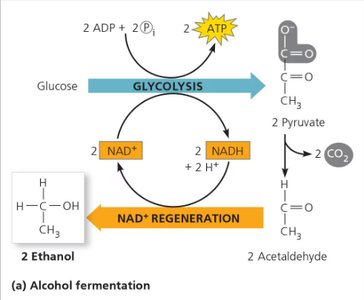
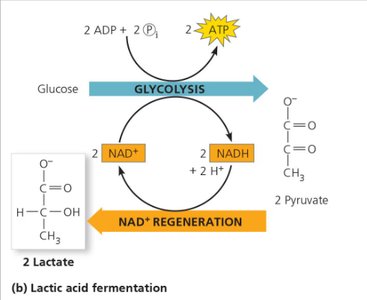
Fermentation allows ATP production without oxygen by recycling NAD+ through the reduction of pyruvate or its derivatives.
Alcohol Fermentation: Pyruvate is converted to ethanol, releasing CO2 and regenerating NAD+.
Lactic Acid Fermentation: Pyruvate is reduced to lactate, regenerating NAD+ without CO2 release.
Comparison of Fermentation, Anaerobic, and Aerobic Respiration
All three use glycolysis to oxidize glucose to pyruvate.
Fermentation: Final electron acceptor is an organic molecule; yields 2 ATP per glucose.
Aerobic Respiration: Final electron acceptor is O2; yields up to 32 ATP per glucose.
Anaerobic Respiration: Final electron acceptor is a molecule other than O2 (e.g., sulfate).
Evolutionary Significance of Glycolysis
Glycolysis is an ancient metabolic pathway, present in nearly all organisms and functioning in the cytosol without the need for organelles or oxygen. This suggests it evolved early in the history of life.
Connections to Other Metabolic Pathways
Catabolic Versatility
Proteins: Deaminated and enter as pyruvate, acetyl CoA, or citric acid cycle intermediates.
Fats: Glycerol enters glycolysis; fatty acids undergo beta oxidation to acetyl CoA.
Carbohydrates: Broken down to glucose or other sugars entering glycolysis.
Biosynthetic (Anabolic) Pathways
Intermediates from glycolysis and the citric acid cycle are used for biosynthesis of amino acids, nucleotides, and fatty acids.
Excess calories are converted to fat for storage.
Regulation of Cellular Respiration
Feedback Inhibition: Surplus ATP or citrate inhibits phosphofructokinase, slowing glycolysis.
AMP: Stimulates phosphofructokinase, increasing glycolysis when ATP is low.
Metabolic balance is maintained by regulating key enzymes in glycolysis and the citric acid cycle.
Summary Table: Major Stages and Products of Cellular Respiration
Stage | Main Location | Main Inputs | Main Outputs | ATP Produced |
|---|---|---|---|---|
Glycolysis | Cytosol | Glucose, 2 NAD+, 2 ADP, 2 Pi | 2 Pyruvate, 2 NADH, 2 ATP (net), 2 H2O | 2 (net) |
Pyruvate Oxidation | Mitochondrial Matrix | 2 Pyruvate, 2 NAD+, 2 CoA | 2 Acetyl CoA, 2 NADH, 2 CO2 | 0 |
Citric Acid Cycle | Mitochondrial Matrix | 2 Acetyl CoA, 6 NAD+, 2 FAD, 2 ADP, 2 Pi | 4 CO2, 6 NADH, 2 FADH2, 2 ATP | 2 |
Oxidative Phosphorylation | Inner Mitochondrial Membrane | 10 NADH, 2 FADH2, 6 O2, 28 ADP, 28 Pi | 6 H2O, 28 ATP | 26–28 |
