 Back
Cellular Respiration: Pathways, Mechanisms, and Energy Yield
Study Guide - Smart Notes
 Tailored notes based on your materials, expanded with key definitions, examples, and context.
Cellular Respiration
Overview of Cellular Respiration
Cellular respiration is a metabolic process by which cells convert biochemical energy from nutrients into adenosine triphosphate (ATP), releasing waste products. This process occurs in both plants and animals and is essential for sustaining life by providing energy for cellular activities.
ATP Production: ATP is synthesized during cellular respiration, which takes place in both plants and animals.
Pathways: Cellular respiration includes metabolic pathways that require oxygen (aerobic).
Redox Reaction: Glucose is oxidized and oxygen is reduced, making the process an oxidation-reduction (redox) reaction.
Energy Yield: The breakdown of one glucose molecule results in the production of 36 to 38 ATP molecules.

Overall Equation for Cellular Respiration
The overall chemical equation for cellular respiration summarizes the oxidation of glucose and the reduction of oxygen to form carbon dioxide, water, and ATP.
Equation:
Nature of Cellular Respiration
Cellular respiration is classified as an oxidation-reduction (redox) process. During this process, electrons are transferred from glucose to oxygen, resulting in the release of energy.
Oxidation: Glucose is oxidized to carbon dioxide and water (electrons are removed from glucose).
Reduction: Oxygen is reduced to water (electrons are passed to oxygen).
Electron Carriers in Cellular Respiration
Electron carriers are essential for transferring electrons during cellular respiration. The main carriers are NAD+ and FAD.
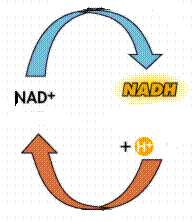
NAD+ (Nicotinamide Adenine Dinucleotide): Acts as an energy carrier and coenzyme. It is reduced to NADH when it picks up two electrons and one hydrogen ion.
FAD (Flavin Adenine Dinucleotide): Another coenzyme, reduced to FADH2 during cellular respiration.
Metabolic Pathways and Reaction Types
Cellular respiration is a metabolic pathway that breaks down carbohydrates. It is an exergonic process (releases energy) and is catabolic (breaks larger molecules into smaller ones).
Catabolic Reactions: Molecules are broken apart (e.g., glucose to CO2 and H2O).
Anabolic Reactions: Molecules are synthesized from smaller units.
Stages of Cellular Respiration
Main Stages
Cellular respiration occurs in several stages, each with specific functions and locations within the cell.
Glycolysis
Intermediate Step (Pyruvate Oxidation)
Krebs Cycle (Citric Acid Cycle)
Electron Transport Chain (ETC)
Cellular Locations
The stages of cellular respiration take place in different parts of the cell:
Glycolysis: Occurs in the cytoplasm.
Intermediate Step, Krebs Cycle, and ETC: Occur in the mitochondria.

Mitochondrial Structure
The mitochondrion is the organelle where most of cellular respiration occurs. Its structure is specialized for efficient energy production.
Outer Membrane: Smooth and encloses the organelle.
Inner Membrane: Highly folded into cristae to increase surface area.
Cristae: Folds of the inner membrane where the electron transport chain is located.
Matrix: The space inside the inner membrane where the Krebs cycle occurs.
Detailed Stages of Cellular Respiration
Glycolysis
Glycolysis is the first stage of cellular respiration and occurs in the cytoplasm. It does not require oxygen (anaerobic).
Location: Cytoplasm
Oxygen Requirement: Anaerobic (does not use oxygen)
ATP Yield: Requires input of 2 ATP, produces 4 ATP (net gain of 2 ATP)
Products: 2 molecules of pyruvate (pyruvic acid), 2 NADH
Intermediate Step (Pyruvate Oxidation)
During the intermediate step, pyruvate is transported into the mitochondria and oxidized to form acetyl CoA, which enters the Krebs cycle.
Product: Acetyl CoA (starting material for the Krebs cycle)
Krebs Cycle (Citric Acid Cycle)
The Krebs cycle is a cyclical series of oxidation reactions that generate ATP, NADH, FADH2, and CO2. It occurs in the mitochondrial matrix and turns twice for each glucose molecule.
Location: Mitochondrial matrix
ATP Yield: 2 ATP per glucose (1 per cycle, 2 cycles per glucose)
Other Products: 6 NADH, 2 FADH2, 4 CO2 per glucose
Historical Note: The Krebs cycle was discovered by Hans Krebs in 1937, who received the Nobel Prize in 1953.

Electron Transport Chain (ETC)
The electron transport chain is the final stage of cellular respiration, occurring across the inner mitochondrial membrane (cristae). It uses electrons from NADH and FADH2 to generate a proton gradient, driving ATP synthesis.
Location: Inner mitochondrial membrane (cristae)
ATP Yield: Approximately 34 ATP per glucose
Oxygen Role: Final electron acceptor, reduced to water

Summary Table: ATP Yield from Cellular Respiration
Stage | ATP Produced (per glucose) |
|---|---|
Glycolysis | 2 |
Krebs Cycle | 2 |
Electron Transport Chain | ~34 |
Total | 36-38 |
Alternative Substrates for Cellular Respiration
Cells can also obtain energy from lipids and proteins. These molecules are broken down into 2-carbon acetyl CoA units, which enter the Krebs cycle and contribute to ATP production.

Fermentation
Fermentation Overview
Fermentation is an anaerobic process (does not require oxygen) that allows cells to produce energy when oxygen is scarce. It is less efficient than cellular respiration, yielding only 2 ATP per glucose molecule.
Lactic Acid Fermentation: Occurs in muscle cells, producing lactic acid as a byproduct.
Alcoholic Fermentation: Occurs in yeast, producing ethanol and CO2 as byproducts.
ATP Yield: Only 2 ATP per glucose (compared to 38 in aerobic respiration)
Key Terms and Concepts
ATP (Adenosine Triphosphate): The main energy currency of the cell.
Redox Reaction: A chemical reaction involving the transfer of electrons.
NAD+ and FAD: Electron carriers that shuttle electrons to the electron transport chain.
Catabolic Pathway: Metabolic pathway that breaks down molecules to release energy.
Anabolic Pathway: Metabolic pathway that synthesizes complex molecules from simpler ones.
