 Back
BackTopic 5 Cellular Respiration: Pathways, Mechanisms, and Regulation
Study Guide - Smart Notes
 Tailored notes based on your materials, expanded with key definitions, examples, and context.
Topic 5 Introduction to Cellular Respiration
Overview
Cellular respiration is a fundamental metabolic process by which cells convert biochemical energy from nutrients into adenosine triphosphate (ATP), releasing waste products. This process is essential for the survival of most organisms and involves a series of redox reactions that occur in both the cytosol and mitochondria of eukaryotic cells.
1. Catabolic Pathways and ATP Synthesis
Energy Flow and Chemical Recycling
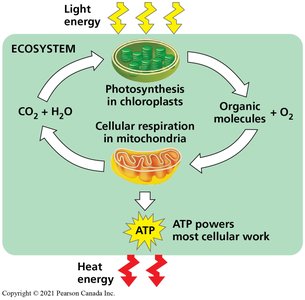
Energy enters ecosystems as light and exits as heat. Photosynthetic organisms convert light energy into chemical energy, which is then used by both autotrophs and heterotrophs through cellular respiration to generate ATP, the energy currency of the cell.
Photosynthesis: Converts CO2 and H2O into organic molecules and O2.
Cellular Respiration: Breaks down organic molecules, using O2 to produce CO2, H2O, and ATP.
2. Redox Reactions in Cellular Respiration
Redox Principles
Redox (reduction-oxidation) reactions are central to energy transfer in biological systems. In these reactions, electrons are transferred from one molecule (the reducing agent) to another (the oxidizing agent).
Oxidation: Loss of electrons from a substance.
Reduction: Gain of electrons by a substance.

In cellular respiration, glucose is oxidized and oxygen is reduced:

Controlled Energy Release
Unlike uncontrolled reactions that release energy explosively, cellular respiration releases energy gradually through the electron transport chain, allowing for efficient ATP synthesis.

3. Role of NAD+ in Redox Reactions
NAD+ as an Electron Carrier
Nicotinamide adenine dinucleotide (NAD+) is a key electron carrier in cellular respiration. It cycles between oxidized (NAD+) and reduced (NADH) states, shuttling electrons to the electron transport chain.
NAD+ (oxidized): Accepts electrons and becomes NADH.
NADH (reduced): Donates electrons to the electron transport chain.

4. Glycolysis and Cellular Respiration Pathways
Pathway Overview
Cellular respiration consists of several interconnected pathways:
Glycolysis: Occurs in the cytosol; breaks down glucose into pyruvate, producing ATP and NADH.
Pyruvate Oxidation: Converts pyruvate to acetyl-CoA in the mitochondrial matrix.
Citric Acid Cycle (Krebs Cycle): Completes the oxidation of acetyl-CoA, generating NADH, FADH2, and ATP.
Oxidative Phosphorylation: Uses electrons from NADH and FADH2 to drive ATP synthesis via the electron transport chain and chemiosmosis.

5. Glycolysis
Glycolysis Overview
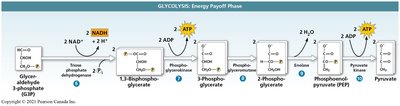
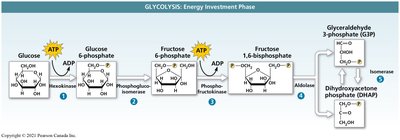
Glycolysis is the first step in cellular respiration, occurring in the cytosol. It involves two phases: the energy investment phase and the energy payoff phase.
Energy Investment Phase: 2 ATP are used to phosphorylate glucose and its intermediates.
Energy Payoff Phase: 4 ATP and 2 NADH are produced, along with 2 pyruvate molecules.

Detailed Steps of Glycolysis
The pathway involves a series of enzyme-catalyzed reactions that convert glucose to pyruvate, with substrate-level phosphorylation generating ATP.
6. Oxidation of Pyruvate
Conversion to Acetyl-CoA
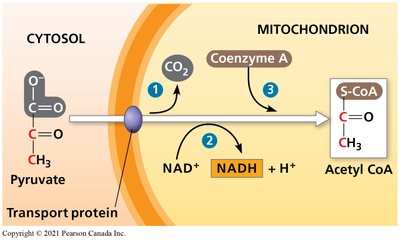
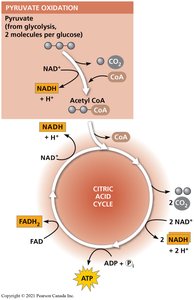
Pyruvate produced in glycolysis is transported into the mitochondrion, where it is converted to acetyl-CoA. This process involves decarboxylation, reduction of NAD+ to NADH, and attachment of coenzyme A.
Products per pyruvate: 1 CO2, 1 NADH, 1 acetyl-CoA
7. Citric Acid Cycle (Krebs Cycle)
Cycle Overview
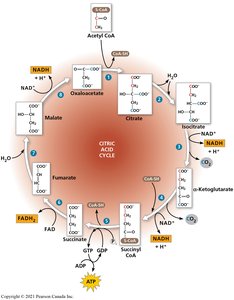
The citric acid cycle completes the oxidation of acetyl-CoA, generating high-energy electron carriers and ATP (or GTP) via substrate-level phosphorylation. The cycle also regenerates the oxaloacetate acceptor.
Products per acetyl-CoA: 3 NADH, 1 FADH2, 1 ATP (or GTP), 2 CO2
8. Electron Transport Chain and Oxidative Phosphorylation
Electron Transport Chain (ETC)
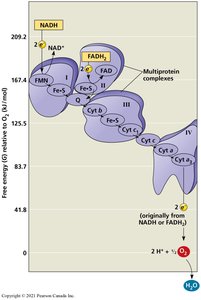
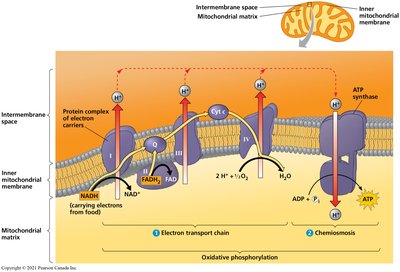
The ETC is a series of protein complexes located in the inner mitochondrial membrane. Electrons from NADH and FADH2 are transferred through these complexes, ultimately reducing O2 to H2O. The energy released is used to pump protons, creating an electrochemical gradient.
Chemiosmosis and ATP Synthesis
The proton gradient generated by the ETC drives ATP synthesis via ATP synthase, a process known as chemiosmosis. This is the main source of ATP in aerobic respiration.
9. Summary Table: ATP Yield from Cellular Respiration
Stage | ATP Produced (per glucose) | NADH Produced | FADH2 Produced |
|---|---|---|---|
Glycolysis | 2 | 2 | 0 |
Pyruvate Oxidation | 0 | 2 | 0 |
Citric Acid Cycle | 2 | 6 | 2 |
Oxidative Phosphorylation | ~26-28 | - | - |
Total | ~30-32 | 10 | 2 |
10. Regulation and Alternative Pathways
Regulation of Cellular Respiration
Key enzymes such as phosphofructokinase regulate the rate of glycolysis and cellular respiration through feedback inhibition and allosteric regulation.
ATP and citrate: Inhibit phosphofructokinase.
AMP: Stimulates phosphofructokinase.
Alternative Substrates
Other macromolecules such as fats and proteins can also be catabolized for energy, entering the respiration pathway at various points.
11. Anaerobic Respiration and Fermentation
Fermentation
When oxygen is not available, cells can generate ATP via fermentation, which regenerates NAD+ but produces much less ATP than aerobic respiration. Common types include lactic acid fermentation and alcoholic fermentation.
Anaerobic Respiration: Uses an electron acceptor other than O2 (e.g., SO42-).
Fermentation: No electron transport chain; ATP produced only by substrate-level phosphorylation.
Key Equations
Overall equation for aerobic respiration:
ATP yield efficiency: (34% efficiency)
