 Back
Cellular Respiration: Pathways, Regulation, and Laboratory Investigation PB7
Study Guide - Smart Notes
 Tailored notes based on your materials, expanded with key definitions, examples, and context.
Cellular Respiration
Overview of Cellular Respiration
Cellular respiration is the process by which cells extract energy from organic molecules, primarily glucose, to produce ATP, the cell's usable energy currency. This process is essential for growth, maintenance, activity, and reproduction in all organisms. The main stages include glycolysis, the Krebs cycle (citric acid cycle), and the electron transport chain. - Autotrophs produce their own energy via photosynthesis, while heterotrophs obtain energy by consuming organic molecules. - The overall equation for aerobic cellular respiration is: - Only about 40% of glucose's energy is converted to ATP; the rest is lost as heat.
Glycolysis
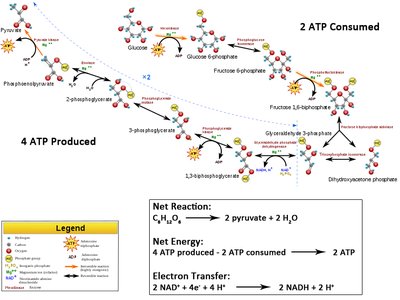
Glycolysis is the first step in glucose degradation, occurring in the cytoplasm. It converts glucose into two pyruvate molecules, producing ATP and NADH. The process consists of 10 enzyme-catalyzed reactions, divided into three phases: investment, cleavage, and energy harvest. - Investment phase: 2 ATP are consumed to phosphorylate glucose. - Cleavage phase: The 6-carbon molecule is split into two 3-carbon molecules. - Energy harvest phase: 4 ATP and 2 NADH are produced. - Net yield: 2 ATP and 2 NADH per glucose. - Glycolysis is anaerobic and occurs in the cell cytoplasm. 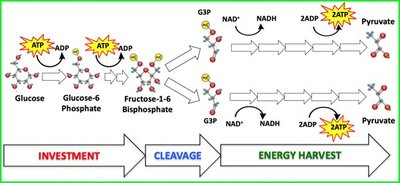
Key Steps and Regulation
- The priming reactions require ATP investment, making them irreversible. - The phosphate group from ATP is transferred to glucose, forming glucose-6-phosphate. - Energy is released as ATP (via substrate-level phosphorylation) and NADH during the energy-yielding phase. - Phosphofructokinase (PFK) is the key regulatory enzyme, activated by low ATP and inhibited by high ATP. 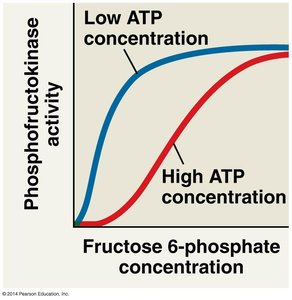
Link Reaction (Pyruvate Oxidation)
Pyruvate produced in glycolysis is transported into the mitochondria and converted to acetyl CoA, which enters the Krebs cycle. This step is essential for aerobic respiration and links glycolysis to the citric acid cycle.
Krebs Cycle (Citric Acid Cycle)
The Krebs cycle occurs in the mitochondrial matrix and involves eight reactions. Acetyl CoA combines with oxaloacetate to form citrate, and subsequent steps regenerate oxaloacetate. - There are four redox reactions per cycle: three with NAD+ and one with FAD. - The cycle produces NADH, FADH2, ATP (or GTP), and CO2. - The cycle is aerobic and requires oxygen. 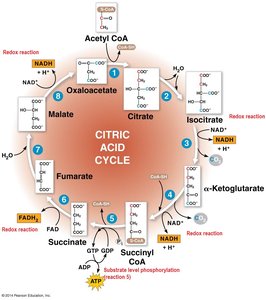
Mitochondrial Structure and Function
Mitochondria are double-membraned organelles where aerobic respiration occurs. - Outer membrane: Contains porins and is more permeable. - Intermembrane space: Accumulates H+ ions, creating a proton gradient. - Inner membrane: Impermeable to H+, contains proteins for electron transport and ATP synthesis. - Matrix: Site of the Krebs cycle and fatty acid oxidation. 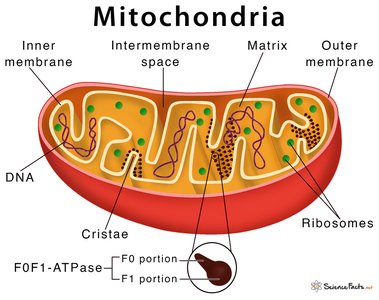
Electron Transport Chain (ETC) and Oxidative Phosphorylation
The ETC is located in the inner mitochondrial membrane and consists of four protein complexes and two mobile carriers (ubiquinone and cytochrome c). - Electrons from NADH and FADH2 are transferred through the chain, releasing energy to pump protons into the intermembrane space. - Oxygen is the final electron acceptor, forming water. - The proton gradient drives ATP synthesis via the F0F1-ATPase complex. 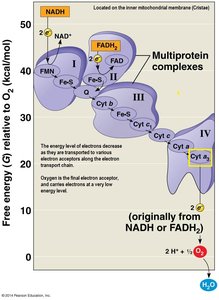
Metabolic Regulation
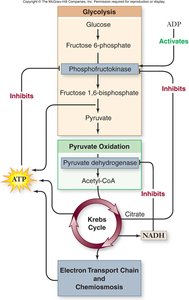
Cellular respiration is tightly regulated to match energy needs. - Phosphofructokinase (PFK) is the main regulator of glycolysis. - High ATP inhibits PFK, slowing glycolysis; low ATP activates it. - Other enzymes, such as pyruvate dehydrogenase, are regulated by feedback mechanisms.
Anaerobic Respiration and Fermentation
When oxygen is unavailable, cells rely on glycolysis and fermentation to produce ATP. - Lactic acid fermentation: Occurs in muscle cells, producing lactic acid. - Alcohol fermentation: Occurs in yeast, producing ethanol and CO2. - End products depend on the pathway: lactic acid, ethanol, or other organic acids.
Inhibitors and Cofactors
Cellular respiration can be inhibited by substances that affect enzyme activity or electron transport. - Fluoride: Inhibits enzymes requiring Mg2+ as a cofactor (e.g., enolase). - Oligomycin: Inhibits ATP synthase, blocking ATP production. - Cyanide and azide: Inhibit cytochrome a3, preventing electron transfer to oxygen. - Uncouplers (DNP, FCCP): Disrupt the proton gradient, stopping ATP synthesis and releasing energy as heat.
Laboratory Investigation: Yeast Respiration
Yeast cells are used to study cellular respiration and fermentation. - Experimental treatments include water (control), sucrose, lactose, glucose, glucose with Mg2+, glucose with NaF, and glucose with citrate/NaF. - Gas production (CO2) is measured to assess respiration rates. - Calculations include mean, standard deviation, and variance for gas produced per hour. 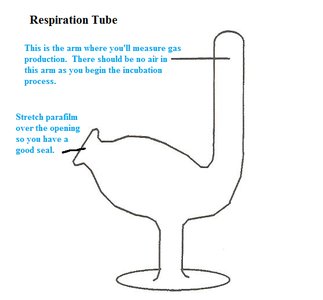
Sample Data Table for Yeast Respiration
Treatment | Contents | Gas Produced (mL/hr) |
|---|---|---|
Water (Control) | 10 mL Water, 5 mL Yeast | [Measured Value] |
Sucrose | 5 mL Sucrose, 5 mL Water, 5 mL Yeast | [Measured Value] |
Lactose | 5 mL Lactose, 5 mL Water, 5 mL Yeast | [Measured Value] |
Glucose | 5 mL Glucose, 5 mL Water, 5 mL Yeast | [Measured Value] |
Glucose-Mg | 5 mL Glucose, 5 mL 0.1 M MgSO4, 5 mL Yeast | [Measured Value] |
Glucose-F | 5 mL Glucose, 5 mL 0.05 M NaF, 5 mL Yeast | [Measured Value] |
Glucose-Citrate-F | 5 mL Glucose, 5 mL citrate/NaF, 5 mL Yeast | [Measured Value] |
Key Equations
- Cellular respiration: - Glycolysis net reaction: - Standard deviation: Additional info: Standard deviation and variance calculations are essential for analyzing experimental data and understanding random variation in biological experiments. ----------------------------------------
