 Back
BackCellular Respiration: Redox Reactions, Pathways, and ATP Production
Study Guide - Smart Notes
 Tailored notes based on your materials, expanded with key definitions, examples, and context.
Q1. Explain cellular respiration as a series of redox reactions in which electrons move from glucose to oxygen and describe how differences in electronegativity drive energy release and ATP production.
Background
Topic: Cellular Respiration & Redox Reactions
This question tests your understanding of how cellular respiration involves the transfer of electrons from glucose to oxygen, and how this process releases energy for ATP synthesis. It also asks you to connect the concept of electronegativity to energy release.
Key Terms and Formulas:
Redox Reaction: A chemical reaction involving the transfer of electrons between two substances.
Oxidation: Loss of electrons from a molecule.
Reduction: Gain of electrons by a molecule.
Electronegativity: The tendency of an atom to attract electrons.
ATP (Adenosine Triphosphate): The main energy currency of the cell.
Step-by-Step Guidance
Start by identifying glucose as the initial electron donor and oxygen as the final electron acceptor in cellular respiration.
Recall that as electrons move from glucose (lower electronegativity) to oxygen (higher electronegativity), energy is released because oxygen attracts electrons more strongly.
Describe how this energy release is harnessed to produce ATP, primarily through the electron transport chain and chemiosmosis.
Explain that the transfer of electrons occurs via redox reactions, with glucose being oxidized and oxygen being reduced.
Try solving on your own before revealing the answer!
Q2. Trace the flow of carbon and electrons through cellular respiration, following carbon from glucose to CO₂ and electrons from glucose to NADH/FADH₂ to the electron transport chain and ultimately to oxygen.
Background
Topic: Carbon and Electron Flow in Cellular Respiration
This question tests your ability to follow the path of carbon atoms and electrons as glucose is broken down and energy is extracted.
Key Terms and Formulas:
Glycolysis: The breakdown of glucose into pyruvate.
Pyruvate Oxidation: Conversion of pyruvate to acetyl-CoA.
Citric Acid Cycle: Oxidation of acetyl-CoA to CO₂.
NADH/FADH₂: Electron carriers that transport electrons to the electron transport chain.
Step-by-Step Guidance
Begin by noting that glucose (C₆H₁₂O₆) is split during glycolysis into two molecules of pyruvate (each with 3 carbons).
During pyruvate oxidation, each pyruvate is converted to acetyl-CoA, releasing CO₂.
Acetyl-CoA enters the citric acid cycle, where the remaining carbons are released as CO₂.
Electrons from glucose are transferred to NAD⁺ and FAD, forming NADH and FADH₂, which carry electrons to the electron transport chain.
Try solving on your own before revealing the answer!
Q3. Describe and compare the purpose, location, inputs, and outputs of glycolysis, pyruvate oxidation, the citric acid cycle, and oxidative phosphorylation in both eukaryotic and prokaryotic cells.
Background
Topic: Pathways of Cellular Respiration
This question tests your knowledge of the major steps in cellular respiration, their locations, and their roles in energy production.
Key Terms and Formulas:
Glycolysis: Occurs in the cytosol; converts glucose to pyruvate.
Pyruvate Oxidation: Occurs in the mitochondrial matrix (eukaryotes) or cytosol (prokaryotes).
Citric Acid Cycle: Occurs in the mitochondrial matrix (eukaryotes) or cytosol (prokaryotes).
Oxidative Phosphorylation: Occurs at the inner mitochondrial membrane (eukaryotes) or plasma membrane (prokaryotes).
Step-by-Step Guidance
List the purpose of each pathway: glycolysis (breakdown of glucose), pyruvate oxidation (conversion to acetyl-CoA), citric acid cycle (complete oxidation of acetyl-CoA), oxidative phosphorylation (ATP synthesis).
Identify the location of each pathway in eukaryotic and prokaryotic cells.
Describe the main inputs and outputs for each pathway (e.g., glycolysis: input = glucose, output = pyruvate, ATP, NADH).
Compare the energy yield and significance of each pathway.
Try solving on your own before revealing the answer!
Q4. Differentiate substrate-level phosphorylation from oxidative phosphorylation and explain why oxidative phosphorylation accounts for most ATP generated during respiration.
Background
Topic: ATP Production Mechanisms
This question tests your understanding of how ATP is produced in cells and why oxidative phosphorylation is the main source.
Key Terms and Formulas:
Substrate-level phosphorylation: Direct transfer of a phosphate group to ADP from a substrate.
Oxidative phosphorylation: ATP synthesis powered by the electron transport chain and chemiosmosis.
ATP synthase: Enzyme that synthesizes ATP using the proton gradient.
Step-by-Step Guidance
Define substrate-level phosphorylation and identify where it occurs (glycolysis and citric acid cycle).
Define oxidative phosphorylation and explain its dependence on the electron transport chain and proton gradient.
Discuss why oxidative phosphorylation produces more ATP than substrate-level phosphorylation.
Relate the efficiency of ATP production to the mechanisms involved.
Try solving on your own before revealing the answer!
Q5. Explain chemiosmosis mechanistically by describing how the electron transport chain establishes a proton gradient and how ATP synthase uses proton-motive force to drive ATP synthesis.
Background
Topic: Chemiosmosis & ATP Synthesis
This question tests your understanding of how the electron transport chain creates a proton gradient and how ATP synthase uses this gradient to make ATP.
Key Terms and Formulas:
Electron Transport Chain (ETC): Series of protein complexes that transfer electrons and pump protons.
Proton Gradient: Difference in proton concentration across a membrane.
ATP Synthase: Enzyme that synthesizes ATP using the energy from the proton gradient.
Proton-motive force: The potential energy stored in the proton gradient.
Step-by-Step Guidance
Describe how the electron transport chain transfers electrons and pumps protons across the inner mitochondrial membrane.
Explain how this creates a proton gradient (higher concentration outside the matrix).
Discuss how protons flow back into the matrix through ATP synthase, driving ATP production.
Relate the movement of protons to the energy required for ATP synthesis.
Try solving on your own before revealing the answer!
Q6. Estimate ATP yield per glucose, explain why the total ATP produced is variable rather than fixed, and evaluate the efficiency of cellular respiration relative to fermentation.
Background
Topic: ATP Yield & Efficiency
This question tests your ability to estimate ATP production and compare the efficiency of cellular respiration and fermentation.
Key Terms and Formulas:
ATP Yield: Number of ATP molecules produced per glucose.
Fermentation: Anaerobic process producing less ATP.
Efficiency: Ratio of energy captured as ATP to total energy in glucose.
Step-by-Step Guidance
List the theoretical maximum ATP yield per glucose (consider glycolysis, citric acid cycle, and oxidative phosphorylation).
Discuss factors that cause variability in ATP yield (e.g., membrane transport, leaky membranes, shuttle systems).
Compare the efficiency of cellular respiration to fermentation in terms of ATP yield and energy extraction.
Explain why fermentation produces much less ATP than cellular respiration.
Try solving on your own before revealing the answer!
Q7. Compare fermentation, anaerobic respiration, and aerobic respiration by identifying final electron acceptors, explaining how NAD⁺ is regenerated, and predicting when each pathway is used.
Background
Topic: Metabolic Pathways & Electron Acceptors
This question tests your ability to distinguish between different metabolic pathways and their mechanisms for regenerating NAD⁺.
Key Terms and Formulas:
Aerobic Respiration: Uses oxygen as the final electron acceptor.
Anaerobic Respiration: Uses other molecules (e.g., sulfate, nitrate) as final electron acceptors.
Fermentation: Regenerates NAD⁺ by transferring electrons to organic molecules.
Step-by-Step Guidance
Identify the final electron acceptor for each pathway (oxygen for aerobic, other compounds for anaerobic, organic molecules for fermentation).
Explain how NAD⁺ is regenerated in each pathway.
Predict under what conditions each pathway is used (e.g., presence or absence of oxygen).
Discuss the implications for ATP yield and cell survival.
Try solving on your own before revealing the answer!
Q8. Apply mechanistic reasoning to predict how changes in oxygen availability, proton permeability, or inhibition of the electron transport chain affect ATP production, membrane potential, and heat generation.
Background
Topic: Regulation and Disruption of Cellular Respiration
This question tests your ability to reason about how changes in cellular conditions affect energy production and cell physiology.
Key Terms and Formulas:
Oxygen Availability: Essential for aerobic respiration.
Proton Permeability: Affects the proton gradient and ATP synthesis.
Electron Transport Chain Inhibition: Blocks ATP production.
Step-by-Step Guidance
Predict what happens to ATP production if oxygen is limited or absent.
Explain how increased proton permeability affects the proton gradient and ATP synthesis.
Discuss the effects of inhibiting the electron transport chain on membrane potential and heat generation.
Relate these changes to cell survival and energy balance.
Try solving on your own before revealing the answer!
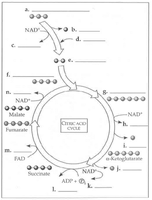
Q9. Diagram and label the Citric Acid Cycle, showing the flow of carbon, electron carriers, and ATP production.
Background
Topic: Citric Acid Cycle (Krebs Cycle)
This question tests your ability to visualize and label the steps of the citric acid cycle, including carbon flow, electron carrier production, and ATP synthesis.
Key Terms and Formulas:
Citric Acid Cycle: Series of reactions that oxidize acetyl-CoA to CO₂ and produce NADH, FADH₂, and ATP.
NADH/FADH₂: Electron carriers generated during the cycle.
ATP (or GTP): Produced by substrate-level phosphorylation.
Step-by-Step Guidance
Start by identifying the entry of acetyl-CoA into the cycle and its combination with oxaloacetate to form citrate.
Trace the steps where carbon atoms are released as CO₂.
Label the points where NAD⁺ and FAD are reduced to NADH and FADH₂.
Indicate where ATP (or GTP) is produced by substrate-level phosphorylation.
Try solving on your own before revealing the answer!
