 Back
Cellular Respiration: Structure, Function, and Regulation
Study Guide - Smart Notes
 Tailored notes based on your materials, expanded with key definitions, examples, and context.
Cellular Respiration and Energy in Living Organisms
Overview of Energy Acquisition
All living organisms require energy to perform essential functions such as growth, movement, and reproduction. This energy is derived from the chemical bonds in organic molecules, primarily glucose. Organisms acquire energy in two main ways:
Autotrophs: Organisms like plants synthesize their own food via photosynthesis, converting sunlight, carbon dioxide, and water into glucose.
Heterotrophs: Animals, fungi, and most bacteria obtain energy by consuming other organisms or organic molecules.
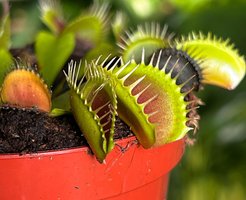
Mixotrophs: Some organisms, such as the Venus flytrap, can both photosynthesize and digest other organisms for nutrients.
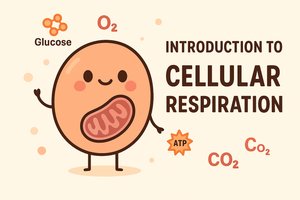
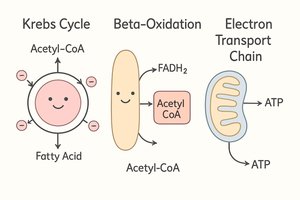
Once glucose is available, cells convert it into ATP through cellular respiration, which consists of three main stages:
Glycolysis – Occurs in the cytoplasm, breaking down glucose into pyruvate.
Krebs Cycle (Citric Acid Cycle) – Completes glucose breakdown in the mitochondria, releasing CO2.
Electron Transport Chain (ETC) – Uses oxygen to generate most ATP.
The overall reaction for cellular respiration is:
Oxygen is essential as the final electron acceptor in the ETC. Only about 40% of glucose's energy is captured as ATP; the rest is lost as heat, helping maintain body temperature.

Glycolysis
Mechanism and Phases
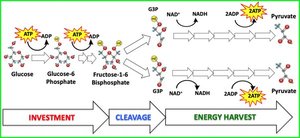
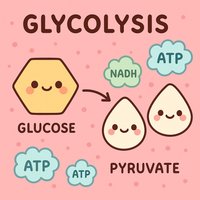
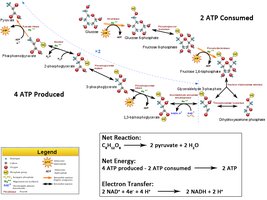
Glycolysis is the initial step in cellular respiration, breaking down one glucose molecule into two pyruvate molecules. This process occurs in the cytoplasm and consists of 10 enzyme-controlled steps, divided into two phases:
Energy Investment Phase: The cell uses 2 ATP to activate glucose.
Energy Payoff Phase: The cell produces 4 ATP and 2 NADH, resulting in a net gain of 2 ATP.
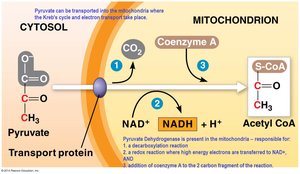
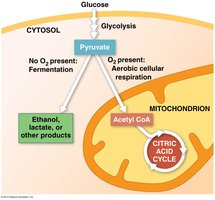
If oxygen is present, pyruvate enters the mitochondria and is converted to acetyl-CoA, which enters the Krebs cycle.
Link Reaction (Pyruvate Oxidation)
Pyruvate is transported into the mitochondrion, where it is oxidized to acetyl-CoA. This reaction produces NADH and releases CO2. Acetyl-CoA then enters the Krebs cycle.
Krebs Cycle (Citric Acid Cycle)
Cycle Steps and Redox Reactions
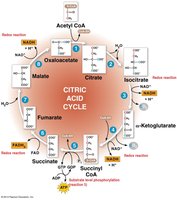
The Krebs cycle, also known as the citric acid or TCA cycle, occurs in the mitochondrial matrix and consists of 8 reactions. Acetyl-CoA combines with oxaloacetate to form citrate, and through a series of steps, oxaloacetate is regenerated. There are four redox reactions per cycle turn: three with NAD+ and one with FAD.
Location: Mitochondrial matrix
Oxygen Requirement: Aerobic process
Products: NADH, FADH2, ATP (or GTP), CO2
Electron Transport Chain (ETC)
Mechanism and Importance of Oxygen
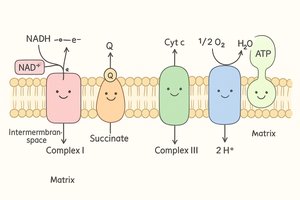
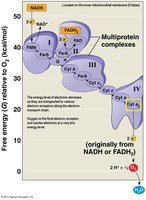
The ETC is located in the inner mitochondrial membrane and is responsible for the majority of ATP production. Oxygen acts as the final electron acceptor, allowing electrons from NADH and FADH2 to flow through protein complexes, creating a proton gradient that drives ATP synthesis.
Without oxygen, cells cannot extract energy efficiently, leading to rapid tissue failure.
Some eukaryotes (e.g., yeast) can perform anaerobic respiration, but long-term survival requires oxygen.
Mitochondrial Structure and Function
Anatomy and Compartments
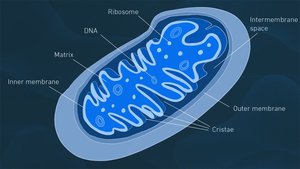
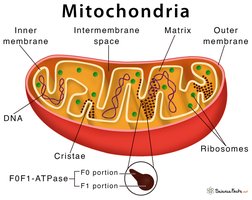
Mitochondria are double-membraned organelles similar in size to bacteria. They contain:
Outer membrane: More permeable due to porins; contains enzymes for lipid metabolism.
Inner membrane: Highly folded (cristae), impermeable to protons, contains proteins for transport, electron transfer, and ATP synthesis.
Intermembrane space: Accumulates H+ ions, creating a chemiosmotic gradient.
Matrix: Contains enzymes for the Krebs cycle, fatty acid catabolism, and pyruvate oxidation.
Inner Membrane and ATP Synthesis
The inner membrane hosts the electron transport chain and ATP synthase (F0F1 complex). Protons flow through the F0 channel, enabling ATP synthesis when ADP and phosphate are bound to the F1 complex.
Metabolic Regulation
Control of Glycolysis
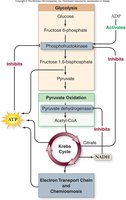
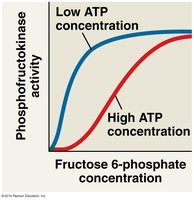
Glucose metabolism is regulated according to cellular energy needs. Phosphofructokinase (PFK) is the key regulatory enzyme in glycolysis, activated by low ATP and inhibited by high ATP. This ensures glycolysis proceeds only when energy is required.
Anaerobic Respiration and Fermentation
Mechanism and Pathways
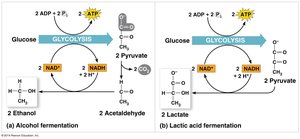
Glycolysis can occur without oxygen, but the Krebs cycle and ETC require oxygen. In the absence of oxygen, NADH and FADH2 cannot unload electrons, so cells rely on fermentation to regenerate NAD+:
Lactic acid fermentation: Pyruvate is reduced to lactic acid (muscle cells).
Alcoholic fermentation: Pyruvate is converted to ethanol (yeast).
Inhibitors of Cellular Respiration
Enzyme and Protein Inhibitors
Various substances can inhibit cellular respiration:
Fluoride: Inhibits glycolytic enzymes requiring Mg2+ as a cofactor.
Azide and Cyanide: Bind to cytochrome a3 in the ETC, preventing electron transfer to oxygen.
Oligomycin: Inhibits ATP synthase by blocking the F0 proton channel, halting ATP production.
Dinitrophenol (DNP) and FCCP: Uncouple oxidative phosphorylation by making the inner membrane leaky to protons, preventing ATP synthesis and releasing energy as heat.

Summary Table: Cellular Respiration Pathways
Stage | Location | Key Products | Oxygen Requirement |
|---|---|---|---|
Glycolysis | Cytoplasm | 2 ATP, 2 NADH, 2 Pyruvate | No |
Pyruvate Oxidation | Mitochondrial Matrix | Acetyl-CoA, NADH, CO2 | Yes |
Krebs Cycle | Mitochondrial Matrix | 2 ATP, 6 NADH, 2 FADH2, 4 CO2 | Yes |
Electron Transport Chain | Inner Mitochondrial Membrane | ~28 ATP, H2O | Yes |
Fermentation | Cytoplasm | Lactic acid or Ethanol, NAD+ | No |
Additional info: The notes include expanded academic context and explanations to ensure completeness and clarity for exam preparation.
