 Back
Cellular Respiration: Structure, Function, and Regulation
Study Guide - Smart Notes
 Tailored notes based on your materials, expanded with key definitions, examples, and context.
Cellular Respiration and Energy in Living Organisms
Overview of Energy Acquisition
All living organisms require energy to perform essential functions such as growth, movement, and reproduction. This energy is derived from the chemical bonds in molecules, primarily glucose. Organisms acquire energy through two main strategies:
Autotrophs: Organisms like plants synthesize their own food via photosynthesis, converting sunlight, carbon dioxide, and water into glucose.
Heterotrophs: Animals, fungi, and most bacteria obtain energy by consuming other organisms or organic molecules.
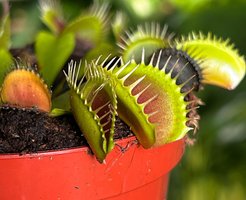
Mixotrophs: Some organisms, such as the Venus flytrap, can both photosynthesize and digest other organisms for nutrients.
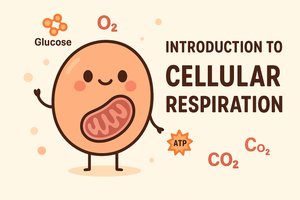
Once glucose is available, cells convert it into ATP through cellular respiration, a multi-stage process.

Stages of Cellular Respiration
Glycolysis: Occurs in the cytoplasm, breaking glucose into pyruvate.
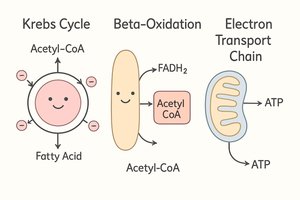
Krebs Cycle (Citric Acid Cycle): Completes glucose breakdown in the mitochondria, releasing CO2.
Electron Transport Chain (ETC): Uses oxygen to generate most ATP.
The overall reaction is:
Oxygen is essential as the final electron acceptor in the ETC. Only about 40% of glucose's energy is captured as ATP; the rest is lost as heat, helping maintain body temperature.
Glycolysis
Process and Phases
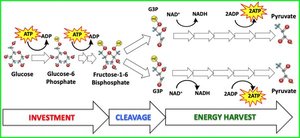
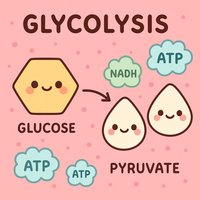
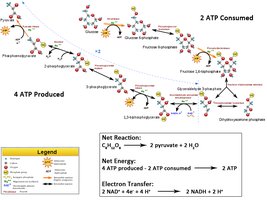
Glycolysis is the initial step in cellular respiration, breaking down one glucose molecule into two pyruvate molecules. It occurs in the cytoplasm and consists of 10 enzyme-controlled steps, divided into two phases:
Energy Investment Phase: 2 ATP are used to activate glucose.
Energy Payoff Phase: 4 ATP and 2 NADH are produced, resulting in a net gain of 2 ATP.
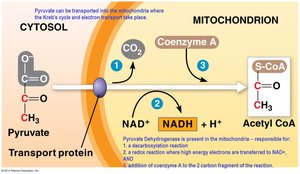
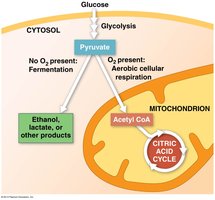
If oxygen is present, pyruvate is transported into the mitochondria and converted to acetyl-CoA, which enters the Krebs cycle.
Link Reaction (Pyruvate Oxidation)
Pyruvate is oxidized to acetyl-CoA in the mitochondria, producing NADH and CO2. This step connects glycolysis to the Krebs cycle.
Krebs Cycle (Citric Acid Cycle)
Cycle Description and Reactions
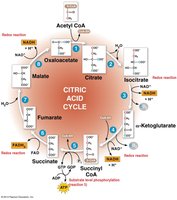
The Krebs cycle, also known as the TCA or citric acid cycle, occurs in the mitochondrial matrix. Acetyl-CoA combines with oxaloacetate to form citrate, and through a series of 8 reactions, oxaloacetate is regenerated. There are four redox reactions per cycle turn: three with NAD+ and one with FAD.
Location: Mitochondrial matrix
Nature: Aerobic (requires oxygen)
Products: NADH, FADH2, CO2, ATP (or GTP)
Electron Transport Chain (ETC)
Mechanism and Importance
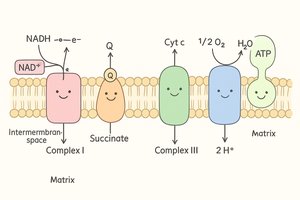
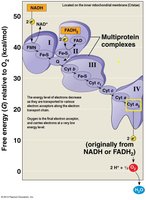
The ETC is located in the inner mitochondrial membrane and is essential for aerobic energy production. Oxygen acts as the final electron acceptor, allowing the chain to function. The ETC consists of four protein complexes and two mobile carriers (ubiquinone and cytochrome c). As electrons pass through the chain, protons are pumped into the intermembrane space, creating a proton gradient that drives ATP synthesis via ATP synthase.
Mitochondrial Structure and Function
Anatomy and Compartments
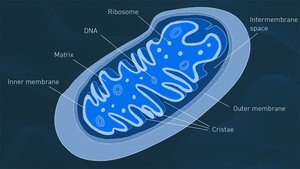
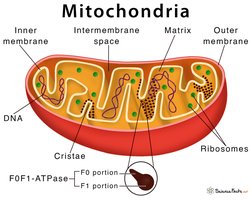
Mitochondria are double-membraned organelles similar in size to bacteria. They contain:
Outer membrane: More permeable due to porins; contains enzymes for lipid metabolism.
Inner membrane: Highly folded (cristae), impermeable to protons, contains proteins for transport, electron transfer, and ATP synthesis.
Intermembrane space: Accumulates H+ ions, creating a chemiosmotic gradient.
Matrix: Contains enzymes for the Krebs cycle, fatty acid catabolism, and pyruvate oxidation.
Proton Gradient and ATP Synthesis
The proton gradient across the inner membrane (proton motive force) drives ATP synthesis. The F0F1 complex (ATP synthase) allows protons to flow back into the matrix, catalyzing ATP formation from ADP and inorganic phosphate.
Metabolic Regulation
Control of Glycolysis
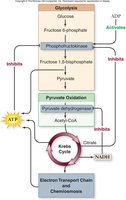
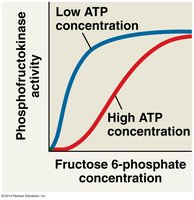
Glucose metabolism is tightly regulated to match cellular energy needs. Phosphofructokinase (PFK) is the key regulatory enzyme in glycolysis, activated by low ATP and inhibited by high ATP. This ensures glycolysis proceeds only when energy is required.
PFK is activated by: High ADP, low ATP
PFK is inhibited by: High ATP
Anaerobic Respiration and Fermentation
Pathways Without Oxygen
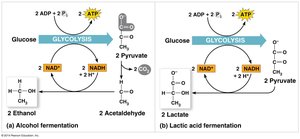
Glycolysis can occur without oxygen, but the Krebs cycle and ETC require oxygen. In the absence of oxygen, cells regenerate NAD+ through fermentation:
Lactic Acid Fermentation: Pyruvate is reduced to lactic acid (muscle cells).
Alcoholic Fermentation: Pyruvate is converted to ethanol (yeast).
Red blood cells rely solely on glycolysis due to lack of mitochondria. Muscle cells use lactic acid fermentation during intense exercise.
Inhibitors and Uncouplers of Cellular Respiration
Enzyme and Protein Inhibitors
Cellular respiration can be inhibited by substances that target key enzymes or proteins:
Fluoride: Inhibits glycolytic enzymes requiring Mg2+ (e.g., hexokinase, phosphofructokinase).
Azide and Cyanide: Bind to cytochrome a3 in the ETC, blocking electron transfer to oxygen.
Oligomycin: Inhibits ATP synthase by blocking the F0 proton channel, halting ATP production.
Uncouplers of Oxidative Phosphorylation
Uncouplers such as DNP and FCCP disrupt the proton gradient by making the inner mitochondrial membrane permeable to protons. This prevents ATP synthesis, causing energy to be released as heat instead.

Summary Table: Cellular Respiration Pathways
Pathway | Location | Oxygen Required? | Main Products |
|---|---|---|---|
Glycolysis | Cytoplasm | No | Pyruvate, ATP, NADH |
Pyruvate Oxidation | Mitochondrial Matrix | Yes | Acetyl-CoA, NADH, CO2 |
Krebs Cycle | Mitochondrial Matrix | Yes | NADH, FADH2, CO2, ATP |
Electron Transport Chain | Inner Mitochondrial Membrane | Yes | ATP, H2O |
Fermentation | Cytoplasm | No | Lactic acid or ethanol, ATP |
