 Back
BackBio 100 LEC Chapter 9 Modules 3-6
Study Guide - Smart Notes
 Tailored notes based on your materials, expanded with key definitions, examples, and context.
Bio 100 LEC Chapter 9
Citric Acid Cycle and Cellular Respiration
Overview of Cellular Respiration
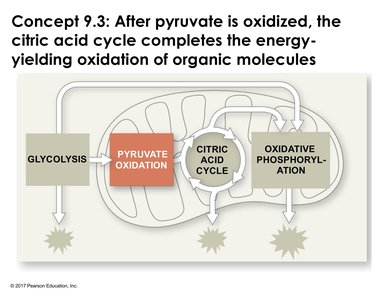
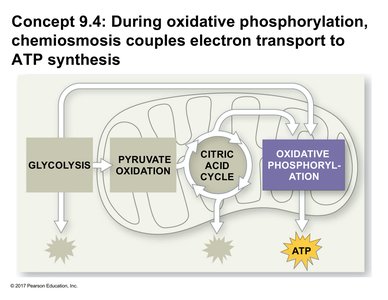
Cellular respiration is a multi-step metabolic pathway that converts biochemical energy from nutrients into adenosine triphosphate (ATP), releasing waste products. The process involves glycolysis, pyruvate oxidation, the citric acid cycle, and oxidative phosphorylation. The citric acid cycle completes the energy-yielding oxidation of organic molecules after pyruvate is oxidized.
Glycolysis: Occurs in the cytosol, breaking down glucose into pyruvate.
Pyruvate Oxidation: Pyruvate is transported into the mitochondrion and converted to acetyl CoA.
Citric Acid Cycle: Acetyl CoA enters the cycle, generating reduced electron carriers.
Oxidative Phosphorylation: Electron carriers drive ATP synthesis via the electron transport chain and chemiosmosis.
Pyruvate Oxidation
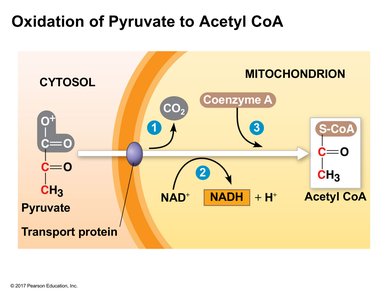
Pyruvate oxidation is a critical step linking glycolysis and the citric acid cycle. It occurs in the mitochondrial matrix and is catalyzed by the multi-enzyme complex pyruvate dehydrogenase.
Transport: Pyruvate moves from the cytosol into the mitochondrial matrix via transport proteins.
Decarboxylation: One carbon is removed from pyruvate as CO2.
Reduction: Electrons are transferred to NAD+, forming NADH.
Acetyl CoA Formation: The remaining two-carbon fragment is attached to coenzyme A, forming acetyl CoA.
The Citric Acid Cycle (Krebs Cycle or TCA Cycle)
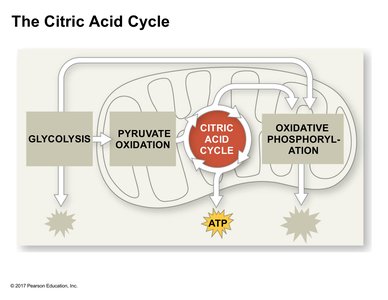
The citric acid cycle is a series of enzyme-catalyzed reactions in the mitochondrial matrix that completes the oxidation of organic molecules. It is cyclic, regenerating oxaloacetate with each turn.
Entry: Acetyl CoA (2C) combines with oxaloacetate (4C) to form citrate (6C).
Decarboxylation: Two carbons are released as CO2 per cycle.
Redox Reactions: NAD+ is reduced to NADH at three steps; FAD is reduced to FADH2 at one step.
ATP/GTP Production: Substrate-level phosphorylation produces GTP (or ATP in some cells).
Cycle Completion: Oxaloacetate is regenerated to accept another acetyl group.
Substrate-Level Phosphorylation in the Citric Acid Cycle
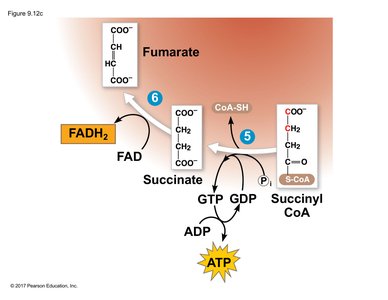
During the cycle, a high-energy thioester bond in succinyl CoA is used to drive the phosphorylation of GDP to GTP, which can then transfer a phosphate to ADP, forming ATP. GTP and ATP are energetically equivalent in this context.
Oxidative Phosphorylation and Chemiosmosis
Electron Transport Chain (ETC)
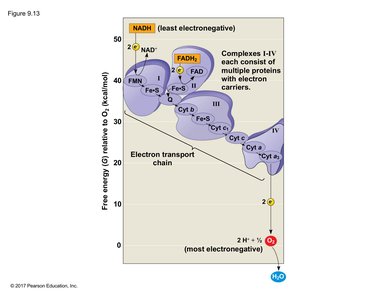
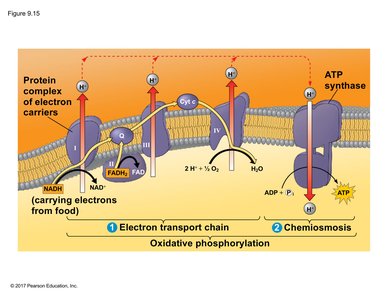
The electron transport chain is a series of protein complexes and electron carriers embedded in the inner mitochondrial membrane. Electrons from NADH and FADH2 are transferred through the chain, ultimately reducing oxygen to water.
Complexes I-IV: Multi-protein complexes that facilitate electron transfer and proton pumping.
Electron Flow: Electrons move from less to more electronegative carriers, releasing free energy in steps.
Oxygen: The final electron acceptor, forming water.
Proton Gradient: Energy released is used to pump protons from the matrix to the intermembrane space, creating an electrochemical gradient (proton motive force).
ATP Synthase and Chemiosmosis
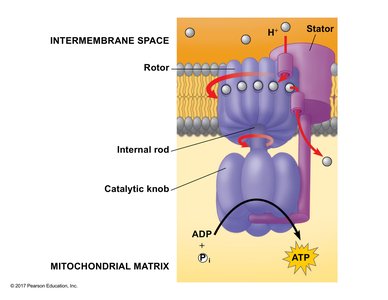
ATP synthase is a molecular rotary motor that synthesizes ATP as protons flow down their gradient from the intermembrane space into the mitochondrial matrix. This process is called chemiosmosis.
Structure: ATP synthase has a membrane-embedded channel and a catalytic knob.
Mechanism: Proton flow drives rotation, catalyzing the phosphorylation of ADP to ATP.
Yield: Most ATP from cellular respiration is produced by oxidative phosphorylation, not substrate-level phosphorylation.
ATP Yield from Cellular Respiration
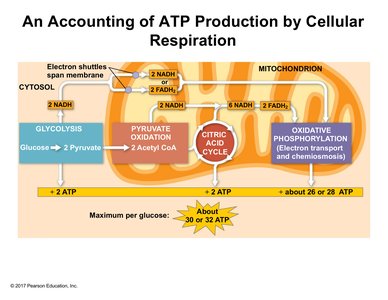
The complete oxidation of one glucose molecule yields about 30–32 ATP molecules. The exact number varies due to differences in shuttle mechanisms and the use of the proton motive force for other cellular work.
Glycolysis: 2 ATP (substrate-level phosphorylation)
Citric Acid Cycle: 2 ATP (or GTP, substrate-level phosphorylation)
Oxidative Phosphorylation: About 26–28 ATP
Fermentation and Anaerobic Respiration
Fermentation
Fermentation enables cells to produce ATP without oxygen by regenerating NAD+ for glycolysis. It is distinct from anaerobic respiration, which uses an electron transport chain with a final electron acceptor other than oxygen.
Alcohol Fermentation
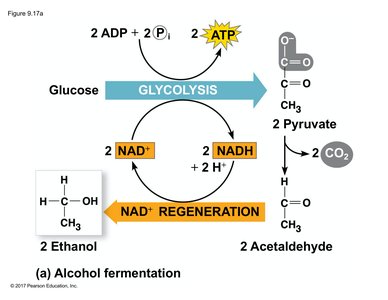
Alcohol fermentation, performed by yeast and some bacteria, converts pyruvate to ethanol in two steps:
Decarboxylation of pyruvate to acetaldehyde (releasing CO2).
Reduction of acetaldehyde to ethanol, regenerating NAD+.
The main purpose is to regenerate NAD+ for glycolysis, not to produce ethanol.
Lactic Acid Fermentation
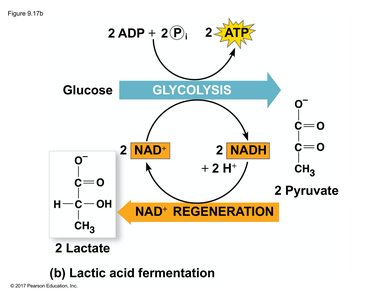
Lactic acid fermentation, common in animal muscle cells and some bacteria, reduces pyruvate directly to lactate, regenerating NAD+ without releasing CO2. Accumulation of lactic acid can contribute to muscle fatigue.
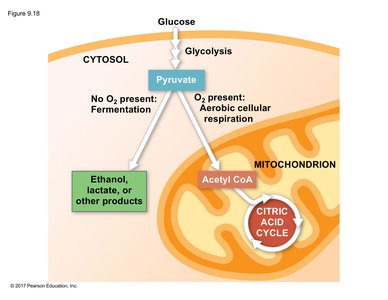
Fate of Pyruvate
The fate of pyruvate depends on oxygen availability. In the presence of oxygen, it enters the mitochondrion for aerobic respiration; in its absence, it undergoes fermentation.
Metabolic Integration and Regulation
Catabolism of Other Molecules
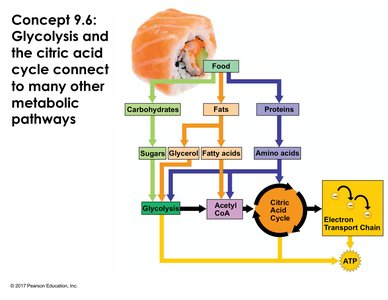
Besides glucose, other macromolecules such as fats and proteins can be used as fuel for cellular respiration. They enter the pathway at various points as intermediates.
Fats: Broken down into glycerol and fatty acids; fatty acids are converted to acetyl CoA via beta-oxidation.
Proteins: Broken down into amino acids, which are deaminated and enter glycolysis or the citric acid cycle.
Regulation of Cellular Respiration
The rate of cellular respiration is tightly regulated to meet cellular energy demands. Phosphofructokinase (PFK) is a key regulatory enzyme in glycolysis, subject to allosteric regulation:
ATP: High levels inhibit PFK (negative feedback).
AMP: High levels stimulate PFK (indicating low energy status).
Citrate: High levels inhibit PFK (feedback from the citric acid cycle).
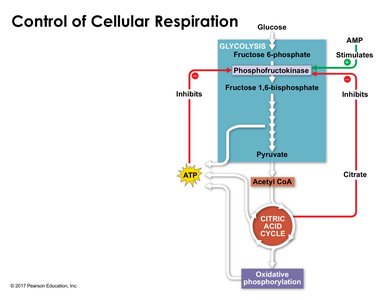
Additional info: The regulation of PFK ensures that ATP is produced only as needed, preventing wasteful overproduction and integrating signals from both glycolysis and the citric acid cycle.
