 Back
Central Dogma and Nucleic Acids Study Guide
Study Guide - Smart Notes
 Tailored notes based on your materials, expanded with key definitions, examples, and context.
Q1. Can DNA travel to the ribosome for translation?
Background
Topic: Central Dogma of Molecular Biology
This question tests your understanding of the roles of DNA and RNA in protein synthesis, specifically whether DNA itself is directly involved in translation at the ribosome.
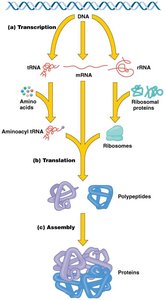
Key Terms:
DNA: Deoxyribonucleic acid, the molecule that stores genetic information in cells.
Ribosome: The cellular machinery where proteins are synthesized.
Translation: The process of synthesizing proteins from mRNA.
mRNA: Messenger RNA, the molecule that carries genetic information from DNA to the ribosome.
Step-by-Step Guidance
Recall the central dogma of molecular biology: information flows from DNA to RNA to protein.
Consider the location of DNA in eukaryotic cells (nucleus) and the location of ribosomes (cytoplasm).
Think about the process that allows genetic information to reach the ribosome: transcription produces mRNA, which then travels to the ribosome.
Ask yourself: Does DNA itself leave the nucleus and participate directly in translation, or is another molecule responsible?
Try solving on your own before revealing the answer!
Final Answer: B: False
DNA does not travel to the ribosome for translation. Instead, mRNA is transcribed from DNA in the nucleus and then moves to the ribosome in the cytoplasm, where translation occurs.
This is a key concept in the central dogma: DNA → RNA → Protein.
Q2. What are nucleic acids made of?
Background
Topic: Structure of Biological Macromolecules
This question tests your knowledge of the basic building blocks of nucleic acids, such as DNA and RNA.
Key Terms:
Nucleic acids: Macromolecules that store and transmit genetic information (DNA and RNA).
Nucleotides: The monomers (building blocks) of nucleic acids.
Lipids, amino acids, proteins: Other types of biological molecules, not the building blocks of nucleic acids.
Step-by-Step Guidance
Recall the four major types of biological macromolecules: carbohydrates, lipids, proteins, and nucleic acids.
Think about the monomers that make up each macromolecule: for example, proteins are made of amino acids.
Identify the monomer for nucleic acids: what is the repeating unit in DNA and RNA?
Review the structure of a nucleotide: it consists of a sugar, a phosphate group, and a nitrogenous base.
Try solving on your own before revealing the answer!
Final Answer: D: Nucleotides
Nucleic acids are made of nucleotides, which are the monomers that form the long chains of DNA and RNA.
Each nucleotide contains a sugar, a phosphate group, and a nitrogenous base.
Q3. What is the correct flow of information in the Central Dogma of Life?
Background
Topic: Central Dogma of Molecular Biology
This question tests your understanding of the sequence in which genetic information is transferred from DNA to RNA to protein.
Key Terms:
Central Dogma: The concept describing the flow of genetic information in cells.
Transcription: The process of copying DNA into RNA.
Translation: The process of synthesizing proteins from RNA.
Step-by-Step Guidance
Recall the central dogma: it describes how genetic information is used to make proteins.
Think about the order: DNA is transcribed into RNA, and RNA is translated into protein.
Review the answer choices and identify which one matches this sequence.
Be careful not to confuse the direction or the molecules involved.
Try solving on your own before revealing the answer!
Final Answer: C: DNA to RNA to Protein
The central dogma states that information flows from DNA to RNA (transcription), then from RNA to protein (translation).
Q4. What would be the complementary RNA strand for the following DNA sequence: 3'-GCGTATG-5'?
Background
Topic: Transcription and Base Pairing
This question tests your ability to use base pairing rules to transcribe a DNA sequence into its complementary RNA strand.
Key Terms and Formula:
Transcription: The process of making an RNA copy from a DNA template.
Base pairing rules: In RNA, A pairs with U, T pairs with A, C pairs with G, and G pairs with C.
Step-by-Step Guidance
Write out the DNA sequence: 3'-GCGTATG-5'.
Reverse the sequence to match the 5' to 3' direction for RNA synthesis.
Apply the base pairing rules for transcription: replace each DNA base with its RNA complement.
Remember that RNA uses uracil (U) instead of thymine (T).
Try solving on your own before revealing the answer!
Final Answer: 5'-CGCAUAC-3'
The complementary RNA strand is 5'-CGCAUAC-3', using the base pairing rules for transcription.
