 Back
BackExam 3 Review
Study Guide - Smart Notes
 Tailored notes based on your materials, expanded with key definitions, examples, and context.
Central Dogma of Molecular Biology
Overview of the Central Dogma
The central dogma of molecular biology describes the flow of genetic information within a biological system. It explains how DNA is transcribed into RNA and then translated into proteins, which perform essential cellular functions.
DNA Replication: The process by which DNA makes a copy of itself during cell division.
Transcription: The synthesis of messenger RNA (mRNA) from a DNA template. This process uses the same language (nucleotides).
Translation: The synthesis of proteins from mRNA. This involves a change in language from nucleotides to amino acids.
Polymerases: Enzymes (DNA or RNA polymerases) that catalyze the formation of nucleic acid chains.
Ribosomes: Cellular structures that facilitate the translation of mRNA into proteins.
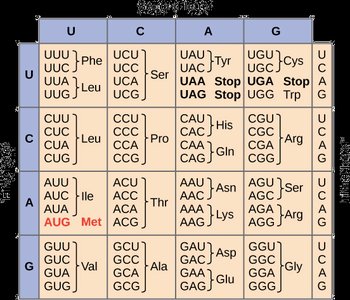
Codons: Triplets of nucleotides in mRNA that specify amino acids. There are 64 possible codon combinations, leading to degeneracy (multiple codons for the same amino acid).
Exons: Expressed sequences of DNA that code for proteins.
Introns: Non-coding sequences removed during mRNA processing.
Base Pairing: In DNA, cytosine (C) pairs with guanine (G), and adenine (A) pairs with thymine (T). In RNA, uracil (U) replaces thymine and pairs with adenine.
Example: The codon AUG codes for methionine (Met) and serves as the start codon for translation.
The Cell Cycle and Cell Division
Phases of the Cell Cycle
The cell cycle is the series of events that cells go through as they grow and divide. It consists of interphase (G1, S, G2) and the mitotic phase (mitosis and cytokinesis).
G0 Phase: Resting state where the cell is not actively dividing.
G1 Phase: Cell growth and preparation for DNA replication.
S Phase: DNA replication occurs.
G2 Phase: Further growth and preparation for mitosis.
Checkpoints: Control mechanisms that ensure the cell is ready to proceed to the next phase (e.g., sufficient nutrients, undamaged DNA).
Uncontrolled cell growth and loss of checkpoint control can lead to cancer.
Stages of Mitosis
Interphase: Cell prepares for division; DNA is replicated.
Prophase/Prometaphase: Chromosomes condense and become visible; spindle apparatus forms.
Metaphase: Chromosomes align at the cell's equator.
Anaphase: Sister chromatids are pulled apart to opposite poles.
Telophase: Nuclear envelopes reform around separated chromosomes.
Cytokinesis: Division of the cytoplasm, resulting in two daughter cells.
Mnemonic for mitosis order: IPMATC (Interphase, Prophase, Metaphase, Anaphase, Telophase, Cytokinesis).
Genetics and Inheritance
Sex-Linked and Polygenic Traits
Genetics studies how traits are inherited through generations. Some traits are sex-linked (associated with sex chromosomes), while others are polygenic (controlled by multiple genes).
Sex-Linked Traits: Traits controlled by genes on the X or Y chromosome. For example, X-linked recessive traits often affect males more than females.
Polygenic Traits: Traits influenced by two or more genes, resulting in a range of phenotypes.
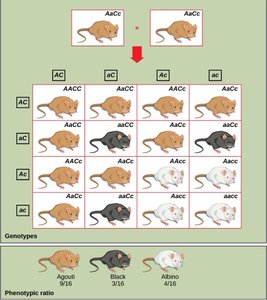
Example: In mice, fur color is determined by two genes (A and C). The combination of alleles produces different phenotypes: agouti, black, and albino.
Punnett Squares and Phenotypic Ratios
Punnett squares are used to predict the genotypes and phenotypes of offspring from genetic crosses.
Genotype: The genetic makeup of an organism (e.g., AaCc).
Phenotype: The observable traits (e.g., agouti, black, albino).
Phenotypic Ratio: The ratio of different phenotypes in the offspring (e.g., 9:3:4 for agouti:black:albino in a dihybrid cross).
Biotechnology Techniques
PCR, Restriction Digests, and Gel Electrophoresis
Modern biotechnology uses various techniques to analyze and manipulate DNA.
PCR (Polymerase Chain Reaction): Technique to amplify millions of copies of a specific DNA sequence.
Restriction Digest: Use of restriction enzymes to cut DNA at specific sequences, useful for cloning and analysis.
Gel Electrophoresis: Technique to separate DNA or proteins based on size by applying an electric field; molecules move toward the positive electrode.
Applications: These methods are fundamental in genetic engineering, forensic analysis, and molecular biology research.
Additional info: The genetic code table (image_1) is directly relevant to the explanation of codons and translation. The dihybrid cross diagram (image_2) is directly relevant to the explanation of polygenic inheritance and phenotypic ratios in genetics.
