 Back
Central Dogma I: Genes, Transcription, and the Genetic Code
Study Guide - Smart Notes
 Tailored notes based on your materials, expanded with key definitions, examples, and context.
Central Dogma and Gene Expression
Overview of the Central Dogma
The central dogma of molecular biology describes the flow of genetic information within a cell: DNA → RNA → Protein. This process is fundamental to understanding how cells use genetic instructions to build proteins, which carry out most cellular functions.
DNA stores genetic information in the form of nucleotide sequences.
Transcription is the process by which a gene's DNA sequence is copied into messenger RNA (mRNA).
Translation is the process by which the mRNA sequence is decoded to build a polypeptide (protein).
Information moves, not matter or energy; the instructions are transferred from DNA to RNA to protein.
Example: The instructions for making the enzyme RNA polymerase are encoded in DNA, transcribed into mRNA, and translated into the protein.
One Gene, One Polypeptide: Historical Foundations
Linking Genes to Enzymes
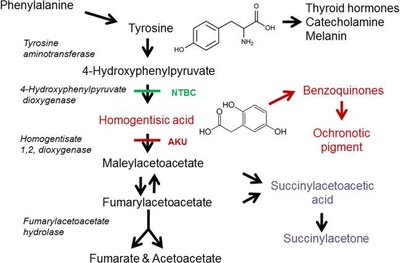
Early studies of inherited diseases, such as alkaptonuria, provided evidence that genes specify enzymes. Garrod (1902) observed that a missing enzyme caused a metabolic block, and Beadle & Tatum (1941) demonstrated that each gene corresponds to a specific enzyme in a pathway.
Garrod's inborn error of metabolism: Alkaptonuria is caused by a defective gene encoding the enzyme homogentisate 1,2-dioxygenase.
Beadle & Tatum: Mutant bread mold strains lacking specific enzymes could be rescued by supplying pathway intermediates, confirming the gene-enzyme link.
Updated concept: Not all proteins are enzymes, and many proteins consist of multiple polypeptide chains. Thus, "one gene, one polypeptide" is a more accurate rule.
Example: Hemoglobin consists of two types of polypeptide chains, each encoded by a different gene.
Transcription: Copying DNA into RNA
Mechanism of Transcription
Transcription is the process by which RNA polymerase synthesizes an RNA strand complementary to the DNA template. This occurs in three main stages:
Initiation: RNA polymerase binds to the promoter region, unwinds the DNA, and begins RNA synthesis.
Elongation: The enzyme moves along the template strand (3′→5′), adding nucleotides to the growing RNA (5′→3′).
Termination: Transcription ends at the terminator sequence, releasing the completed RNA transcript.
Key Points:
RNA polymerase does not require a primer.
The RNA transcript matches the coding strand of DNA, with uracil (U) replacing thymine (T).
Directionality is crucial: DNA is read 3′→5′, RNA is built 5′→3′.
The Genetic Code: Codons and Translation
Structure and Properties of the Genetic Code
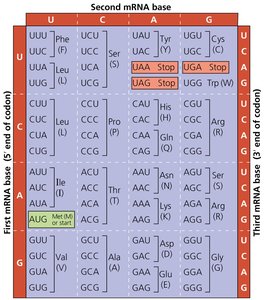
The genetic code is a set of rules by which the sequence of nucleotides in mRNA is translated into the sequence of amino acids in a protein. Each codon consists of three nucleotides, allowing for 64 possible combinations.
Three-letter codons: With four bases (A, U, G, C), three-letter codons yield possible codons.
Redundancy: 61 codons specify 20 amino acids; several codons can code for the same amino acid (degeneracy).
Start codon: AUG (methionine) signals the beginning of translation.
Stop codons: UAA, UAG, UGA signal the end of translation.
The code is nearly universal across organisms.
Example: The codon UUU codes for phenylalanine; AUG codes for methionine and serves as the start signal.
From DNA to Protein: The Flow of Information
Transcription and Translation Overview
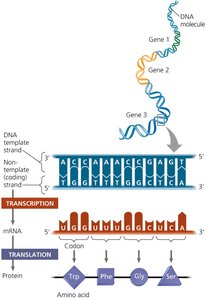
The process of gene expression involves two main steps: transcription (DNA to mRNA) and translation (mRNA to protein). The sequence of bases in DNA determines the sequence of bases in mRNA, which in turn determines the sequence of amino acids in the protein.
Transcription: DNA template strand is used to synthesize mRNA.
Translation: Ribosomes read mRNA codons and assemble the corresponding amino acids into a polypeptide.
Each gene encodes a specific polypeptide or functional RNA.
Example: The DNA sequence 3′-ATGCAT-5′ is transcribed into mRNA 5′-UACGUA-3′, which is then translated into a specific sequence of amino acids.
Key Terms and Definitions
Gene: A stretch of DNA read out to make a functional product (polypeptide or RNA).
Gene expression: The process of reading a gene into its product (transcription and translation).
Central dogma: Information flows DNA → RNA → protein.
Transcription: Copying a gene's DNA sequence into RNA.
Translation: Decoding mRNA into a polypeptide.
mRNA: Messenger RNA, the RNA copy of a protein-coding gene.
Ribozyme: An RNA molecule with enzymatic activity.
Splicing: Cutting and rejoining eukaryotic RNA before translation.
RNA polymerase: The enzyme that synthesizes RNA from a DNA template.
Promoter: DNA sequence where RNA polymerase binds to start transcription.
Terminator: DNA sequence where transcription ends.
Codon: Three-nucleotide word in mRNA specifying an amino acid.
Reading frame: The grouping of mRNA into codons, set by the start codon.
Redundancy: Multiple codons for one amino acid; the code is never ambiguous.
Practice Questions
A template strand reads 3′-ATGCAT-5′. Write the mRNA transcribed from it, mark its 5′ and 3′ ends, and give the sequence of the coding strand.
A bread-mould mutant grows on minimal medium only when supplied with the last intermediate of a pathway. Which enzyme does it lack, and what does that say about its genes?
Explain why there are 64 codons but only 20 amino acids, and name two things the cell does with the spare codons.
Summary of Key Concepts
A broken step in metabolism, inherited, means a broken gene.
Information flows DNA → RNA → protein.
Base pairing is the mechanism for copying genetic information.
Transcription involves promoter, template, directionality, and terminator.
The genetic code is based on triplets: 64 codons, 20 amino acids, start and stop signals, redundancy, and universality.
