 Back
Central Dogma I: Genes, Transcription, and the Genetic Code
Study Guide - Smart Notes
 Tailored notes based on your materials, expanded with key definitions, examples, and context.
Central Dogma I: Genes, Transcription, and the Genetic Code
Overview
This study guide covers the foundational concepts of how genetic information flows from DNA to RNA to protein, known as the central dogma of molecular biology. It explores the historical experiments that established the gene-enzyme relationship, the process of transcription, and the logic of the genetic code.
The Gene-Enzyme Connection
Historical Foundations: Inherited Diseases and Enzymes
Early studies of inherited metabolic diseases, such as alkaptonuria, provided evidence that genes specify enzymes. Archibald Garrod observed that certain diseases run in families and are present from birth, suggesting a genetic basis for missing enzymes.
Alkaptonuria: A metabolic disorder where urine turns black due to the accumulation of homogentisic acid, caused by a non-functional enzyme in the tyrosine degradation pathway.
Key Inference: The instructions for making enzymes are inherited, not the enzymes themselves.
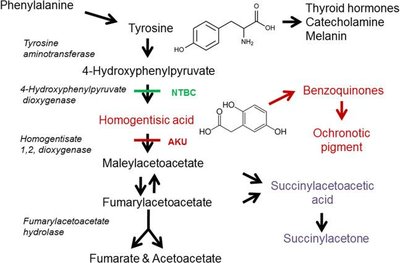
One Gene, One Polypeptide Hypothesis
Beadle and Tatum's experiments with bread mold (Neurospora) demonstrated that each gene encodes a specific enzyme (later refined to polypeptide). Mutants lacking a single enzyme could be rescued by supplying the corresponding metabolic intermediate.
Conclusion: Each gene corresponds to a single polypeptide or functional RNA.
Modern View: Not all proteins are enzymes, some proteins have multiple polypeptide chains, and some genes encode functional RNAs.
The Central Dogma of Molecular Biology
Information Flow: DNA → RNA → Protein
The central dogma describes the directional flow of genetic information:
Transcription: DNA is copied into RNA.
Translation: RNA is decoded to synthesize proteins.
Key Principle: What moves is information, not matter or energy.
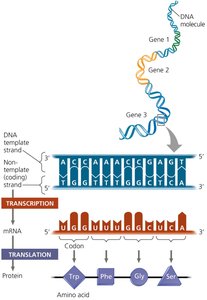
Transcription: From DNA to RNA
Mechanism of Transcription
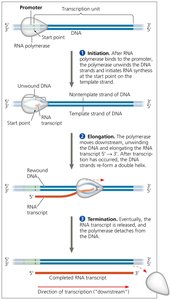
Transcription is the process by which RNA polymerase synthesizes an RNA strand complementary to a DNA template. It occurs in three main stages:
Initiation: RNA polymerase binds to the promoter region, unwinds the DNA, and begins RNA synthesis.
Elongation: RNA polymerase moves along the template strand (3′→5′), adding nucleotides to the 3′ end of the growing RNA (5′→3′ direction).
Termination: Transcription ends at a terminator sequence, releasing the RNA transcript.
Base Pairing: In RNA, uracil (U) pairs with adenine (A) instead of thymine (T).
Template vs. Coding Strand: The RNA sequence is complementary to the template strand and matches the coding strand (except U for T).
The Genetic Code: Codons and Translation
Triplet Code Logic
The genetic code is read in three-nucleotide sequences called codons. With four RNA bases (A, U, G, C), three-letter codons provide 64 possible combinations—enough to encode 20 amino acids and start/stop signals.
Redundancy: Multiple codons can specify the same amino acid (degeneracy), but each codon is unambiguous.
Start Codon: AUG (methionine) signals the start of translation.
Stop Codons: UAA, UAG, UGA signal the end of translation.
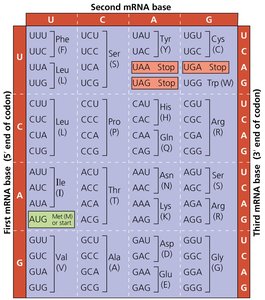
Reading the Code
Codons are read 5′→3′, three bases at a time, starting from AUG.
The reading frame is set by the start codon and is non-overlapping.
Key Terms and Definitions
Gene: A stretch of DNA that encodes a functional product (polypeptide or RNA).
Gene Expression: The process of transcribing and (usually) translating a gene into its product.
Transcription: Synthesis of RNA from a DNA template.
Translation: Synthesis of a polypeptide from an mRNA template.
RNA Polymerase: The enzyme that synthesizes RNA during transcription.
Promoter: DNA sequence where RNA polymerase binds to initiate transcription.
Terminator: DNA sequence signaling the end of transcription.
Codon: A three-nucleotide sequence in mRNA that specifies an amino acid or stop signal.
Reading Frame: The grouping of nucleotides into codons, set by the start codon.
Redundancy (Degeneracy): Multiple codons for one amino acid.
Practice Questions
A template strand reads 3′-ATGCAT-5′. What is the mRNA sequence transcribed from it? What is the coding strand sequence?
A bread-mold mutant grows only when supplied with the last intermediate of a pathway. Which enzyme is missing, and what does this indicate about its genes?
Why are there 64 codons but only 20 amino acids? Name two uses for the extra codons.
Summary Table: The Flow of Genetic Information
Step | Process | Key Enzyme | Product | Direction |
|---|---|---|---|---|
Transcription | DNA → RNA | RNA Polymerase | mRNA | 5′→3′ (RNA built) |
Translation | RNA → Protein | Ribosome | Polypeptide | N-terminus to C-terminus |
Additional info: Some genes encode functional RNAs (e.g., tRNA, rRNA) that are not translated into protein. In eukaryotes, RNA transcripts are often processed (capping, polyadenylation, splicing) before translation.
