 Back
Central Dogma II: Transcription, RNA Processing, and Translation
Study Guide - Smart Notes
 Tailored notes based on your materials, expanded with key definitions, examples, and context.
Central Dogma II: From DNA to Protein
Overview
The central dogma of molecular biology describes the flow of genetic information within a cell: DNA → RNA → Protein. This process involves transcription (copying DNA into RNA), RNA processing (in eukaryotes), and translation (reading RNA to build proteins). The genetic code is nearly universal, allowing genes from one organism to be expressed in another.
Transcription: DNA to RNA
Stages of Transcription
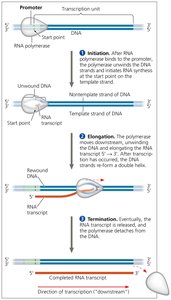
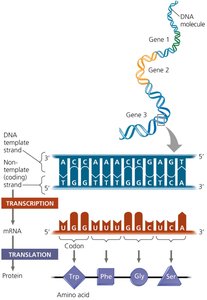
Transcription is the process by which RNA is synthesized from a DNA template. It occurs in three main stages:
Initiation: RNA polymerase binds to the promoter region of the gene, unwinds the DNA, and begins RNA synthesis at the start point.
Elongation: RNA polymerase moves along the template strand, synthesizing RNA in the 5′→3′ direction by adding complementary RNA nucleotides.
Termination: Upon reaching a terminator sequence, the RNA transcript is released, and the polymerase detaches from the DNA.
Promoters and Transcription Factors in Eukaryotes
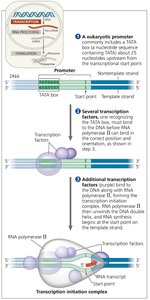
In eukaryotes, promoters often include a TATA box upstream of the start site. Transcription factors recognize and bind to the promoter, recruiting RNA polymerase II to form the transcription initiation complex.
RNA Processing in Eukaryotes
Modifications to Pre-mRNA
Before leaving the nucleus, eukaryotic pre-mRNA undergoes several modifications:
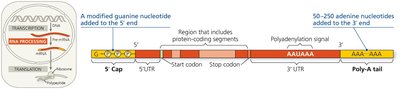
5′ Cap: A modified guanine nucleotide is added to the 5′ end, protecting the RNA and aiding ribosome binding.
Poly-A Tail: 50–250 adenine nucleotides are added to the 3′ end, stabilizing the RNA and facilitating export from the nucleus.
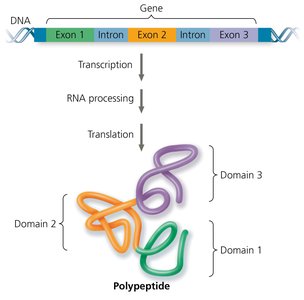
Splicing: Non-coding regions (introns) are removed, and coding regions (exons) are joined together. Alternative splicing allows one gene to produce multiple protein isoforms.
The Genetic Code
Codons and the Codon Table
The genetic code is read in triplets of nucleotides called codons. Each codon specifies an amino acid or a stop signal. The code is redundant (multiple codons for most amino acids), unambiguous (each codon specifies only one amino acid), and nearly universal.
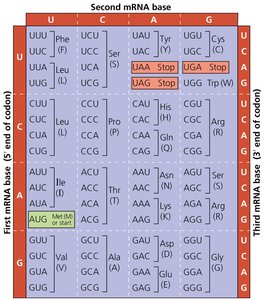
Start codon: AUG (methionine)
Stop codons: UAA, UAG, UGA (do not code for amino acids)
Translation: RNA to Protein
Mechanism of Translation
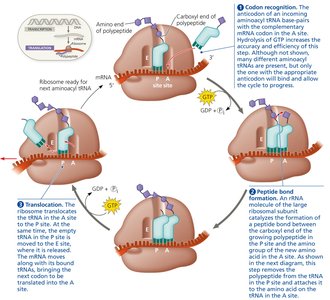
Translation is the process by which ribosomes synthesize proteins using mRNA as a template. It occurs in three stages:
Initiation: The ribosome assembles at the start codon (AUG) on the mRNA.
Elongation: tRNAs bring amino acids to the ribosome, matching their anticodons to codons on the mRNA. The ribosome forms peptide bonds between amino acids, growing the polypeptide chain.
Termination: When a stop codon is reached, a release factor binds, and the completed polypeptide is released.
tRNA and Aminoacyl-tRNA Synthetases
tRNA: Transfer RNA molecules have an anticodon that pairs with the mRNA codon and an attached amino acid.
Aminoacyl-tRNA synthetases: Enzymes that attach the correct amino acid to its corresponding tRNA, enforcing the genetic code.
Ribosome Structure and Function
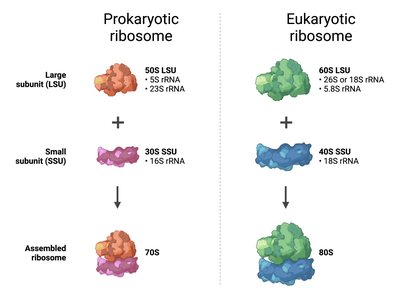
Ribosome: Composed of rRNA and proteins, with two subunits (large and small). Prokaryotic ribosomes are 70S (50S + 30S), eukaryotic are 80S (60S + 40S).
Sites: A (aminoacyl) site for incoming tRNA, P (peptidyl) site for growing chain, E (exit) site for empty tRNA.
Mutations and Their Effects
Types of Point Mutations
Silent mutation: Changes a base but not the amino acid (due to redundancy).
Missense mutation: Changes one amino acid to another.
Nonsense mutation: Changes a codon to a stop codon, truncating the protein.
Frameshift mutation: Insertion or deletion not divisible by three, altering the reading frame and usually resulting in a nonfunctional protein.
Antibiotics and the Ribosome
Mechanism of Action
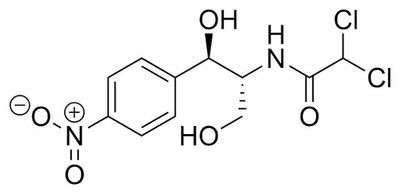
Some antibiotics, such as chloramphenicol, selectively inhibit bacterial ribosomes without affecting eukaryotic ribosomes, exploiting structural differences. However, mitochondria in eukaryotic cells have ribosomes similar to bacteria, which can lead to side effects.
Summary Table: Replication, Transcription, and Translation
Process | Product | Template | Enzyme | Enzyme Composition |
|---|---|---|---|---|
Replication | DNA (two copies) | Both DNA strands | DNA polymerase | Protein |
Transcription | RNA (pre-mRNA → mRNA) | One DNA strand (template) | RNA polymerase | Protein |
Translation | Polypeptide | mRNA (codons) | Ribosome | rRNA + Protein |
Key Terms and Definitions
Pre-mRNA: The initial RNA transcript before processing.
5′ Cap: Modified guanine nucleotide at the 5′ end of mRNA.
Poly-A Tail: String of adenines at the 3′ end of mRNA.
Intron/Exon: Non-coding/coding regions of a gene.
Splicing: Removal of introns and joining of exons.
tRNA: Adapter molecule in translation.
Aminoacyl-tRNA synthetase: Enzyme that attaches amino acids to tRNAs.
Ribosome: rRNA-protein complex that synthesizes proteins.
Mutation: Change in DNA sequence; can be silent, missense, nonsense, or frameshift.
Practice Questions
Given the mRNA sequence 5′-AUG UUU AAA UGA-3′, write the polypeptide sequence. What happens if a G is inserted after the first U?
What would happen if all aminoacyl-tRNA synthetases were inhibited?
How can two cells with the same genome produce different proteins?
