 Back
Central Dogma II: Transcription, RNA Processing, Translation, and the Genetic Code
Study Guide - Smart Notes
 Tailored notes based on your materials, expanded with key definitions, examples, and context.
Central Dogma II: From DNA to Protein
Overview of the Central Dogma
The central dogma of molecular biology describes the flow of genetic information within a cell: DNA is transcribed into RNA, which is then translated into protein. This process is fundamental to all living organisms and underlies gene expression and cellular function.
Transcription: Synthesis of RNA from a DNA template.
RNA Processing: Modification of the primary RNA transcript in eukaryotes.
Translation: Decoding of mRNA into a polypeptide chain.
Genetic Code: The set of rules by which information encoded in mRNA is translated into proteins.
Transcription: Making RNA from DNA
Stages of Transcription
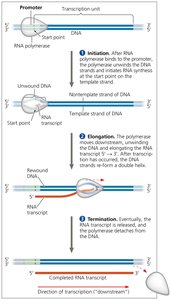
Transcription is the process by which RNA polymerase synthesizes RNA from a DNA template. It occurs in three main stages:
Initiation: RNA polymerase binds to the promoter region of DNA, marking the start point and identifying the template strand. In eukaryotes, transcription factors bind first, often at the TATA box, to help position RNA polymerase.
Elongation: The enzyme unwinds the DNA and reads the template strand in the 3′→5′ direction, synthesizing RNA in the 5′→3′ direction. Nucleotides are added to the RNA's 3′ end.
Termination: Upon reaching the terminator sequence, the RNA transcript is released, and the polymerase detaches from the DNA.
Eukaryotic Promoters and Transcription Initiation
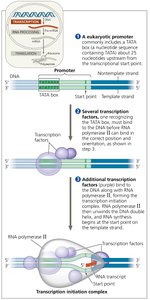
Eukaryotic transcription initiation is more complex, involving multiple transcription factors and a specialized promoter region called the TATA box. These factors assemble at the promoter to form the transcription initiation complex, enabling RNA polymerase II to begin RNA synthesis.
TATA box: A conserved DNA sequence about 25 nucleotides upstream from the start point.
Transcription factors: Proteins that recognize the TATA box and recruit RNA polymerase II.
Initiation complex: The assembly of transcription factors and RNA polymerase at the promoter.
RNA Processing in Eukaryotes
Modifications to the Primary Transcript
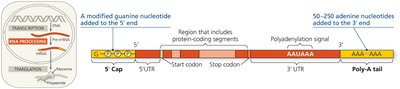
Before leaving the nucleus, eukaryotic pre-mRNA undergoes several modifications to become mature mRNA:
5′ Cap: Addition of a modified guanine nucleotide to the 5′ end, protecting the RNA and marking it for translation.
Poly-A Tail: Addition of 50–250 adenine nucleotides to the 3′ end, aiding stability and export.
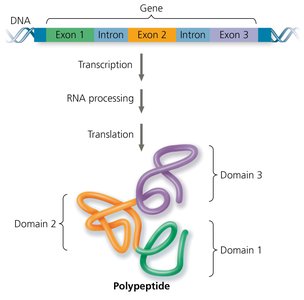
Splicing: Removal of introns (non-coding regions) and joining of exons (coding regions) by the spliceosome.
Alternative Splicing: Allows one gene to produce multiple protein isoforms by joining different combinations of exons.
The Genetic Code: Codons and Translation
Structure and Properties of the Genetic Code
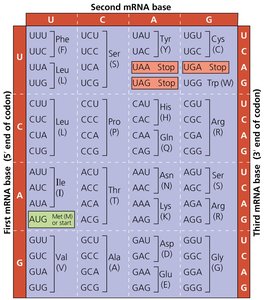
The genetic code consists of 64 codons, each made of three RNA bases. Codons specify amino acids or signal translation to start or stop. The code is redundant (multiple codons for one amino acid), never ambiguous, and nearly universal across organisms.
Start codon: AUG (methionine)
Stop codons: UAA, UAG, UGA (no amino acid assigned)
Redundancy: Some amino acids have multiple codons (e.g., Leu has six codons).
Universality: The same code is used in almost all organisms.
 s
Translating mRNA into Protein
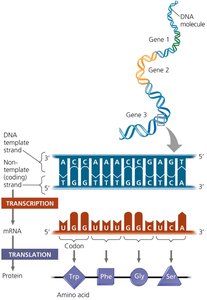
Translation is the process by which ribosomes decode mRNA into a polypeptide chain. Each codon is read in sequence, starting from AUG, and matched to its corresponding amino acid.
tRNA: Transfer RNA molecules carry amino acids and match codons via their anticodon.
Aminoacyl-tRNA synthetase: Enzyme that attaches the correct amino acid to its tRNA.
Ribosome: The molecular machine composed of rRNA and proteins, with three sites (A, P, E) for tRNA binding and polypeptide synthesis.
Mutations: Effects of Single Base Changes
Types of Small-Scale Mutations
Mutations can alter the protein product of a gene. The effect depends on the type and location of the change:
Silent mutation: Base change does not alter the amino acid (due to redundancy).
Missense mutation: Base change swaps one amino acid for another.
Nonsense mutation: Base change creates a stop codon, ending translation early.
Frameshift mutation: Insertion or deletion not divisible by three; alters all downstream codons.
Example: Insertion of one base in a 300-codon gene causes a frameshift, changing every amino acid after the insertion and usually introducing a premature stop codon.
Antibiotics and Ribosome Differences
Chloramphenicol: Selective Inhibition of Bacterial Protein Synthesis
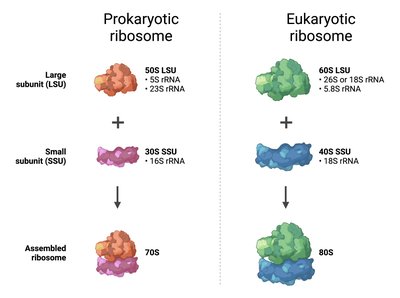
Chloramphenicol is an antibiotic that inhibits bacterial ribosomes, blocking peptide bond formation and halting protein synthesis. Despite the universality of the genetic code and ribosomes, structural differences between bacterial (70S) and eukaryotic (80S) ribosomes allow selective targeting.
Bacterial ribosome: 70S (50S + 30S subunits)
Eukaryotic ribosome: 80S (60S + 40S subunits)
Drug binding: Chloramphenicol binds the bacterial 50S subunit; eukaryotic ribosomes are spared due to structural differences.
Side effects: Mitochondria have bacterial-like ribosomes, so high doses can affect them.
Summary Table: Replication, Transcription, Translation
Comparison of Information Flow Processes
Process | Thing Made | Template Read | Enzyme | Enzyme Composition |
|---|---|---|---|---|
Replication | DNA (two copies) | Both DNA strands | DNA polymerase (needs primer) | Protein |
Transcription | RNA (pre-mRNA → mRNA) | One DNA strand (template) | RNA polymerase (no primer) | Protein |
Translation | Polypeptide | mRNA, 5′→3′, in codons | Ribosome | rRNA + protein |
Key Terms and Definitions
Pre-mRNA: The primary transcript from a eukaryotic gene, before processing.
5′ cap: Modified guanine added to the 5′ end of mRNA.
Poly-A tail: String of adenines added to the 3′ end of mRNA.
Intron/Exon: Non-coding/coding regions of a gene.
Splicing: Removal of introns and joining of exons.
Alternative splicing: Production of multiple proteins from one gene.
tRNA: Adapter molecule for translation.
Anticodon: Three bases on tRNA that pair with mRNA codon.
Aminoacyl-tRNA synthetase: Enzyme that attaches amino acid to tRNA.
Ribosome: RNA-protein complex that synthesizes proteins.
Silent, missense, nonsense, frameshift mutations: Types of base changes affecting protein coding.
Proteome partitioning: Allocation of cellular protein resources, affecting growth rate.
Practice Questions
An mRNA reads 5′-AUG UUU AAA UGA-3′. Write the polypeptide. Then insert a G after the first U and write it again.
A drug blocks every aminoacyl-tRNA synthetase. Predict its effect on translation, and explain why the ribosome cannot compensate.
Two cells share one genome. One makes a protein the other never makes, from the same gene. Name two steps at which this can be decided.
Additional info:
Equations: Insertion/deletion not divisible by three, alters reading frame.
Alternative splicing increases protein diversity without increasing gene number.
Antibiotics exploit structural differences in ribosomes for selective toxicity.
