 Back
Central Dogma, Replication, Transcription, and Translation Study Guide
Study Guide - Smart Notes
 Tailored notes based on your materials, expanded with key definitions, examples, and context.
Q1. What is the central dogma of molecular biology?
Background
Topic: Central Dogma
This question tests your understanding of how genetic information flows from DNA to RNA to protein in cells.
Key Terms:
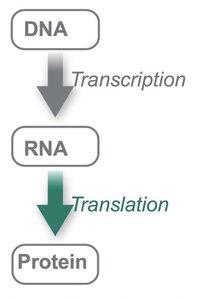
Central Dogma: The process by which the information in DNA is transcribed into RNA and then translated into protein.
Transcription: The synthesis of RNA from a DNA template.
Translation: The synthesis of protein from an mRNA template.
Step-by-Step Guidance
Recall that the central dogma describes the directional flow of genetic information in cells.
Identify the three main stages: DNA is transcribed to RNA, and RNA is translated to protein.
Think about the molecules involved at each stage: DNA, RNA, and protein.
Consider the processes: transcription (DNA to RNA) and translation (RNA to protein).
Try solving on your own before revealing the answer!
Final Answer:
The central dogma states that genetic information flows from DNA to RNA to protein. DNA is transcribed into RNA, which is then translated into protein.
Q2. Fill in the blanks: Genetic information is stored within the sequence of _______. This information is transcribed into a sequence of _________, which are then translated into a sequence of _______.
Background
Topic: Information Flow in Cells
This question tests your knowledge of the order and types of molecules involved in the central dogma.
Key Terms:
DNA bases: The nucleotides (A, T, C, G) that make up DNA.
RNA bases: The nucleotides (A, U, C, G) that make up RNA.
Amino acids: The building blocks of proteins.
Step-by-Step Guidance
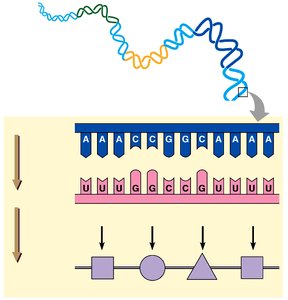
Recall that genetic information is stored in DNA as a sequence of bases.
During transcription, this information is copied into RNA bases.
During translation, the RNA sequence is used to build a sequence of amino acids (protein).
Match the correct terms to each blank based on the central dogma.
Try solving on your own before revealing the answer!
Final Answer:
Genetic information is stored within the sequence of DNA bases. This information is transcribed into a sequence of RNA bases, which are then translated into a sequence of amino acids.
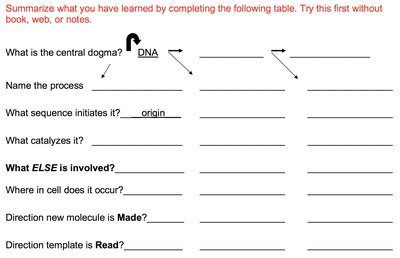
Q3. Summarize what you have learned by completing the following table: What is the central dogma? Name the process. What sequence initiates it? What catalyzes it? What else is involved? Where in cell does it occur? Direction new molecule is made? Direction template is read?
Background
Topic: Replication, Transcription, and Translation
This question tests your ability to organize and recall key facts about the central dogma and the processes involved.
Key Terms:
Origin: The starting point for DNA replication.
Promoter: The sequence that initiates transcription.
Polymerase: The enzyme that catalyzes both DNA and RNA synthesis.
Directionality: New nucleic acids are synthesized in the 5' to 3' direction.
Step-by-Step Guidance
Identify the central dogma: DNA → RNA → Protein.
List the processes: Replication (DNA synthesis), Transcription (RNA synthesis), Translation (protein synthesis).
Recall what sequence initiates each process: origin for replication, promoter for transcription, start codon for translation.
Think about the enzymes involved: DNA polymerase for replication, RNA polymerase for transcription, ribosome for translation.
Consider where each process occurs: nucleus for replication and transcription, cytoplasm for translation.
Remember the directionality: new molecules are made 5' to 3', templates are read 3' to 5'.
Try solving on your own before revealing the answer!
Final Answer:
Central dogma: DNA → RNA → Protein
Processes: Replication, Transcription, Translation
Initiating sequence: Origin (replication), Promoter (transcription), Start codon (translation)
Catalyst: DNA polymerase, RNA polymerase, Ribosome
Other molecules: Helicase, tRNA, rRNA, etc.
Location: Nucleus (replication/transcription), Cytoplasm (translation)
Direction new molecule is made: 5' to 3'
Direction template is read: 3' to 5'
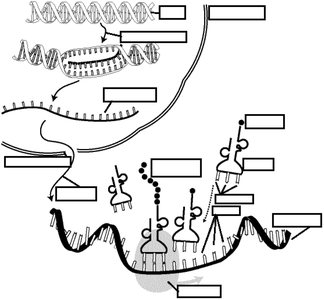
Q4. Label the diagram showing the processes of transcription and translation.
Background
Topic: Transcription and Translation
This question tests your ability to identify and label the key steps and molecules involved in transcription and translation.
Key Terms:
Transcription: The process of copying DNA into RNA.
Translation: The process of synthesizing protein from mRNA.
Ribosome: The molecular machine that carries out translation.
tRNA: Transfer RNA, brings amino acids to the ribosome.
Step-by-Step Guidance
Identify the DNA, mRNA, and ribosome in the diagram.
Label the process of transcription (DNA to mRNA).
Label the process of translation (mRNA to protein).
Identify and label tRNA and amino acids involved in translation.
Try solving on your own before revealing the answer!
Final Answer:
The diagram should be labeled with DNA, mRNA, ribosome, tRNA, amino acids, transcription, and translation at the appropriate locations.
