 Back
Chapter 1: Biology – Exploring Life
Study Guide - Smart Notes
 Tailored notes based on your materials, expanded with key definitions, examples, and context.
Biology: The Scientific Study of Life
Definition and Scope of Biology
Biology is the scientific study of life, encompassing the structure, function, growth, origin, evolution, and distribution of living organisms. Biologists seek to answer the fundamental question: What is life?
Biology: The science that investigates living organisms and their interactions with each other and their environments.
Key focus: Understanding the characteristics that define living things.
Characteristics of Life
Seven Properties of Living Organisms
All living things share a set of fundamental characteristics that distinguish them from nonliving matter.
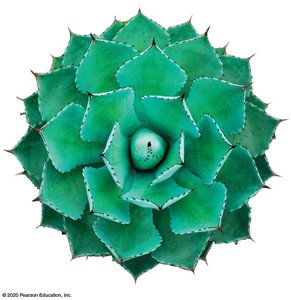
Order: Living things exhibit complex but ordered organization, often visible in their structures.
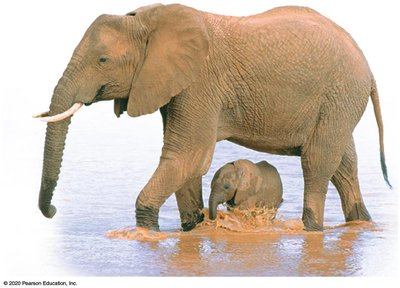
Reproduction: Organisms reproduce their own kind, ensuring the continuation of their species.
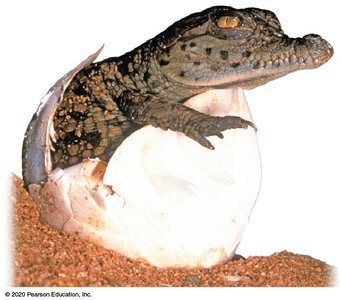
Growth and Development: Information carried by genes controls the pattern of growth and development in all organisms.
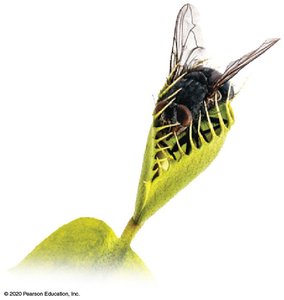
Response to the Environment: Living things respond to environmental stimuli.
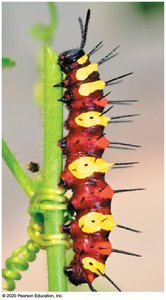
Energy Processing: Organisms obtain and use energy to power their activities and chemical reactions.
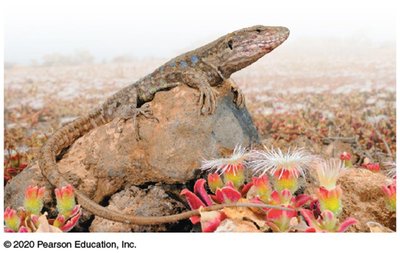
Regulation: Organisms regulate their internal environment to maintain conditions suitable for life (homeostasis).
Evolutionary Adaptation: Populations of organisms evolve over generations as individuals with traits best suited to their environments have greater reproductive success.
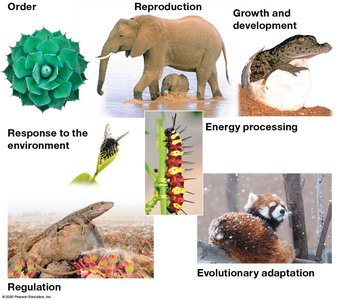
Examples of Life's Properties
Order: The geometric arrangement of leaves in a plant.
Reproduction: Elephants producing offspring.
Growth and Development: A crocodile hatching from an egg and growing into an adult.
Response to the Environment: A Venus flytrap closing on an insect.
Energy Processing: A caterpillar consuming leaves for energy.
Regulation: A lizard sunbathing to regulate its body temperature.
Evolutionary Adaptation: The thick fur of a red panda for cold environments.
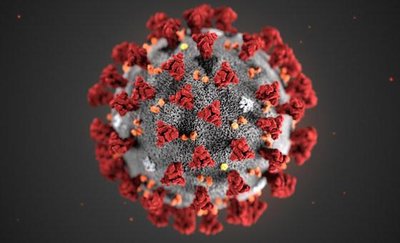
Challenging Cases: Are Viruses Alive?
Viruses exhibit some but not all properties of life. For example, they can evolve and contain genetic material, but they cannot reproduce or carry out metabolism independently. This makes their classification as 'alive' controversial.
Domains of Life
The Three-Domain System
All living organisms are classified into three domains based on genetic and cellular differences:
Bacteria: Single-celled prokaryotes with diverse metabolic capabilities.
Archaea: Single-celled prokaryotes, often found in extreme environments, genetically distinct from bacteria.
Eukarya: Organisms with eukaryotic cells, including protists, plants, fungi, and animals.
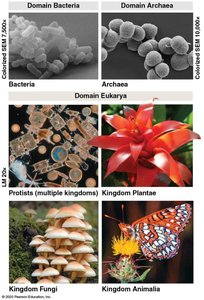
Hierarchy of Biological Organization
Levels of Organization
Biology is studied at multiple levels, from the smallest molecules to the entire biosphere. Each level exhibits emergent properties—new characteristics that arise from the interactions of components at lower levels.
1. Biosphere: All life on Earth and the places where life exists.
2. Ecosystem: All living things in a particular area, along with nonliving components.
3. Community: All organisms in an ecosystem.
4. Population: All individuals of a species within a specific area.
5. Organism: An individual living thing.
6. Organ/Organ System: Body parts that perform specific functions.
7. Tissue: Groups of similar cells performing a function.
8. Cell: The fundamental unit of life.
9. Organelle: Functional components within cells.
10. Molecule: Chemical structures consisting of two or more atoms.
The Nature of Science
What is Science?
Science is an approach to understanding the natural world through observation, experimentation, and reasoning. It is both a process and a body of knowledge.
Hypothesis: A proposed explanation for a set of observations, which must be testable and falsifiable.
Prediction: The expected outcome if a hypothesis is correct.
Theory: A well-substantiated explanation of some aspect of the natural world, broader in scope than a hypothesis (e.g., Cell Theory, Germ Theory, Evolutionary Theory).
All scientific ideas are provisional and subject to revision based on new evidence.
Falsifiability in Science
For a claim to be scientific, it must be falsifiable—capable of being proven false by observation or experiment. Non-falsifiable claims (e.g., moral judgments or metaphysical statements) are outside the scope of science.
Example of a falsifiable claim: "DNA carries instructions for cells."
Example of a non-falsifiable claim: "Everything happens for a reason."
Controlled Experiments and Observational Data
Controlled Experiments
In a controlled experiment, all variables except one (the independent variable) are kept constant. The effect of the independent variable on the dependent variable is measured.
Independent Variable: The factor manipulated by the researcher.
Dependent Variable: The factor that changes in response to the independent variable.
Controlled experiments allow for clear cause-and-effect conclusions.
Observational Data
Not all scientific investigations are experiments; some rely on careful observation and analysis of natural phenomena to test hypotheses.
Themes of Biology
Major Unifying Themes
Several themes unify the study of biology:
Evolution: The central theme explaining the unity and diversity of life.
Information Flow: Genetic information is stored, transmitted, and used within biological systems.
Structure and Function: Biological structures are closely related to their functions.
Energy and Matter Pathways: Life involves the transfer and transformation of energy and matter.
Interactions: Organisms interact with each other and their environments.
