 Back
Chapter 1: Biology – Exploring Life and the Scientific Method
Study Guide - Smart Notes
 Tailored notes based on your materials, expanded with key definitions, examples, and context.
Biology: Exploring Life
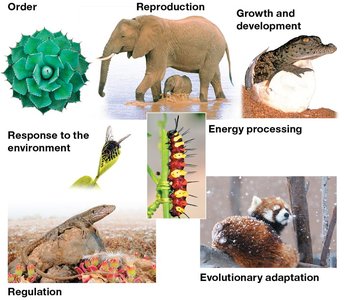
Properties of Life
Biology is the scientific study of life, encompassing a wide range of living organisms and their interactions. All living things share certain fundamental properties that distinguish them from non-living matter.
Order: Living things exhibit complex organization, from molecules to entire organisms.
Reproduction: Organisms reproduce, passing their genetic information to offspring.
Growth and Development: Organisms grow and develop according to inherited instructions.
Energy Processing: Living things obtain and use energy for metabolic activities.
Response to the Environment: Organisms respond to environmental stimuli.
Regulation: Internal conditions are regulated to maintain homeostasis.
Evolutionary Adaptation: Populations evolve over generations, adapting to their environments.
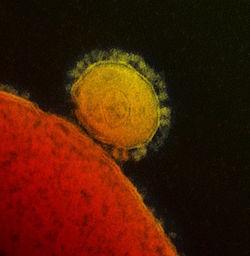
Are Viruses Alive?
Viruses occupy a unique position in biology. They possess genetic material and can evolve, but lack cellular structure and independent metabolism, raising debate about their status as living or non-living entities.
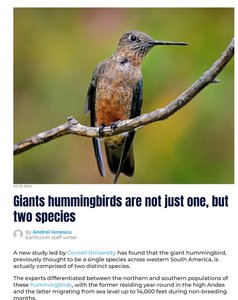
What Designates a Species?
Defining a species can be challenging. Scientists use genetic, morphological, and behavioral criteria to distinguish species, but boundaries are sometimes unclear. For example, recent studies have shown that what was once considered a single species of hummingbird is actually two distinct species.
The Diversity of Life
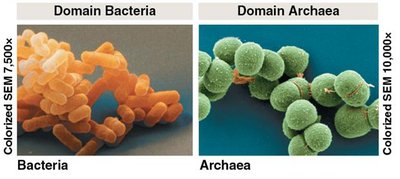
The Three Domains of Life
All life is classified into three domains: Bacteria, Archaea, and Eukarya. Each domain contains unique characteristics and evolutionary histories.
Bacteria: Prokaryotic, unicellular organisms with diverse metabolic capabilities.
Archaea: Prokaryotic, often found in extreme environments, genetically distinct from bacteria.
Eukarya: Eukaryotic organisms, including protists, plants, fungi, and animals.
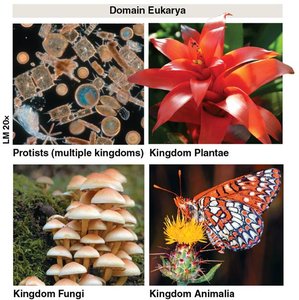
Subgroups of Eukarya
Protists: Diverse, mostly unicellular organisms.
Plantae: Multicellular, photosynthetic organisms.
Fungi: Multicellular or unicellular, decomposers.
Animalia: Multicellular, heterotrophic organisms.
Hierarchical Organization of Life
Levels of Biological Organization
Life is organized in a hierarchy, with each level exhibiting emergent properties not found at lower levels.
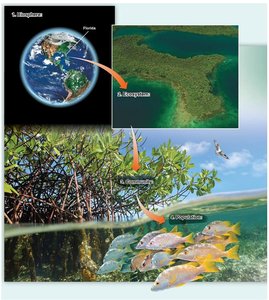
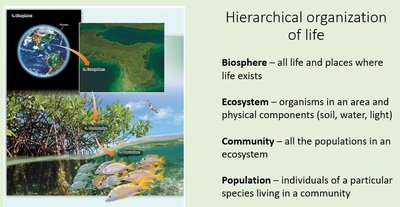
Biosphere: All life and places where life exists.
Ecosystem: Organisms in an area and their physical environment.
Community: All populations in an ecosystem.
Population: Individuals of a particular species in a community.
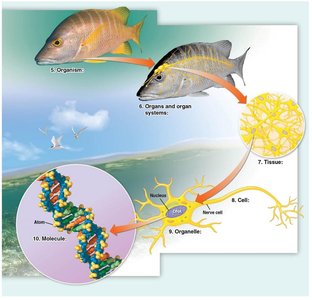
Organism: An individual living thing.
Organs/Organ Systems: Body parts performing specific functions.
Tissue: Groups of similar cells performing functions.
Cell: Basic unit of life.
Organelle: Structure within a cell.
Molecule: Chemical structure composed of atoms.
The Scientific Method
Designing Controlled Experiments
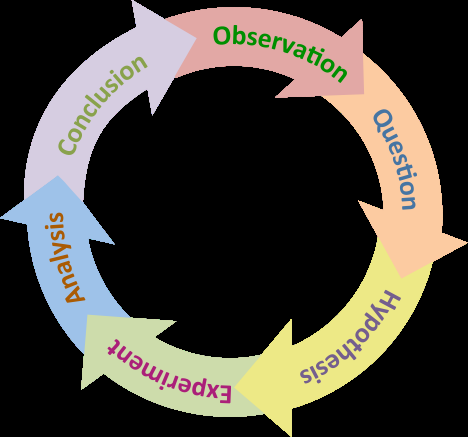
Scientists use the scientific method to generate reliable data and reach conclusions. This process involves observation, hypothesis formation, experimentation, analysis, and conclusion.
Observation: Noticing phenomena in nature.
Question: Asking why or how something occurs.
Hypothesis: Proposing a testable explanation.
Experiment: Testing the hypothesis with controlled variables.
Analysis: Interpreting data.
Conclusion: Drawing inferences based on results.
Key Terms in Experimental Design
Qualitative Data: Descriptive, non-numerical information.
Quantitative Data: Numerical measurements.
Independent Variable: The factor manipulated by the experimenter.
Dependent Variable: The factor measured in response to changes in the independent variable.
Hypothesis: A testable statement predicting an outcome.
x-axis: Typically represents the independent variable in a graph.
y-axis: Typically represents the dependent variable in a graph.
Continuous Data: Data that can take any value within a range (e.g., height).
Discrete Data: Data that can only take specific values (e.g., number of eggs).
Example: Batesian Mimicry Case Study
Batesian mimicry is a form of biological resemblance where a harmless species mimics a dangerous one to avoid predation. Scientists tested this by placing plasticine models of coral snakes (dangerous) and king snakes (harmless) in areas with and without coral snakes. The attack rate on mimics was much higher where the model species was absent, supporting the hypothesis of mimicry driven by natural selection.
Variable | Type |
|---|---|
Location (deadly species present or absent) | Independent (discrete) |
Attack rate | Dependent |
Control | Southeastern US location |
Correlation vs. Causation
Correlation means two variables are related, but it does not imply that one causes the other. Scientific studies must distinguish between mere correlation and true causation.
Evolution: The Core Theme of Biology
Evolution and Natural Selection
Evolution is the change in inherited characteristics of populations over time. Natural selection is the process by which individuals with advantageous traits survive and reproduce more successfully, leading to adaptation.
Fitness: The ability to survive and reproduce.
Adaptation: Heritable trait that increases fitness.
Four Steps of Natural Selection:
Individual variation – individuals vary in traits, many of which are heritable.
Overproduction – more offspring are produced than can survive.
Unequal reproductive success – individuals with better traits reproduce more.
Better traits over time – advantageous traits become more common.
Summary Table: Domains and Kingdoms of Life
Domain | Kingdoms/Subgroups | Characteristics |
|---|---|---|
Bacteria | Bacteria | Prokaryotic, unicellular |
Archaea | Archaea | Prokaryotic, often extremophiles |
Eukarya | Protists, Plantae, Fungi, Animalia | Eukaryotic, multicellular or unicellular |
Additional info:
Scientific validity is determined by reproducibility, peer review, and logical reasoning.
Graphs: Bar graphs are used for discrete data; line graphs for continuous data.
Evolution explains both the unity (shared traits) and diversity (adaptations) of life.
