 Back
BackChapter 1: Biology – Exploring Life (Big Ideas and Foundations)
Study Guide - Smart Notes
 Tailored notes based on your materials, expanded with key definitions, examples, and context.
Biology: The Scientific Study of Life
Introduction to Biology
Biology is the scientific study of life, encompassing the vast diversity of living organisms and the hierarchical organization that characterizes all life forms. Biologists seek to understand the properties that define life and the processes that sustain it.
Definition: Biology investigates the structure, function, growth, origin, evolution, and distribution of living organisms.
Scope: Ranges from molecules and cells to entire ecosystems and the biosphere.
Properties of Life
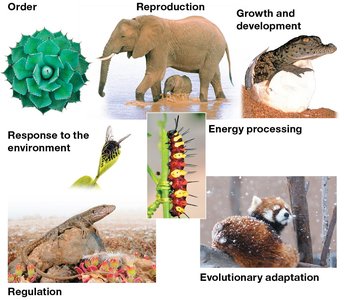
All living organisms share a set of fundamental properties that distinguish them from nonliving matter. These properties are essential for the maintenance and perpetuation of life.
Order: Life is characterized by highly ordered structures.
Reproduction: Organisms reproduce their own kind.
Growth and Development: Inherited information encoded in DNA controls the pattern of growth and development.
Energy Processing: Organisms take in energy and use it to power their activities.
Regulation: Organisms have regulatory mechanisms that maintain a stable internal environment (homeostasis).
Response to the Environment: All organisms respond to environmental stimuli.
Evolutionary Adaptation: Adaptations evolve over generations as individuals with heritable traits best suited to their environments have greater reproductive success.
The Diversity and Classification of Life
The Three Domains of Life
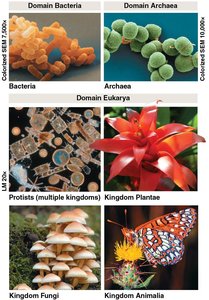
Biologists classify the diversity of life into three domains based on cellular organization and genetic relationships. This classification reflects evolutionary relationships among organisms.
Domain Bacteria: Composed of prokaryotic cells, these organisms are widespread and diverse.
Domain Archaea: Also prokaryotic, archaea often inhabit extreme environments and have unique biochemical characteristics.
Domain Eukarya: Includes all eukaryotic organisms, such as protists, fungi, plants, and animals.
Taxonomic Hierarchy
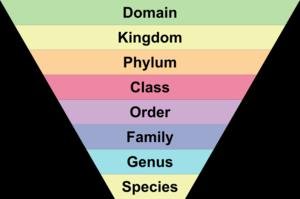
Taxonomy is the science of naming, defining, and classifying organisms into groups based on shared characteristics. The hierarchy reflects evolutionary relationships and organizes biological diversity.
Level | Example (Human) |
|---|---|
Domain | Eukarya |
Kingdom | Animalia |
Phylum | Chordata |
Class | Mammalia |
Order | Primates |
Family | Hominidae |
Genus | Homo |
Species | sapiens |
Life’s Hierarchy of Organization
Emergent Properties and Levels of Organization
Biologists study life across a hierarchy of structural levels, from molecules to the biosphere. At each level, new properties emerge that are not present at the preceding level, known as emergent properties.
Biosphere: All life on Earth and the places where life exists.
Ecosystem: All organisms in a particular area and the physical environment.
Community: All organisms in an ecosystem.
Population: All individuals of a species in a community.
Organism: An individual living thing.
Organ System: Several organs working together for a specific function.
Organ: Body parts that perform a specific function.
Tissue: Groups of similar cells performing a specific function.
Cell: The fundamental unit of life.
Organelle: Membrane-enclosed functional structures within cells.
Molecule: Chemical structure consisting of two or more atoms.
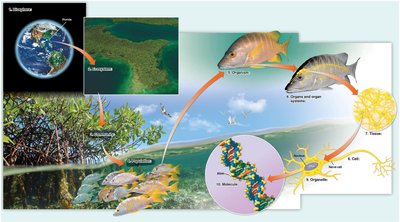
The Process of Science
What Is Science?
Science is a systematic approach to understanding the natural world through observation, hypothesis formation, experimentation, and analysis. It relies on evidence and logical reasoning.
Scientific Method: Involves making observations, forming hypotheses, making predictions, conducting experiments, and analyzing data.
Scientific Theory: A broad explanation supported by a large body of evidence.
Controlled Experiments
Controlled experiments are designed to test hypotheses by manipulating one variable (independent variable) and observing the effect on another variable (dependent variable), while keeping other factors constant.
Experimental Group: Receives the variable being tested.
Control Group: Does not receive the variable; serves as a baseline for comparison.
Example: Camouflage experiment with mice models in different habitats to test predation rates.
Habitat | Attacks on Camouflaged Models | Attacks on Noncamouflaged Models | % Attacks on Noncamouflaged Models |
|---|---|---|---|
Beach (light habitat) | 2 | 5 | 71% |
Inland (dark habitat) | 5 | 16 | 76% |
Additional info: Quantitative data refers to numerical measurements, while qualitative data refers to descriptive observations.
Scientific Thinking and Collaboration
The process of science is iterative, nonlinear, and collaborative. It involves exploration, feedback from the scientific community, and consideration of societal impacts.
Exploration and Discovery: Observing and asking questions about the natural world.
Analysis and Feedback: Peer review and replication of results.
Societal Benefits: Application of scientific knowledge to solve real-world problems.
Five Unifying Themes in Biology
1. Evolution: The Core Theme of Biology
Evolution explains both the unity and diversity of life. It is the process by which species change over time through mechanisms such as natural selection.
Natural Selection: Individuals with advantageous traits are more likely to survive and reproduce, passing those traits to future generations.
Tree of Life: All species are related through common ancestry, forming a branching tree of evolutionary relationships.
Applications: Evolutionary theory informs medicine, conservation, and agriculture.
2. Life Depends on the Flow of Information
Biological processes depend on the storage, transmission, and use of information. DNA is the molecule of heredity, encoding instructions for building and regulating organisms.
Gene Expression: The process by which information from a gene is used to synthesize functional gene products (proteins).
Regulation: Organisms respond to internal and external signals to regulate gene expression and maintain homeostasis.
3. Structure and Function Are Related
At every level of biological organization, the structure of a component is closely related to its function. This relationship is fundamental to understanding how organisms work.
Example: The shape of hemoglobin enables it to transport oxygen; the long extensions of nerve cells facilitate signal transmission.
4. Life Depends on the Transfer and Transformation of Energy and Matter
All living organisms require energy and matter to grow, develop, and maintain their structures. Energy flows through ecosystems, while matter cycles among living and nonliving components.
Energy Flow: Sunlight is converted to chemical energy by producers, transferred to consumers, and lost as heat.
Matter Cycling: Elements cycle through the ecosystem via producers, consumers, and decomposers.
5. Life Depends on Interactions Within and Between Systems
Biological systems are composed of interacting parts. The study of these interactions, known as systems biology, helps scientists understand complex behaviors and emergent properties.
Emergent Properties: New characteristics arise from the interactions of system components.
Systems Biology: Analyzes the interactions among parts of biological systems to model their behavior.
Biology, Technology, and Society
Connections and Applications
Science aims to understand natural phenomena, while technology applies scientific knowledge for practical purposes. Advances in one field often drive progress in the other, impacting society in significant ways.
Examples: Medical technologies, agricultural improvements, and environmental conservation all rely on biological research.
