 Back
Chapter 1: Biology – Exploring Life (Campbell Biology: Concepts & Connections, 10th Edition)
Study Guide - Smart Notes
 Tailored notes based on your materials, expanded with key definitions, examples, and context.
Biology: Exploring Life
Introduction to Biology
Biology is the scientific study of life, encompassing the structure, function, growth, origin, evolution, and distribution of living organisms. The field seeks to understand the diversity and unity of life, as well as the processes that sustain it.
Biology investigates living systems from molecules to the biosphere.
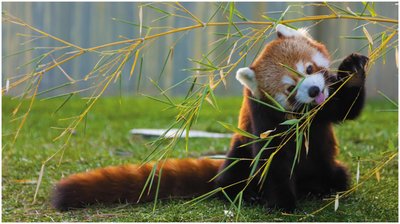
Organisms, such as the red panda (Ailurus fulgens), are adapted to their environments through unique structural and functional traits.
Big Ideas in Biology
Biology is organized around several unifying themes that help explain the complexity of life:
Cellular Basis of Life
Information and Heredity
Matter and Energy
Growth, Development, and Reproduction
Homeostasis
Evolution
Structure and Function
Unity and Diversity of Life
Interdependence in Nature
Science as a Way of Knowing
1.1 Biology is the Scientific Study of Life
Properties of Life
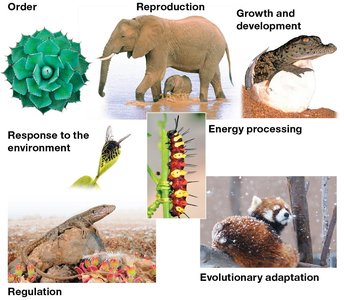
All living things share a set of common characteristics, often summarized by the acronym R.A.R.E.H.O.G.:
Order: Highly ordered structure, such as cells and tissues.
Reproduction: Ability to produce offspring.
Growth and Development: Organisms grow and develop according to genetic instructions.
Energy Processing: Use of energy to power activities (e.g., metabolism).
Regulation (Homeostasis): Maintenance of stable internal conditions.
Response to the Environment: Ability to sense and react to stimuli.
Evolutionary Adaptation: Populations evolve over generations to adapt to their environment.
What is Alive?
Determining if something is alive can be challenging. For example, corals are living organisms, while crystals are not, despite their ordered structure. Viruses are not considered alive because they cannot reproduce independently or carry out metabolism.
1.2 The Diversity of Life: Three Domains
Classification of Life
Taxonomists classify organisms into three domains based on cellular organization and genetics:
Domain Bacteria: Prokaryotic, unicellular organisms with simple cells.
Domain Archaea: Prokaryotic, often found in extreme environments, genetically distinct from bacteria.
Domain Eukarya: Eukaryotic organisms, including protists, fungi, plants, and animals.
Humans belong to the Domain Eukarya.
1.3 Life’s Hierarchy of Organization
Levels of Biological Organization
Biologists study life at multiple levels, each with emergent properties resulting from the arrangement and interaction of parts:
Biosphere: All environments on Earth that support life.
Ecosystem: All living and nonliving components in a particular area.
Community: All organisms in an ecosystem.
Population: Individuals of one species in a specific area.
Organism: An individual living thing.
Organ System: Group of organs working together.
Organ: Structure composed of tissues with specific functions.
Tissue: Group of similar cells performing a function.
Cell: Basic unit of life.
Organelle: Functional components within cells.
Molecule: Chemical structure consisting of atoms.
Emergent properties arise at each level due to the arrangement and interactions of parts.
The Process of Science
What Is Science?
Science is an evidence-based approach to understanding the natural world. It involves:
Making observations
Formulating hypotheses
Making predictions
Testing hypotheses through experiments or further observations
Analyzing data
A scientific theory is a broad explanation supported by a large body of evidence. Scientific laws describe universal phenomena (e.g., gravity).
Controlled Experiments
In a controlled experiment, researchers manipulate one variable (independent variable) and measure its effect on another (dependent variable). A control group is used for comparison.
Independent variable: The factor manipulated by the researcher.
Dependent variable: The factor measured in response to changes in the independent variable.
Example: Francesco Redi’s experiment on spontaneous generation used covered and uncovered meat to test if maggots arose spontaneously.
Data Types
Quantitative data: Numerical measurements.
Qualitative data: Descriptive observations.
Table: Results from Camouflage Experiment
This table compares predation rates on camouflaged and non-camouflaged mouse models in different habitats.
Habitat | Number of Attacks on Camouflaged Models | Number of Attacks on Noncamouflaged Models | % Attacks on Noncamouflaged Models |
|---|---|---|---|
Beach (light habitat) | 2 | 5 | 71% |
Inland (dark habitat) | 5 | 16 | 76% |
Additional info: This experiment demonstrates the selective advantage of camouflage in reducing predation.
1.6–1.7: Scientific Thinking and Collaboration
Testing Hypotheses with Observational Data
Not all hypotheses can be tested experimentally; some require observational data, such as DNA sequence comparisons to determine evolutionary relationships.
The Scientific Process
Science is repetitive, nonlinear, and collaborative. It involves exploration, feedback from the scientific community, and societal applications. Hypothesis testing is central to scientific progress.
1.8: Biology, Technology, and Society
Science aims to understand natural phenomena, while technology applies scientific knowledge for practical purposes. Both fields are interdependent, with advances in one often driving progress in the other.
1.9: Evolution – The Core Theme of Biology
Unity and Diversity of Life
Evolution explains both the unity and diversity of life. Charles Darwin’s theory of natural selection describes how species change over time, leading to adaptation and speciation.
Each species has a unique evolutionary history.
Natural selection results in unequal reproductive success, driving adaptation.
Applications of Evolutionary Theory
Evolutionary principles are applied in medicine, agriculture, and conservation. Humans influence evolution through artificial selection (selective breeding) and natural selection (environmental pressures).
1.11: Life Depends on the Flow of Information
Genetic information, primarily in the form of DNA, directs the structure and function of living organisms. Information from the environment also regulates biological processes and gene expression.
1.12: Structure and Function Are Related
Biological structures are closely related to their functions at all levels of organization. For example, the shape of hemoglobin enables oxygen transport, and the structure of nerve cells facilitates signal transmission.
1.13: Life Depends on the Transfer and Transformation of Energy and Matter
Energy flows through ecosystems, entering as sunlight, converted to chemical energy by producers, transferred to consumers, and lost as heat. Matter cycles between the environment and living organisms.
1.14: Life Depends on Interactions Within and Between Systems
Emergent properties arise from interactions among system components. Systems biology models these interactions to understand complex biological systems.
Summary Table: Seven Properties of Life (RAREHOG)
Property | Description |
|---|---|
Order | Highly organized structure |
Reproduction | Ability to produce offspring |
Growth & Development | Increase in size and complexity |
Energy Processing | Acquisition and use of energy |
Regulation (Homeostasis) | Maintenance of internal stability |
Response to Environment | Ability to sense and react to stimuli |
Evolutionary Adaptation | Change over generations for survival |
Key Terms and Concepts
Emergent Properties: New characteristics that arise at each level of organization due to interactions among components.
Hypothesis: A tentative, testable explanation for an observation.
Scientific Theory: A well-supported, broad explanation for a range of phenomena.
Artificial Selection: Human-driven selection of desirable traits in organisms.
Natural Selection: Differential survival and reproduction due to environmental pressures.
