 Back
BackChapter 1: Biology – Exploring Life (Campbell Biology, 10th Edition)
Study Guide - Smart Notes
 Tailored notes based on your materials, expanded with key definitions, examples, and context.
Biology: The Scientific Study of Life
Introduction to Biology
Biology is the scientific study of life, encompassing the diversity of living organisms and the hierarchy of their organization. Life is defined by a set of properties shared by all living things, and biologists seek to understand these properties through observation, experimentation, and analysis.
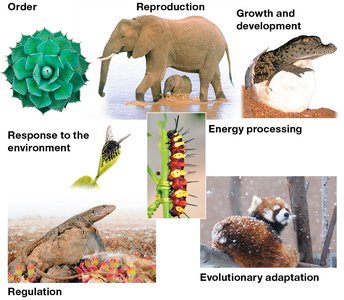
Order: Living organisms exhibit highly ordered structures.
Reproduction: Organisms reproduce their own kind, ensuring the continuation of their species.
Growth and Development: Inherited information encoded in DNA controls the pattern of growth and development.
Energy Processing: Organisms obtain and use energy to power their activities.
Regulation: Organisms maintain a stable internal environment through regulatory mechanisms (homeostasis).
Response to the Environment: All organisms respond to environmental stimuli.
Evolutionary Adaptation: Populations evolve over generations as individuals with advantageous traits have greater reproductive success.
The Diversity and Classification of Life
The Three Domains of Life
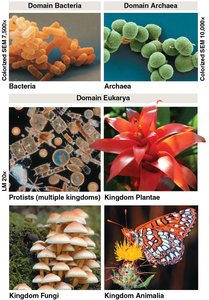
Taxonomists classify living organisms into three domains based on cellular organization and genetic relationships:
Domain Bacteria: Prokaryotic, unicellular organisms with simple cells.
Domain Archaea: Prokaryotic, unicellular organisms often found in extreme environments; genetically distinct from bacteria.
Domain Eukarya: Organisms with eukaryotic cells, including protists, fungi, plants, and animals.
Taxonomic Hierarchy
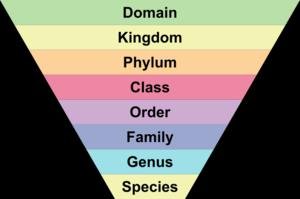
Organisms are further classified into a hierarchy of categories: Domain, Kingdom, Phylum, Class, Order, Family, Genus, and Species. This system reflects evolutionary relationships and allows scientists to organize the diversity of life.
Life’s Hierarchy of Organization
Emergent Properties and Levels of Biological Organization
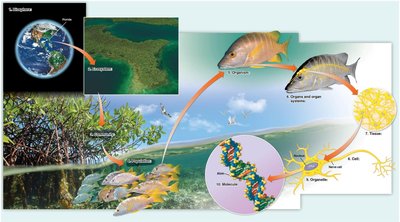
Biologists study life at multiple levels, from molecules to the biosphere. At each level, new properties emerge due to the arrangement and interactions of parts. These are called emergent properties.
Biosphere: All life on Earth and the places where life exists.
Ecosystem: All organisms in a particular area and the physical environment.
Community: All organisms in an ecosystem.
Population: All individuals of a species in a community.
Organism: An individual living thing.
Organ System: Several organs working together for a specific function.
Organ: Body part with a specific function.
Tissue: Group of similar cells performing a function.
Cell: Fundamental unit of life.
Organelle: Functional structure within a cell.
Molecule: Chemical structure consisting of atoms.
The Process of Science
What Is Science?
Science is a systematic approach to understanding the natural world through observation, hypothesis formation, experimentation, and analysis. Scientific knowledge is evidence-based and subject to revision as new data emerge.
Observation: Gathering data about phenomena.
Hypothesis: A testable explanation for an observation.
Prediction: A logical outcome expected if the hypothesis is correct.
Experiment: Testing the hypothesis by manipulating variables and collecting data.
Analysis: Interpreting data to support or refute the hypothesis.
Theory: A broad explanation supported by extensive evidence.
Controlled Experiments
Controlled experiments manipulate one variable (independent variable) to observe its effect on another (dependent variable), while keeping other factors constant. Control groups provide a baseline for comparison.
Habitat | Number of Attacks on Camouflaged Models | Number of Attacks on Noncamouflaged Models | % Attacks on Noncamouflaged Models |
|---|---|---|---|
Beach (light habitat) | 2 | 5 | 71% |
Inland (dark habitat) | 5 | 16 | 76% |
Additional info: This table demonstrates how camouflage affects predation rates in different habitats, illustrating the importance of experimental design in testing hypotheses.
Scientific Thinking and Collaboration
The process of science is iterative, nonlinear, and collaborative. It involves exploration, feedback from the scientific community, and consideration of societal impacts.
Five Unifying Themes in Biology
1. Evolution: The Core Theme of Biology
Evolution explains both the unity and diversity of life. Charles Darwin's theory of natural selection describes how heritable traits that enhance survival and reproduction become more common in populations over generations.
Natural Selection: Differential survival and reproduction of individuals due to differences in phenotype.
Artificial Selection: Human-directed breeding for desirable traits in plants and animals.
2. Life Depends on the Flow of Information
Genetic information encoded in DNA is transmitted from one generation to the next and directs cellular activities. Organisms also process information from their environment to regulate internal processes and gene expression.
3. Structure and Function Are Related
At all levels of biology, the structure of a biological component is closely related to its function. For example, the shape of a protein determines its role in the cell, and the structure of nerve cells enables them to transmit signals efficiently.
4. Life Depends on the Transfer and Transformation of Energy and Matter
Energy flows through ecosystems, entering as sunlight, converted to chemical energy by producers, transferred to consumers, and eventually lost as heat. Matter cycles between the living and nonliving components of ecosystems.
5. Life Depends on Interactions Within and Between Systems
Biological systems are interconnected, and emergent properties arise from the interactions of their parts. Systems biology seeks to understand these complex interactions at multiple levels of organization.
Summary Table: Properties of Life
Property | Description | Example |
|---|---|---|
Order | Highly ordered structure | Plant leaf arrangement |
Reproduction | Ability to produce offspring | Elephants giving birth |
Growth and Development | Increase in size and complexity | Embryo development |
Energy Processing | Acquiring and using energy | Caterpillar eating leaves |
Regulation | Maintaining internal balance | Lizard basking for temperature regulation |
Response to Environment | Reacting to stimuli | Venus flytrap closing on prey |
Evolutionary Adaptation | Inherited traits that enhance survival | Red panda's fur for cold climates |
