 Back
BackChapter 1: Biology – The Scientific Study of Life
Study Guide - Smart Notes
 Tailored notes based on your materials, expanded with key definitions, examples, and context.
Biology: The Scientific Study of Life
Defining Biology and Life
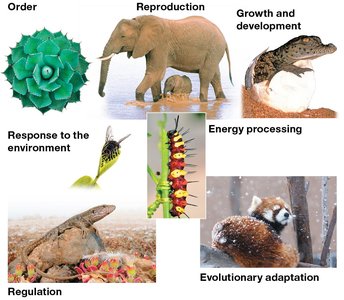
Biology is the scientific study of life, encompassing a vast diversity of organisms and a hierarchy of organization. Life is defined by a set of properties common to all living organisms, including order, reproduction, growth and development, energy processing, regulation, response to the environment, and evolutionary adaptation. The cell is recognized as the fundamental structural and functional unit of life.
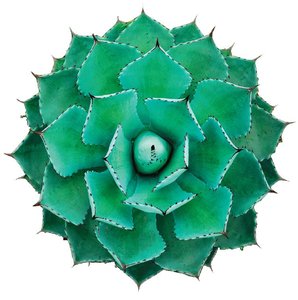
Order: Life is characterized by highly ordered structures, such as the arrangement of cells and tissues in organisms.
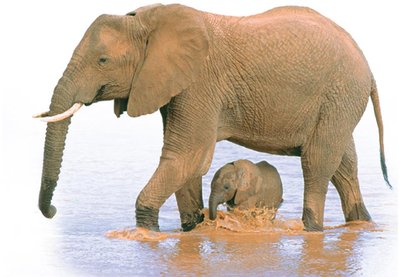
Reproduction: Organisms reproduce their own kind, ensuring the continuation of species.
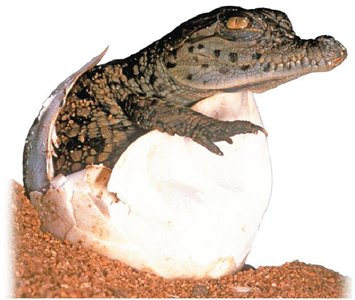
Growth and Development: Inherited information encoded in DNA controls the pattern of growth and development.
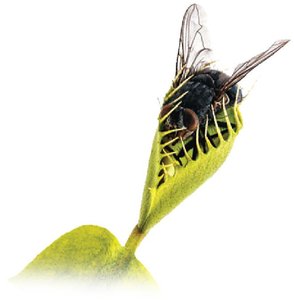
Response to the Environment: All organisms respond to environmental stimuli.
Energy Processing: Organisms take in energy and use it to power their activities.
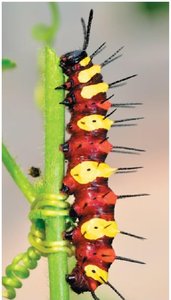
Regulation: Organisms have regulatory mechanisms that maintain a beneficial internal environment.
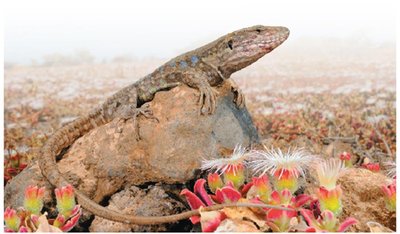
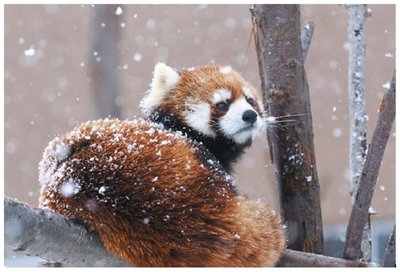
Evolutionary Adaptation: Adaptations evolve over generations as individuals with heritable traits best suited to their environments have greater reproductive success.
Biological Diversity and Classification
The Three Domains of Life
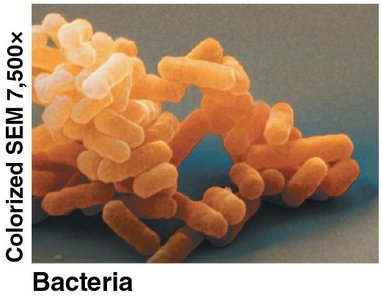
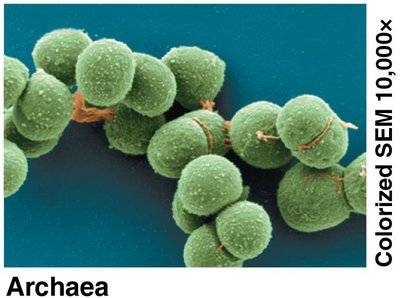
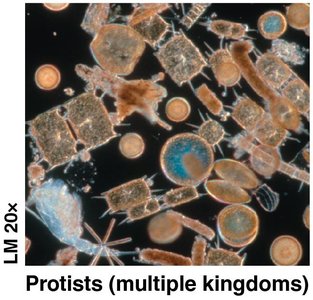
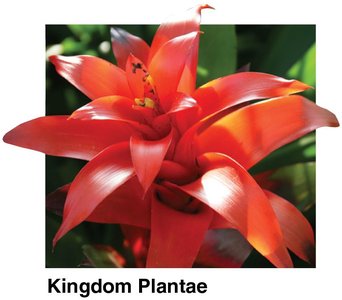
Taxonomists classify species into broader groups, and biologists organize life into three domains: Bacteria, Archaea, and Eukarya. Domains Bacteria and Archaea contain organisms with simple cells, while Domain Eukarya includes protists and the kingdoms Fungi, Plantae, and Animalia.
Domain | Example |
|---|---|
Bacteria |
|
Archaea |
|
Eukarya |
|
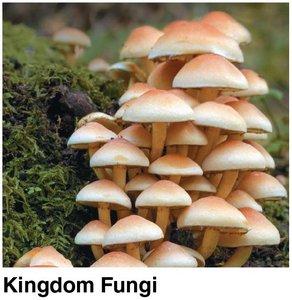
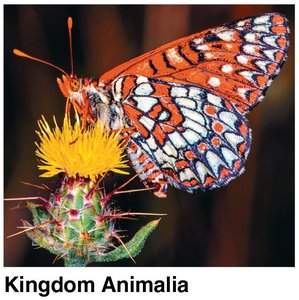
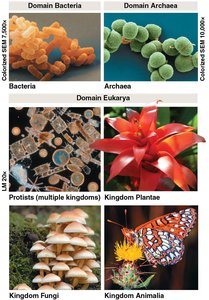
Taxonomic Hierarchy
Biological classification follows a hierarchical structure: Domain, Kingdom, Phylum, Class, Order, Family, Genus, Species. This system helps organize the vast diversity of life.
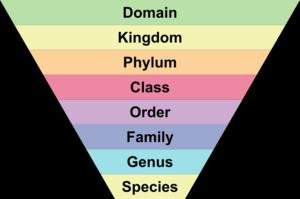
Life’s Hierarchy of Organization and Emergent Properties
Levels of Biological Organization
Biologists study life across a broad range of scales, from molecules to the entire biosphere. Each level of organization exhibits emergent properties, which arise from the arrangement and interactions of component parts.
Biosphere: All life on Earth and the places where life exists.
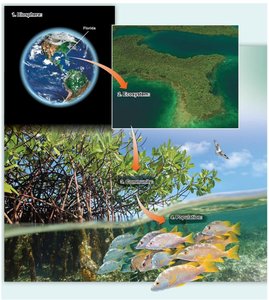
Ecosystem: All organisms in a particular area, plus physical components like soil, water, and light.
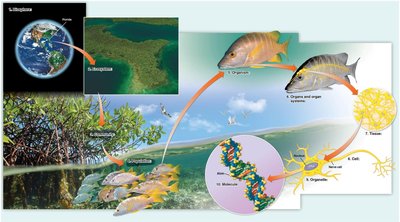
Community: All organisms in an ecosystem.
Population: All individuals of a species in a community.
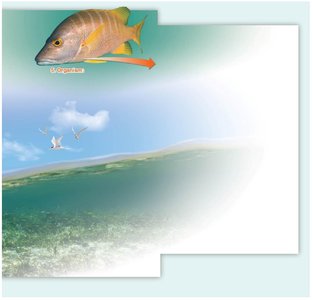
Organism: An individual living thing.
Organ System: Body parts that perform a specific function.
Organ: Several organs may cooperate in an organ system.
Tissue: A group of similar cells performing a specific function.
Cell: The fundamental structural and functional unit of life.
Organelle: A membrane-enclosed functional structure in a cell.
Molecule: A chemical structure consisting of two or more atoms.
The Process of Science
Scientific Inquiry and Hypothesis Testing
Science is an evidence-based process of inquiry. The scientific method involves making observations, forming hypotheses, making predictions, testing hypotheses through experiments or additional observations, and analyzing data. A scientific theory is broad in scope and supported by a large body of evidence.
Observation: Gathering qualitative or quantitative data.
Hypothesis: A proposed explanation for an observation.
Prediction: A statement about what will happen if the hypothesis is correct.
Experiment: Testing the hypothesis by manipulating variables.
Analysis: Interpreting the results to support or refute the hypothesis.
Controlled Experiments
In controlled experiments, researchers manipulate one component (the independent variable) and observe the effects on another (the dependent variable). Experimental groups are compared with control groups to demonstrate the effect of a single variable.
Habitat | Number of Attacks on Camouflaged Models | Number of Attacks on Noncamouflaged Models | % Attacks on Noncamouflaged Models |
|---|---|---|---|
Beach (light habitat) | 2 | 5 | 71% |
Inland (dark habitat) | 5 | 16 | 76% |
Five Unifying Themes in Biology
Theme 1: Evolution
Evolution is the core theme of biology, explaining both the unity and diversity of life. Darwin's theory of evolution by natural selection describes how species change over time, with each species representing a twig on the tree of life.
Natural Selection: Individuals with traits best suited to their environment are more likely to survive and reproduce.
Artificial Selection: Humans selectively breed plants and animals, acting as agents of evolution.
Theme 2: Information Flow
Life depends on the transmission and use of information. DNA is responsible for heredity and programming cellular activities by providing the blueprint for proteins. Information from the environment regulates body processes and gene expression.
Gene Expression: The process by which information from a gene is used to synthesize a functional gene product, often a protein.
Theme 3: Structure and Function
Structure and function are related at every level of life. For example, the structure of hemoglobin enables it to transport oxygen, and the long extensions of nerve cells allow them to transmit impulses efficiently.
Theme 4: Energy and Matter
Life depends on the transfer and transformation of energy and matter. Energy flows through ecosystems, entering as sunlight, converted to chemical energy by producers, passed to consumers, and exiting as heat. Matter cycles through the atmosphere, soil, producers, consumers, and decomposers.
Theme 5: Interactions Within and Between Systems
Emergent properties result from interactions between components of biological systems. Systems biology models the behavior of biological systems by analyzing these interactions, from molecules and cells to the global biosphere.
Summary Table: Properties of Life
Property | Description | Example |
|---|---|---|
Order | Highly ordered structures |
|
Reproduction | Organisms reproduce their own kind |
|
Growth and Development | DNA controls growth and development |
|
Response to Environment | Respond to environmental stimuli |
|
Energy Processing | Take in and use energy |
|
Regulation | Maintain internal environment |
|
Evolutionary Adaptation | Adaptations evolve over generations |
|
