 Back
BackChapter 1: Biology – The Study of Life
Study Guide - Smart Notes
 Tailored notes based on your materials, expanded with key definitions, examples, and context.
Biology: The Study of Life
1.1 The Characteristics of Life
Biology is the scientific study of life, encompassing the diversity and unity of living organisms. All living things share certain fundamental characteristics that distinguish them from nonliving matter.
Living things are composed of the same chemical elements as nonliving things and obey the same physical and chemical laws.
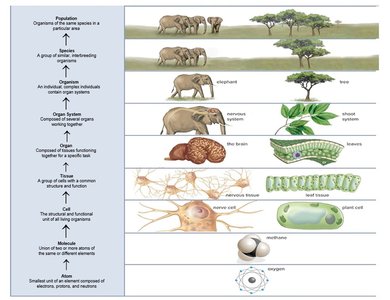
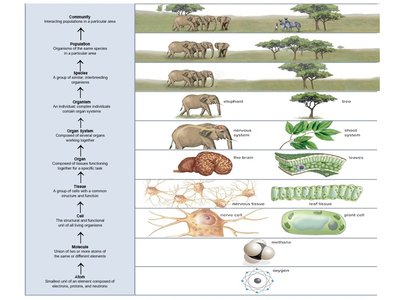
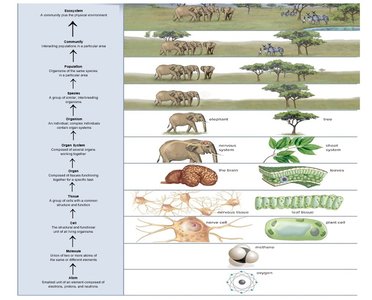
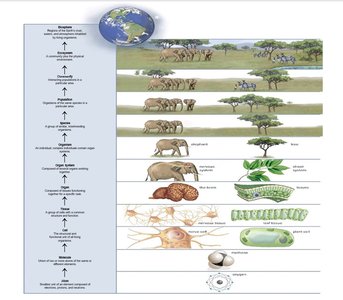
Life is organized into hierarchical levels, from atoms to the biosphere. Each level exhibits emergent properties not present at lower levels.
The cell is the basic unit of structure and function in all living things. Organisms may be unicellular or multicellular.
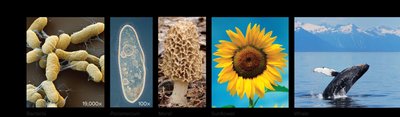
Levels of Biological Organization
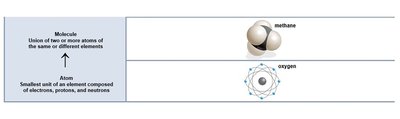
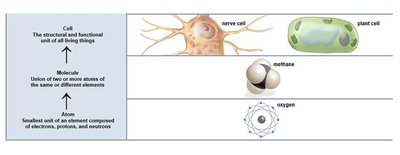
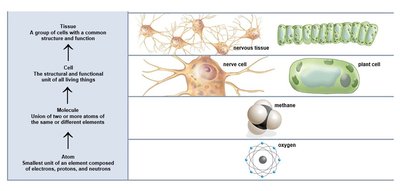
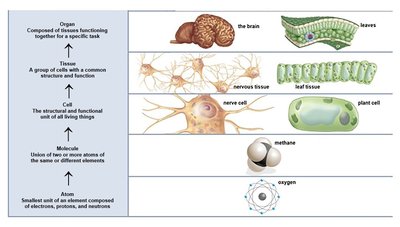
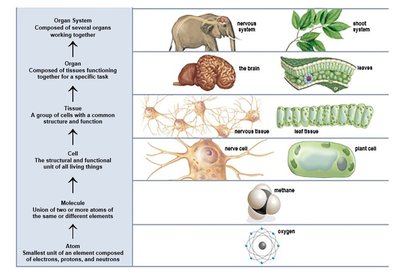
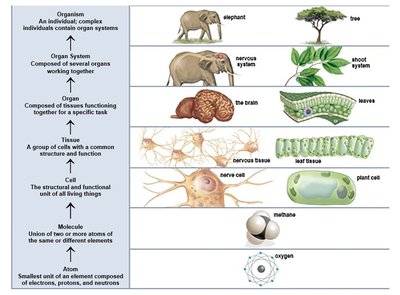
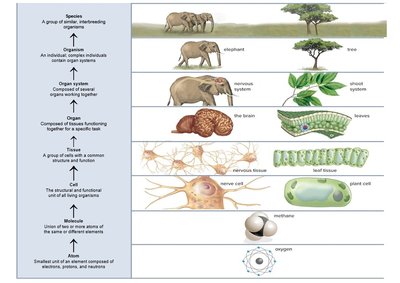
Atoms: Smallest unit of an element, composed of electrons, protons, and neutrons.
Molecules: Union of two or more atoms of the same or different elements.
Cells: The structural and functional unit of all living things.
Tissues: Groups of cells with a common structure and function.
Organs: Composed of tissues functioning together for a specific task.
Organ Systems: Composed of several organs working together.
Organisms: Individual living beings.
Species: Groups of similar, interbreeding organisms.
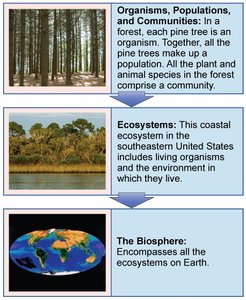
Populations: Organisms of the same species in a particular area.
Communities: Interacting populations in a particular area.
Ecosystems: Communities plus the physical environment.
Biosphere: All regions of the Earth's crust, waters, and atmosphere inhabited by living things.
How the Biosphere Is Organized
Biosphere: The zone of air, land, and water where organisms exist.
Ecosystem: A community plus its physical environment.
Community: Interacting populations within the same environment.
Population: All members of a species within an area.
Species: Group of similar, interbreeding organisms.
Life Requires Materials and Energy
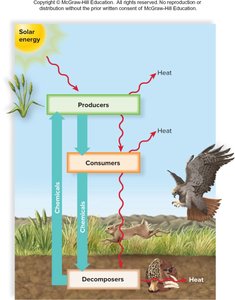
Energy is the capacity to do work and is required to maintain organization and conduct life-sustaining processes. Metabolism encompasses all chemical reactions in a cell. The sun is the ultimate energy source for most life on Earth, with plants, algae, and some bacteria capturing solar energy through photosynthesis.
Photosynthesis: Converts solar energy into chemical energy of carbohydrates.
Metabolism: All chemical reactions in a cell.
Ecosystems: Chemical Cycling and Energy Flow
Chemicals cycle between living and nonliving components.
Energy flows from the sun through producers, consumers, and decomposers, with heat lost at each step.
Living Organisms Maintain Homeostasis and Respond to Their Environment
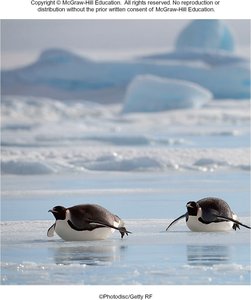
Homeostasis is the maintenance of internal conditions within certain boundaries. Organisms use feedback systems to monitor and adjust internal conditions. They also interact with and respond to environmental changes, often resulting in movement.
Living Organisms Reproduce and Develop
Reproduction is essential for the maintenance of populations.
Genetic information (genes) is passed to the next generation via DNA.
Development includes all changes from conception to death.
Living Organisms Have Adaptations
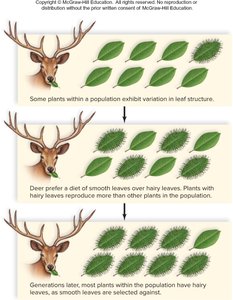
Adaptation: Any modification that makes an organism better suited to its environment.
Evolution: Change in a population over time, leading to increased adaptation.
1.2 Evolution and the Classification of Life
Theory of Evolution
The theory of evolution explains both the diversity and unity of life, proposing that all living things descended from a common ancestor through descent with modification.
Natural Selection: The mechanism of evolution proposed by Charles Darwin. Individuals with favorable traits are more likely to survive and reproduce, increasing the frequency of those traits in the population.
Mutations: Random changes in DNA that introduce variation, fueling natural selection.
Evolutionary Tree of Life
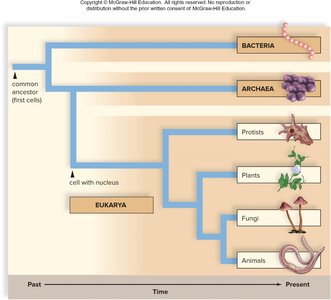
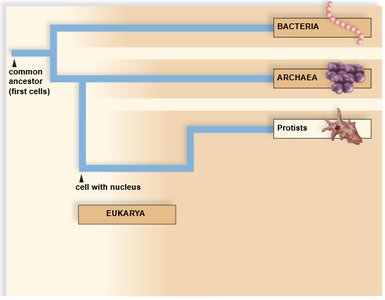
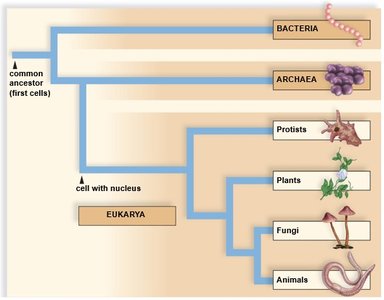
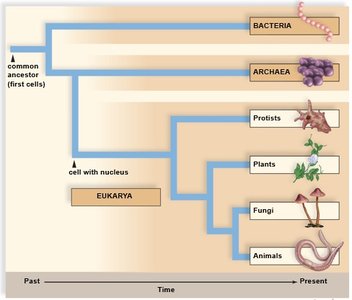
An evolutionary tree traces the ancestry of life on Earth to a common ancestor, illustrating relationships among domains and kingdoms.
Organizing Diversity: Taxonomy and Systematics
Taxonomy is the discipline of identifying, naming, and classifying organisms. Systematics studies evolutionary relationships. Classification categories, from least to most inclusive, are: species, genus, family, order, class, phylum, kingdom, supergroup, and domain.
Category | Human | Corn |
|---|---|---|
Domain | Eukarya | Eukarya |
Supergroup | Opisthokonta | Archaeplastids |
Kingdom | Animalia | Plantae |
Phylum | Chordata | Anthophyta |
Class | Mammalia | Monocotyledones |
Order | Primates | Commelinales |
Family | Hominidae | Poaceae |
Genus | Homo | Zea |
Species | H. sapiens | Z. mays |
Domains of Life
Domain Archaea: Unicellular prokaryotes living in extreme environments; lack a membrane-bound nucleus.
Domain Bacteria: Unicellular prokaryotes found in diverse environments; lack a membrane-bound nucleus.
Domain Eukarya: Unicellular and multicellular organisms with a membrane-bound nucleus.
Kingdoms of Eukarya
Protista: Algae, protozoans, slime molds, water molds; mostly unicellular or simple multicellular.
Fungi: Molds, mushrooms, yeasts; mostly multicellular, absorb food.
Plantae: Algae, mosses, ferns, conifers, flowering plants; multicellular, photosynthesize food.
Animalia: Sponges, worms, insects, fishes, amphibians, reptiles, birds, mammals; multicellular, ingest food.
Eukaryotic Supergroups
Supergroup | Sample Organisms |
|---|---|
Excavata | Diplomonads, euglenozoans |
Chromalveolata | Dinoflagellates, ciliates, diatoms, golden algae, brown algae, water molds |
Rhizaria | Foraminiferans, radiolarians |
Archaeplastida | Red algae, green algae, land plants |
Amoebozoa | Amoeboids, slime molds |
Opisthokonta | Fungi, choanoflagellates, animals |
Scientific Names
Universal, Latin-based, binomial nomenclature.
First word: genus (capitalized); second word: species (lowercase); both italicized.
Examples: Homo sapiens (humans), Zea mays (corn).
1.3 The Process of Science
The Scientific Method
The scientific method is a systematic approach to gaining new knowledge through research. It involves the following steps:
Observation: Gathering information about phenomena.
Hypothesis: Formulating a tentative explanation.
Predictions and Experiments: Designing and conducting experiments to test the hypothesis.
Data Collection and Statistical Analysis: Gathering and analyzing results.
Results and Conclusion: Interpreting data to support or reject the hypothesis.
Experimental Design
Experimental variable: The factor being tested.
Test group: Exposed to the experimental variable.
Control group: Not exposed to the experimental variable.
Data: Results should be observable and objective, often presented in tables or graphs.
Statistical Analysis
Standard error: Indicates how far off the average the data are.
Statistical significance: Probability value (p); p < 0.05 is considered significant.
Conclusions and Peer Review
Data are interpreted to determine if the hypothesis is supported.
Findings are published and reviewed by peers; other scientists attempt to replicate results.
Scientific Theory vs. Law
Scientific Theory: Concepts joining together well-supported hypotheses, supported by extensive evidence.
Scientific Principle/Law: Widely accepted set of theories with no serious challenges to validity.
Basic Theories of Biology
Theory | Concept |
|---|---|
Cell | All organisms are composed of cells; new cells come from preexisting cells. |
Homeostasis | Internal environment remains relatively constant. |
Evolution | All living organisms have a common ancestor, but each is adapted to a particular way of life. |
1.4 Science and the Challenges Facing Society
Science and Technology
Science: Systematic way of acquiring knowledge about the natural world.
Technology: Application of scientific knowledge to human interests (e.g., cell phones, new drugs).
Climate Change
Refers to changes in Earth's climate cycles due to human activities, primarily from increased carbon emissions (burning fossil fuels, deforestation).
Results in global warming and altered ecosystems.
Biodiversity and Habitat Loss
Biodiversity: Total number and relative abundance of species, genetic variability, and ecosystem diversity.
Extinction: Loss of species due to human activities, especially in tropical rain forests and coral reefs.
Emerging Diseases
New diseases arise from increased exposure to animals, changes in behavior, technology, globalization, and pathogen mutation.
Examples: H5N1, H7N9, SARS, MERS, SARS-CoV-2.
