 Back
BackChapter 1: Biology – The Study of Life (Mini-Textbook Study Notes)
Study Guide - Smart Notes
 Tailored notes based on your materials, expanded with key definitions, examples, and context.
Biology: The Study of Life
Introduction to Biology
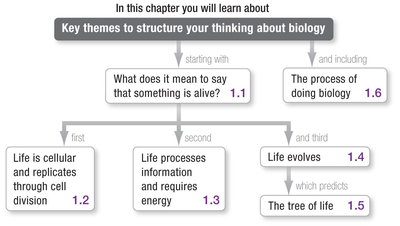
Biology is the scientific study of living organisms and their interactions with one another and their environments. All living organisms share five fundamental characteristics: cells, replication, information, energy, and evolution. These characteristics form the foundation for understanding what it means to be alive.
Cells: All living things are composed of one or more cells, which are the basic units of life.
Replication: Living organisms reproduce, passing genetic information to the next generation.
Information: Organisms process hereditary or genetic information encoded in genes as well as information from the environment.
Energy: All life requires energy to carry out cellular processes.
Evolution: Populations of organisms evolve over time through changes in their genetic makeup.
The Framework of Modern Biology
Three Central Theories
Modern biology is built upon three major theories:
The Cell Theory: All organisms are made of cells, and all cells come from preexisting cells.
The Theory of Evolution by Natural Selection: Explains how populations of organisms change over time and how new species arise.
The Chromosome Theory of Inheritance: Describes how genetic information is transmitted from one generation to the next via chromosomes.
Life is Cellular and Replicates Through Cell Division
The Cell Theory
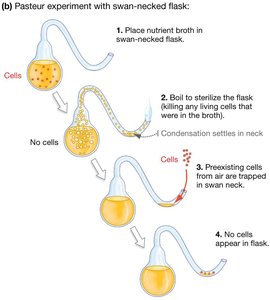
The cell theory states that all living things are composed of cells and that all cells arise from preexisting cells. This was demonstrated by experiments such as those conducted by Louis Pasteur, which disproved the idea of spontaneous generation.
Cells: Highly organized compartments separated from their environment by a membrane.
Cell Division: The process by which cells replicate, ensuring continuity of life.
Microscopy and Cell Size
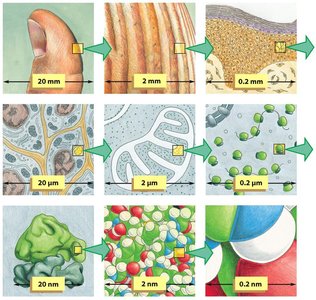
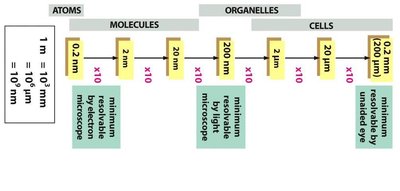
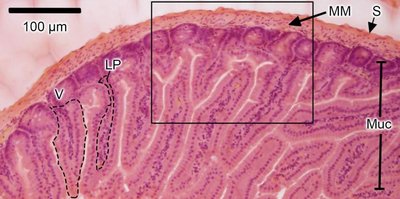
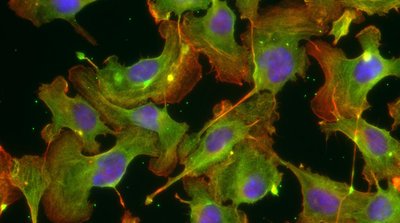
Cells and their components vary greatly in size, from atoms and molecules to organelles and whole cells. Microscopy is essential for studying these structures.
Light Microscopy: Resolves structures as small as 200 nm; often uses stains or fluorescent markers.
Electron Microscopy: Uses electron beams to resolve structures down to 0.2 nm. Includes scanning (SEM) for surfaces and transmission (TEM) for internal structures.
Life Processes Information and Requires Energy
Genetic Information and the Central Dogma
Genes, located on chromosomes, are segments of DNA that contain hereditary information. The Central Dogma of molecular biology describes the flow of genetic information within a cell: DNA is transcribed into RNA, which is then translated into protein.
Gene: A segment of DNA that codes for a functional product, usually a protein.
Central Dogma:
Energy and Metabolism
All living organisms require energy to drive chemical reactions necessary for life. Organisms acquire energy in the form of adenosine triphosphate (ATP) and obtain molecules needed to build cellular components.
ATP: The primary energy currency of the cell.
Metabolism: The sum of all chemical reactions in an organism.
Life Evolves: The Theory of Evolution by Natural Selection
Evolution and Natural Selection
Evolution is the change in the characteristics of a population over time. Charles Darwin and Alfred Russel Wallace proposed that evolution occurs through natural selection, where individuals with advantageous traits are more likely to survive and reproduce.
Natural Selection: The process by which heritable traits that enhance survival and reproduction become more common in successive generations.
Population: A group of individuals of the same species living in the same area at the same time.
The Tree of Life and Phylogeny
The cell theory and the theory of evolution together suggest that all species are related by common ancestry. The relationships among species can be depicted as a phylogenetic tree, which is constructed using genetic sequence data.
Three Domains of Life: Bacteria, Archaea, and Eukarya.
Prokaryotes: Bacteria and Archaea; unicellular, lack a nucleus and membrane-bound organelles.
Eukaryotes: Eukarya; can be unicellular or multicellular, have a nucleus and membrane-bound organelles.
Feature | Prokaryotes | Eukaryotes |
|---|---|---|
Nucleus | Absent | Present |
Membrane-bound organelles | Absent | Present |
Cellularity | Unicellular | Unicellular or Multicellular |
Viruses: Not Considered Living Organisms
Viruses are not made of cells and cannot carry out life processes independently. They require a host cell to reproduce and cannot generate their own ATP, amino acids, or nucleotides.
Virus: An infectious particle composed of genetic material (DNA or RNA) surrounded by a protein coat; not considered alive by most biologists.
Doing Biology: The Nature of Science
The Scientific Method
Science is a systematic approach to understanding the natural world through observation, measurement, and experimentation. Biologists use the scientific method to test hypotheses and answer questions about the universe.
Hypothesis: A testable statement that explains an observation.
Experiment: A controlled test designed to evaluate the effect of a variable.
Prediction: A measurable or observable result that must be correct if the hypothesis is valid.
Control: A standard for comparison in an experiment.
Hypothesis testing involves stating a hypothesis and its predictions, then designing an experiment or observational study to test those predictions.
Summary Table: Key Differences Between Prokaryotes, Eukaryotes, and Viruses
Feature | Prokaryotes | Eukaryotes | Viruses |
|---|---|---|---|
Cellular Structure | Yes | Yes | No |
Nucleus | No | Yes | No |
Membrane-bound Organelles | No | Yes | No |
Independent Metabolism | Yes | Yes | No |
Reproduction | Binary fission | Mitosis/meiosis | Requires host cell |
