 Back
Chapter 1: Biology – The Study of Life (Mini-Textbook Study Notes)
Study Guide - Smart Notes
 Tailored notes based on your materials, expanded with key definitions, examples, and context.
Biology: The Study of Life
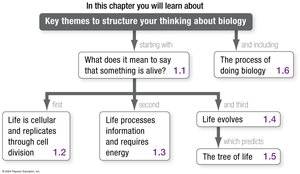
Key Themes and Structure of Biology
Biology is the scientific study of life, encompassing the structure, function, growth, origin, evolution, and distribution of living organisms. This chapter introduces the foundational concepts that define life and the scientific methods used to study it.
What does it mean to say that something is alive? Living organisms share five fundamental characteristics: cellular organization, replication, information processing, energy utilization, and evolution.
Life is cellular and replicates through cell division (see section 1.2).
Life processes information and requires energy (see section 1.3).
Life evolves (see section 1.4).
The tree of life depicts evolutionary history (see section 1.5).
The process of doing biology (see section 1.6).
What Does It Mean to Say That Something is Alive?
Fundamental Characteristics of Life
All living organisms share five fundamental characteristics:
Cellular Organization: All organisms are made up of membrane-bound cells.
Replication: All organisms are capable of reproduction.
Information Processing: All organisms process hereditary information encoded in genes and respond to environmental information.
Energy Utilization: All organisms acquire and use energy to stay alive.
Evolution: Populations of organisms are continually evolving; individuals do not evolve, but populations do over generations.
Theories in Biology
Definition and Examples of Scientific Theory
A theory is an explanation for a very general class of phenomena or observations supported by a wide body of evidence. Unlike everyday usage, a scientific theory is not speculation or guesswork; it is repeatedly tested and widely accepted as true.
Cell Theory: All organisms are made of cells; cells are the basic unit of life.
Chromosome Theory of Inheritance: Hereditary information is transmitted via chromosomes.
Theory of Evolution by Natural Selection: Organisms are related and change over time.
Life is Cellular and Replicates through Cell Division
Discovery and Structure of Cells
The cell theory states that all organisms are made up of cells, which are highly organized compartments separated from their environment by a membrane barrier. Cells are the basic unit of life, whether single-celled or multicellular, and all cells come from preexisting cells.
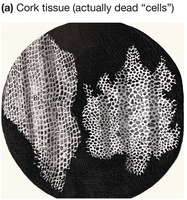
Robert Hooke (1665): Devised a microscope and observed cork tissue, naming the compartments "cells."
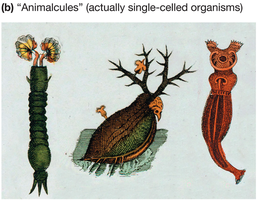
Anton van Leeuwenhoek: Improved magnification and observed single-celled organisms, termed "animalcules."
Scientific Method and Hypothesis Testing
Nature of Science and Experimental Design
Science relies on asking questions, making observations, forming hypotheses, testing them, and analyzing results. A hypothesis is a testable statement explaining an observation. Experiments allow researchers to test the effect of a single factor, and predictions must be measurable and observable.
Critical Experimental Design: Includes control groups, constant conditions, repetition, and large sample sizes to ensure precision and minimize bias.
Precision: The potential for results to generalize to the entire population increases with sample size.
Bias: Ensuring the sample represents the whole population is essential.
Example Experiment: DDT and Eggshell Thickness
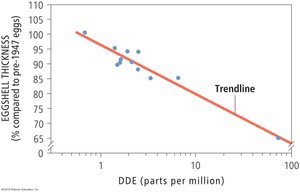
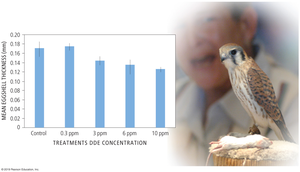
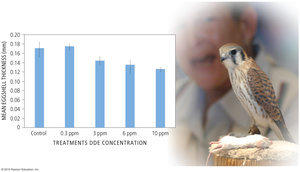
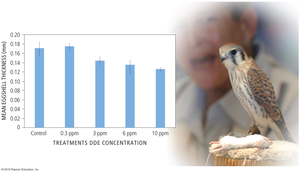
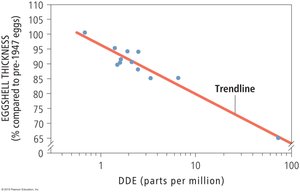
Researchers observed declining hatchling survival and reduced eggshell thickness correlated with DDT residues in parent birds. Controlled experiments exposed American kestrels to different concentrations of DDE (a DDT metabolite) and confirmed reduced eggshell thickness.
Variables: Eggshell thickness (response), DDE concentration (treatment).
Results: Negative correlation between DDE concentration and eggshell thickness.
Interpretation: Correlation does not mean causation; further testing and replication are needed.
Cell Theory and Spontaneous Generation
Testing the Origin of Cells
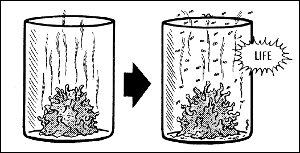
Cell theory challenged the idea of spontaneous generation, which posited that organisms could arise spontaneously under certain conditions. The all-cells-from-cells hypothesis states that cells are produced only when pre-existing cells grow and divide.
Life Processes Information and Requires Energy
Chromosome Theory and Central Dogma
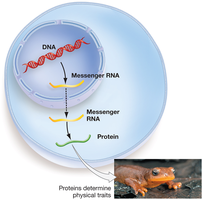
The chromosome theory of inheritance states that hereditary information is encoded in genes located on chromosomes. DNA is the hereditary material, and genes are segments of DNA that code for cell products. The central dogma of biology describes the flow of information: DNA codes for RNA, which codes for proteins.
DNA Replication: DNA is copied to pass genetic information from cell to cell or from one organism to its offspring. Mistakes (mutations) can lead to heritable variations.
Central Dogma Equation:
Energy Utilization in Life
Organisms acquire and use energy in various ways:
Plants and Bacteria: Produce sugar using energy from sunlight (photosynthesis).
Single-celled Organisms: Some use chemical and heat energy from the environment.
Animals and Fungi: Use molecules absorbed from the environment as food.
Evolution and Natural Selection
Definition and Mechanisms
Evolution is the change in characteristics of a population over time. Darwin and Wallace proposed that species are related by common ancestry and can be modified from generation to generation (descent with modification).
Natural Selection: Explains how evolution occurs. Two conditions must be met: (1) individuals vary in heritable characteristics, and (2) certain traits increase reproductive success in a particular environment.
Fitness: The ability of an individual to produce surviving offspring.
Adaptation: A trait that increases fitness in a particular environment.
Example: Darwin's Finches
Finches on the Galápagos Islands evolved beak shapes suited to available food sources. Small, pointed beaks were an adaptation for eating small, soft seeds, leading to increased fitness and prevalence of this trait.
The Tree of Life and Phylogeny
Depicting Evolutionary History
The tree of life is a family tree of organisms, describing genealogical relationships among species with a single ancestral species at its base. Phylogeny is the actual genealogical relationship among all organisms.
Three Major Groups: Eukaryotes (Eukarya), Bacteria, and Archaea.
Phylogenetic Tree: Used to show relationships between species; branches sharing recent common ancestors are closely related.
Taxonomy and Classification
Linnaeus’ System and Scientific Names
Taxonomy is the effort to name and classify organisms. Each organism is given a unique two-part scientific name consisting of genus and species. Scientific names are always italicized; genus names are capitalized, species names are not (e.g., Homo sapiens).
The Process of Doing Biology
Example: Giraffe Neck Length Hypothesis
The food competition hypothesis proposed that giraffes evolved long necks to reach food unavailable to other mammals. Testable predictions included variable neck length, heritability, and feeding high in trees. However, research showed giraffes do not usually feed high in trees, leading to rejection of the hypothesis.
Summary Table: Levels of Classification
Level | Description |
|---|---|
Domain | Largest grouping; Eukarya, Bacteria, Archaea |
Kingdom | Major subdivisions within domains |
Phylum | Groups of related classes |
Class | Groups of related orders |
Order | Groups of related families |
Family | Groups of related genera |
Genus | Closely related species |
Species | Individuals that regularly breed together or have distinct characteristics |
Additional info: These notes expand brief points into full academic explanations, add definitions, examples, and context to ensure completeness and clarity for General Biology students.
