 Back
Chapter 1: Biology – The Study of Life (Mini-Textbook Study Notes)
Study Guide - Smart Notes
 Tailored notes based on your materials, expanded with key definitions, examples, and context.
Biology: The Study of Life
Introduction to Biology
Biology is the scientific study of life and living organisms. It seeks to answer fundamental questions about what it means to be alive, how life is organized, and how living things interact with each other and their environment. This chapter introduces the core themes and processes that structure biological thinking.
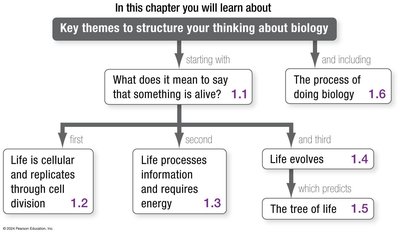
What Does It Mean to Say That Something is Alive?
Five Fundamental Characteristics of Life
Cells: All organisms are made up of membrane-bound cells, which are the basic units of life.
Replication: All organisms are capable of reproduction, ensuring the continuation of their species.
Information: All organisms process hereditary information encoded in genes and respond to information from their environment.
Energy: All organisms acquire and use energy to maintain life and carry out biological processes.
Evolution: Populations of organisms are continually evolving, leading to the diversity of life.
Theories in Biology
Major Biological Theories
Theory: An explanation for a broad class of phenomena, supported by a wide body of evidence. In science, a theory is not a guess but a well-substantiated explanation.
Cell Theory: All organisms are made of cells, and all cells come from preexisting cells.
Theory of Evolution by Natural Selection: Explains how organisms are related and how they change over time.
Chromosome Theory of Inheritance: Describes how hereditary information is transmitted from one generation to the next.
Life is Cellular and Replicates through Cell Division
Discovery of Cells
Cells were first observed by Robert Hooke and Anton van Leeuwenhoek in the 1600s using early microscopes. Hooke observed cork tissue and coined the term "cells," while Leeuwenhoek observed single-celled organisms he called "animalcules." These discoveries led to the development of cell theory.
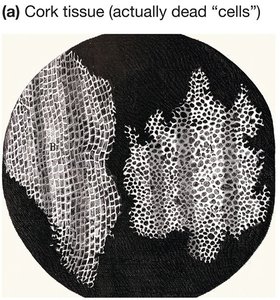
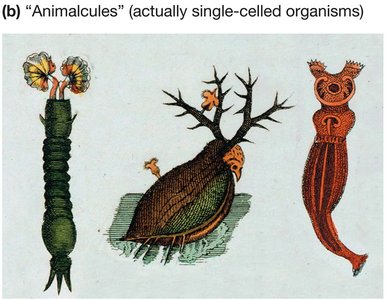
Principles of Cell Theory
All organisms are made up of cells.
All cells come from preexisting cells (not by spontaneous generation).
Testing Cell Theory: Pasteur's Experiment
Louis Pasteur's experiment demonstrated that cells arise from preexisting cells, not spontaneously. He used swan-necked flasks to show that sterilized broth remained free of cells unless exposed to preexisting cells from the air.
Life Processes Information and Requires Energy
Genetic Information and the Chromosome Theory of Inheritance
Genes, located on chromosomes, encode hereditary information.
DNA (deoxyribonucleic acid) is the molecule that stores genetic information.
Genes are segments of DNA that code for cell products.
Structure of DNA
DNA is a double helix composed of four types of nucleotides: Adenine (A), Thymine (T), Cytosine (C), and Guanine (G).
Base pairing: A pairs with T, and C pairs with G. This allows DNA to be copied accurately.
The Central Dogma of Molecular Biology
The central dogma describes the flow of genetic information in cells: DNA is transcribed into RNA, which is then translated into protein. Proteins determine the structure and function of cells.
Transcription: DNA → RNA
Translation: RNA → Protein
Mutations and Genetic Variation
DNA is copied with high fidelity, but mistakes (mutations) can occur.
Mutations can change proteins and lead to heritable variation, which is the basis for evolution.
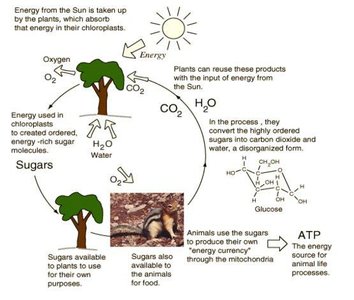
Energy and Metabolism
Cells require energy to carry out chemical reactions.
Organisms acquire energy in the form of ATP (adenosine triphosphate) and need molecules for building cellular components.
How organisms acquire energy is central to the diversity of life (e.g., photosynthesis in plants, consumption in animals).
Life Evolves
Evolution and Natural Selection
Evolution: Change in the characteristics of a population over time.
Population: Group of individuals of the same species living in the same area at the same time.
Natural Selection: The process by which individuals with advantageous heritable traits reproduce more successfully, causing those traits to become more common in the population.
Conditions for Natural Selection
Individuals in a population vary in heritable traits.
Certain traits increase reproductive success in a given environment.
Fitness and Adaptation
Fitness: The ability of an individual to produce surviving offspring.
Adaptation: A trait that increases an individual's fitness in a particular environment.
Example: Darwin’s Finches
On the Galápagos Islands, finches with small, pointed beaks had higher fitness when small, soft seeds were abundant. This adaptation increased their survival and reproduction, leading to an increase in the frequency of small, pointed beaks in the population.
The Tree of Life and Phylogeny
Phylogenetic Trees
The tree of life depicts evolutionary relationships among species, with a single ancestral species at its base.
Phylogeny is the actual genealogical relationships among all organisms.
Genetic data (DNA/RNA sequences) are used to infer phylogenetic relationships.
Major Domains of Life
Bacteria (prokaryotes)
Archaea (prokaryotes)
Eukarya (eukaryotes, have a nucleus)
Taxonomy and Scientific Naming
Taxonomy: The science of naming and classifying organisms.
Each organism is given a unique two-part scientific name (genus and species), e.g., Homo sapiens.
Genus names are capitalized; species names are not. Both are italicized.
Doing Biology: The Scientific Method
Nature of Science
Science involves asking testable questions, formulating hypotheses, and collecting data through observation or experimentation.
Hypothesis: A testable statement explaining an observation.
Experiment: A controlled test of a hypothesis.
Prediction: A measurable or observable result expected if the hypothesis is correct.
Null Hypothesis: Specifies what should be observed if the hypothesis is incorrect.
Experimental Design
Include a control group to compare with the treatment group.
Keep experimental conditions constant except for the independent variable.
Use large sample sizes and repeat tests for reliability.
Example: Testing Nitrogen Requirement in Corn Plants
Independent variable: Presence or absence of nitrogen in water.
Dependent variables: Leaf length, leaf number, leaf yellowing.
Control group: Plants watered with distilled water only.
Treatment group: Plants watered with nitrogen-containing fertilizer.
Other variables (e.g., light, temperature) must be kept constant.
Importance of Controls
Controls are essential to determine whether observed effects are due to the independent variable. Without a control group, it is impossible to draw reliable conclusions about the effect of the treatment.
Summary Table: Key Concepts in Chapter 1
Concept | Definition | Example |
|---|---|---|
Cell Theory | All organisms are made of cells; all cells come from preexisting cells | Pasteur's experiment disproving spontaneous generation |
Central Dogma | Flow of genetic information: DNA → RNA → Protein | Gene expression in cells |
Evolution | Change in population characteristics over time | Darwin’s finches adapting to food sources |
Natural Selection | Individuals with advantageous traits reproduce more successfully | Beak size in finches |
Taxonomy | Naming and classifying organisms | Homo sapiens |
Scientific Method | Process of hypothesis testing and experimentation | Testing nitrogen requirement in plants |
