 Back
Chapter 1: Biology—Exploring Life (Study Notes)
Study Guide - Smart Notes
 Tailored notes based on your materials, expanded with key definitions, examples, and context.
Biology: Exploring Life
1.1 Biology is the Scientific Study of Life
Biology is defined as the scientific study of life. To understand what constitutes life, biologists identify several key properties that distinguish living organisms from non-living matter.
Order: Living things exhibit complex but ordered organization, such as the arrangement of cells in tissues.
Reproduction: Organisms reproduce their own kind, ensuring the continuation of species.
Growth and Development: Organisms grow and develop according to inherited genetic instructions.
Energy Processing: Living things obtain and use energy to power their activities and maintain their internal order.
Regulation: Organisms regulate their internal environment to maintain conditions suitable for life (homeostasis).
Response to the Environment: Living things respond to environmental stimuli.
Evolutionary Adaptation: Populations evolve over generations, adapting to their environments through natural selection.
The cell is the fundamental structural and functional unit of life. All living organisms are composed of cells, which carry out essential life processes.
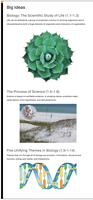
1.2 Biologists Arrange the Diversity of Life into Three Domains
Taxonomists classify living organisms into hierarchical groups based on shared characteristics. The broadest classification divides life into three domains:
Domain Bacteria: Composed of prokaryotic cells lacking a nucleus; includes most common bacteria.
Domain Archaea: Also prokaryotic, but with unique biochemical and genetic properties; often found in extreme environments.
Domain Eukarya: Contains all eukaryotic organisms, which have cells with nuclei. This domain includes:
Protists: Diverse, mostly unicellular organisms.
Kingdom Fungi: Includes molds, yeasts, and mushrooms.
Kingdom Plantae: Multicellular plants.
Kingdom Animalia: Multicellular animals.
Humans belong to the Domain Eukarya, Kingdom Animalia.
1.3 Life’s Hierarchy of Organization and Emergent Properties
Biologists study life at multiple levels of organization, from molecules to the biosphere. Each level exhibits emergent properties—characteristics that arise from the arrangement and interaction of parts within a system.
Molecule: Chemical structure consisting of two or more atoms.
Organelle: Functional components within cells (e.g., mitochondria).
Cell: Basic unit of life.
Tissue: Group of similar cells performing a specific function.
Organ: Structure composed of multiple tissues working together.
Organ System: Group of organs that cooperate in a major body function.
Organism: Individual living entity.
Population: Group of organisms of the same species in a given area.
Community: All organisms in a particular area.
Ecosystem: Community plus the physical environment.
Biosphere: All life on Earth and the places where life exists.
Each higher level in the hierarchy includes all levels below it. For example, an organ contains tissues, which contain cells, which contain molecules.
The Process of Science
Science is a method for understanding the natural world through observation, experimentation, and reasoning. The scientific process involves:
Observation: Gathering information about phenomena.
Hypothesis Formation: Proposing explanations based on observations.
Experimentation: Testing hypotheses through controlled experiments.
Analysis: Interpreting data to draw conclusions.
Communication: Sharing results with the scientific community.
Scientific inquiry is iterative and self-correcting, leading to increasingly accurate models of the natural world.
