 Back
Chapter 1: Evolution and the Foundations of Biology – Guided Study Notes
Study Guide - Smart Notes
 Tailored notes based on your materials, expanded with key definitions, examples, and context.
Q1. Describe the five unifying themes of biology and give an example for each.
Background
Topic: Unifying Themes in Biology
This question is testing your understanding of the major themes that organize biological knowledge and help connect different concepts in biology.
Key Terms:
Organization: How biological systems are structured and ordered.
Information: How genetic and environmental information is used and transmitted.
Energy and Matter: How organisms obtain and use energy and matter.
Interactions: How organisms interact with each other and their environment.
Evolution: The process by which species change over time.
Step-by-Step Guidance
Identify each of the five themes from your textbook or class notes.
Write a brief description of what each theme means in the context of biology.
Think of an example from your reading or class that illustrates each theme (e.g., for evolution, the adaptation of finch beaks).
Organize your answers in a table or list for clarity.
Try solving on your own before revealing the answer!
Final Answer:
Organization: Biological systems are organized from molecules to the biosphere. Example: Cells are organized into tissues, which form organs.
Information: Life processes are based on genetic information. Example: DNA carries genetic instructions for protein synthesis.
Energy and Matter: Organisms obtain and use energy and matter. Example: Plants convert sunlight into chemical energy via photosynthesis.
Interactions: Organisms interact with each other and their environment. Example: Bees pollinate flowers while collecting nectar.
Evolution: Populations change over time through natural selection. Example: Darwin’s finches evolved different beak shapes to exploit different food sources.
These themes help organize the study of biology and connect concepts across different levels of organization.
Q2. What are emergent properties? Give two examples.
Background
Topic: Emergent Properties in Biological Systems
This question is about understanding how new properties arise at each level of biological organization that are not present at the preceding level.
Key Terms:
Emergent Properties: Characteristics that appear as complexity increases, due to the arrangement and interactions of parts.
Step-by-Step Guidance
Define what is meant by an emergent property in biology.
Think of an example at the cellular or organismal level (e.g., the heart's ability to pump blood).
Consider another example at a higher level, such as an ecosystem or population.
Try solving on your own before revealing the answer!
Final Answer:
Emergent properties are new characteristics that arise at each level of organization, due to the arrangement and interactions of parts. Examples: 1) The ability of a heart to pump blood (not present in individual heart cells). 2) The cycling of nutrients in an ecosystem (not present in individual organisms).
Q3. At every level of biological organization there is a correlation between structure and function. Give an example not found in the text.
Background
Topic: Structure and Function in Biology
This question asks you to apply the concept that biological structures are adapted to their functions.
Key Terms:
Structure: The physical arrangement or shape of a biological component.
Function: The role or activity of that component.
Step-by-Step Guidance
Recall the definition of structure and function in biology.
Think of a biological structure (e.g., the shape of a bird’s wing, the surface area of roots).
Explain how the structure is related to its function.
Try solving on your own before revealing the answer!
Final Answer:
Example: The thin, flat shape of a leaf increases its surface area for absorbing sunlight, which is essential for photosynthesis.
Q4. Define each level of biological organization from the biosphere to molecules.
Background
Topic: Levels of Biological Organization
This question is about understanding the hierarchy of biological organization, from the largest scale (biosphere) to the smallest (molecules).
Key Terms:
Biosphere, Ecosystem, Community, Population, Organism, Organ System, Organ, Tissue, Cell, Organelle, Molecule
Step-by-Step Guidance
List each level in order from largest to smallest.
Write a brief definition for each level, focusing on what distinguishes it from the others.
Use examples to clarify each definition if needed.
Try solving on your own before revealing the answer!
Final Answer:
Biosphere: All life on Earth and all places where life exists.
Ecosystem: All living and nonliving things in a particular area.
Community: All living organisms in an ecosystem.
Population: Individuals of the same species in a given area.
Organism: An individual living thing.
Organ System: Groups of organs that work together.
Organ: A body part with a specific function.
Tissue: Groups of similar cells performing a function.
Cell: The basic unit of life.
Organelle: Specialized structures within a cell.
Molecule: Chemical structure consisting of two or more atoms.
Q5. Define the following terms: eukaryotic cell, prokaryotic cell, genes, gene expression, genome.
Background
Topic: Cell Types and Genetic Information
This question is about understanding the basic vocabulary of cell biology and genetics.
Key Terms:
Eukaryotic cell: Cell with a nucleus and membrane-bound organelles.
Prokaryotic cell: Cell without a nucleus or membrane-bound organelles.
Gene: A unit of hereditary information.
Gene expression: The process by which information from a gene is used to build a functional product.
Genome: The complete set of genetic material in an organism.
Step-by-Step Guidance
Write a concise definition for each term, using your textbook or class notes.
Consider how each term relates to the others (e.g., genes are part of the genome).
Think of examples or analogies to help remember each definition.
Try solving on your own before revealing the answer!
Final Answer:
Eukaryotic cell: A cell with a nucleus and other membrane-bound organelles.
Prokaryotic cell: A cell lacking a nucleus and membrane-bound organelles.
Gene: A segment of DNA that codes for a protein or RNA molecule.
Gene expression: The process by which a gene’s information is converted into the structures and functions of a cell.
Genome: The entire set of genetic instructions in an organism.
Q6. Label the gene, DNA, RNA, amino acids, and protein in the figure. Next, label the three steps in the process and describe each.
Background
Topic: The Flow of Genetic Information (Central Dogma)
This question is about the process by which genetic information flows from DNA to RNA to protein, known as the central dogma of molecular biology.
Key Terms and Process:
Gene: A segment of DNA that codes for a protein.
DNA: The molecule that stores genetic information.
RNA: A molecule that carries genetic information from DNA to the ribosome.
Amino acids: The building blocks of proteins.
Protein: A functional molecule made of amino acids.
Transcription: The process of making RNA from DNA.
Translation: The process of making a protein from RNA.
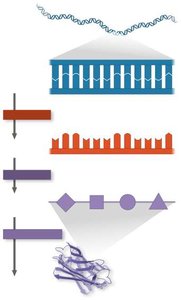
Step-by-Step Guidance
Identify the DNA strand at the top of the figure and label it as DNA (containing the gene).
Label the process where DNA is used to make RNA (transcription).
Label the RNA strand and the process where RNA is used to assemble amino acids (translation).
Label the chain of amino acids and the final folded protein structure.
Describe each step: transcription (DNA to RNA), translation (RNA to amino acids), and protein folding (amino acids to functional protein).
Try solving on your own before revealing the answer!
Final Answer:
Gene/DNA: The top strand is DNA, containing the gene.
Transcription: The process where DNA is copied into RNA.
RNA: The next strand is RNA, carrying the genetic message.
Translation: The process where RNA is used to assemble amino acids.
Amino acids: The shapes represent amino acids being linked together.
Protein: The final structure is a folded protein.
Each step is essential for expressing genetic information as a functional protein.
Q17. Study the evolutionary tree. What is indicated by each twig? What do the branch points represent? Label the branch point that represents the ancestral point for all species of finch.
Background
Topic: Evolutionary Trees (Phylogenetics)
This question is about interpreting evolutionary trees, which show relationships among species based on common ancestry.
Key Terms:
Evolutionary tree (phylogeny): A diagram showing evolutionary relationships.
Branch point (node): Represents a common ancestor.
Twigs: Represent current species or groups.
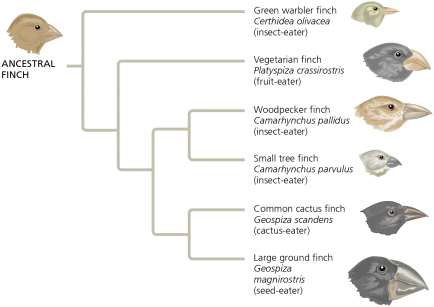
Step-by-Step Guidance
Look at the tips (twigs) of the tree and identify what each one represents (a species of finch).
Examine the branch points (nodes) and consider what they represent (common ancestors).
Find the branch point at the base of the tree and think about which ancestor it represents (the ancestral finch).
Label the branch point that is the most recent common ancestor of all the finch species shown.
Try solving on your own before revealing the answer!
Final Answer:
Each twig represents a different species of finch.
Each branch point (node) represents a common ancestor shared by the species branching from it.
The branch point at the base of the tree is the ancestral finch, from which all the other species evolved.
This tree shows how different finch species are related through evolution from a common ancestor.
