 Back
Chapter 1: Evolution, the Themes of Biology, and Scientific Inquiry – Study Notes
Study Guide - Smart Notes
 Tailored notes based on your materials, expanded with key definitions, examples, and context.
Chapter 1: Evolution, the Themes of Biology, and Scientific Inquiry
Unifying Themes in Biology
Biology is the scientific study of life, and it is characterized by several unifying themes that help organize our understanding of living systems. These themes provide a framework for studying the complexity of life, from molecules to the biosphere.
Organization: Life is structured in a hierarchical manner, from molecules and cells to organisms and ecosystems.
Information: Living organisms store, transmit, and respond to genetic information.
Energy and Matter: Life requires the transfer and transformation of energy and matter to sustain biological processes.
Interactions: Organisms interact with each other and their environment, affecting survival and reproduction.
Evolution: Evolution explains both the unity and diversity of life, as all organisms are modified descendants of common ancestors.
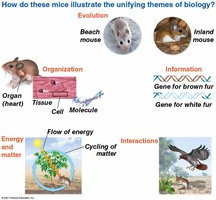
Levels of Biological Organization
Life can be studied at different levels, each with unique properties that emerge from the arrangement and interaction of parts. This concept is known as emergent properties.
Reductionism: Breaking down complex systems into simpler components for study.
Systems Biology: Analyzing interactions among parts of a biological system to understand emergent properties.
Structure and Function
There is a close relationship between the structure of biological components and their function. Understanding one often provides insight into the other.
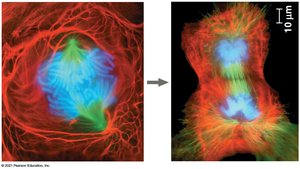
The Cell: Basic Unit of Life
The cell is the smallest unit of organization that can perform all activities required for life. According to the cell theory, all living organisms are composed of cells.
Prokaryotic cells: Simpler, smaller, lack a nucleus and membrane-bound organelles (e.g., Bacteria, Archaea).
Eukaryotic cells: Larger, contain a nucleus and membrane-bound organelles (e.g., plants, animals, fungi, protists).
Genetic Information and Gene Expression
Genetic information is stored in DNA (deoxyribonucleic acid), which is organized into chromosomes. Genes are units of inheritance that encode instructions for building cellular molecules, primarily proteins.
DNA is composed of four nucleotides: A, G, C, and T.
Gene expression: The process by which information from a gene is used to synthesize a functional product (usually a protein).
Central Dogma:
Genomics and Proteomics
Genomics is the study of whole sets of genes, while proteomics is the study of entire sets of proteins (the proteome) expressed by cells, tissues, or organisms. These fields rely on high-throughput technology and bioinformatics.
Energy and Matter in Biological Systems
All living organisms require energy to carry out life processes. Energy flows through ecosystems, typically entering as sunlight and exiting as heat, while matter cycles within ecosystems.
Producers: Organisms (e.g., plants) that convert solar energy into chemical energy.
Consumers: Organisms that obtain energy by feeding on other organisms or their remains.
Interactions in Biological Systems
Interactions occur at all levels of biological organization, from molecules within cells to organisms within ecosystems. Many biological processes are regulated by feedback mechanisms:
Negative feedback: The response reduces the initial stimulus (e.g., regulation of blood glucose).
Positive feedback: The end product speeds up its own production (e.g., blood clotting).
Evolution: The Core Theme of Biology
Unity and Diversity of Life
Evolution explains both the similarities and differences among living organisms. All life shares a common genetic language (DNA), and evolutionary processes have led to the diversity of species observed today.
Approximately 1.8 million species have been identified and named.
Each species is given a two-part scientific name (genus and species), e.g., Homo sapiens.
The Three Domains of Life
All organisms are classified into three domains:
Domain | Characteristics |
|---|---|
Bacteria | Prokaryotic, diverse, widespread |
Archaea | Prokaryotic, often found in extreme environments |
Eukarya | Eukaryotic, includes plants, fungi, animals, and protists |
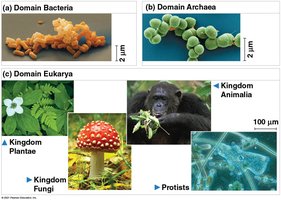
Kingdoms of Eukarya
Plantae: Multicellular, photosynthetic organisms
Fungi: Absorb nutrients from their environment
Animalia: Multicellular organisms that ingest food
Protists: Mostly single-celled, diverse group
Charles Darwin and Natural Selection
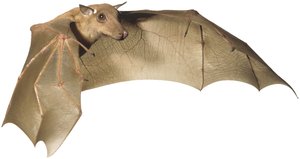
Charles Darwin's theory of evolution by natural selection provides a scientific explanation for the unity and diversity of life. Key observations and inferences include:
Individuals in a population vary in heritable traits.
More offspring are produced than survive, leading to competition.
Individuals with advantageous traits are more likely to survive and reproduce.
Over generations, beneficial traits become more common in the population.
Scientific Inquiry and the Process of Science
Forming and Testing Hypotheses
Science is a process of inquiry that involves making observations, forming hypotheses, and testing them through experiments. A hypothesis is a testable explanation for an observation.
Inductive reasoning: Deriving generalizations from specific observations.
Deductive reasoning: Making specific predictions from general premises.
Controlled experiments: Compare an experimental group with a control group, manipulating only one variable at a time.
Theories in Science
A scientific theory is broader in scope than a hypothesis, generates new hypotheses, and is supported by a large body of evidence.
Science, Technology, and Society
Science seeks to understand natural phenomena, while technology applies scientific knowledge for practical purposes. Both are interdependent and can have profound effects on society, raising ethical, political, and cultural issues.
The Value of Diverse Viewpoints
Science benefits from the collaboration of individuals with diverse backgrounds and perspectives, leading to more robust and innovative discoveries.
