 Back
Chapter 1: Evolution, the Themes of Biology, and Scientific Inquiry – Study Notes
Study Guide - Smart Notes
 Tailored notes based on your materials, expanded with key definitions, examples, and context.
Evolution, the Themes of Biology, and Scientific Inquiry
Introduction to Biology
Biology is the scientific study of life, encompassing a vast scope from molecules to the entire biosphere. Life is recognized by a set of characteristics and processes that living things perform. The study of biology reveals several unifying themes that help organize and explain the diversity and complexity of life.
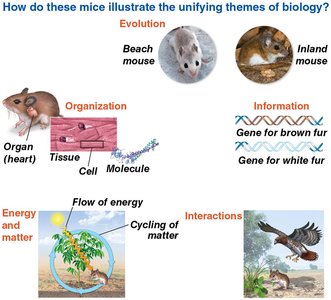
Unifying Themes in Biology
Organization: Life is structured in a hierarchical manner, from molecules to the biosphere.
Information: Living organisms store and transmit genetic information, primarily in the form of DNA.
Energy and Matter: Life requires the transfer and transformation of energy and cycling of matter.
Interactions: Biological systems interact at all levels, from molecules to ecosystems.
Evolution: The process that accounts for the unity and diversity of life.
Properties of Life
All living organisms share certain properties that distinguish them from nonliving matter:
Order
Evolutionary adaptation
Regulation
Reproduction
Response to the environment
Growth and development
Energy processing

Levels of Biological Organization
Hierarchy of Life
Life can be studied at different levels, each with emergent properties that arise from the arrangement and interaction of parts:
Biosphere
Ecosystems
Communities
Populations
Organisms
Organs and organ systems
Tissues
Cells
Organelles
Molecules

Emergent Properties and Systems Biology
Emergent properties arise at each level of organization due to the arrangement and interactions of parts. Systems biology is an approach that studies the interactions among the parts of a biological system, complementing reductionism.
Structure and Function
There is a close correlation between structure and function at all levels of biological organization. Understanding the structure of a biological component provides insight into its function, and vice versa.

The Cell: Basic Unit of Life
Cell Theory and Types of Cells
The cell is the smallest unit capable of performing all activities required for life. According to cell theory, all living organisms are composed of cells. Cells are classified as:
Prokaryotic cells: Simpler, smaller, lack a nucleus and membrane-bound organelles (e.g., Bacteria, Archaea).
Eukaryotic cells: Larger, contain a nucleus and membrane-bound organelles (e.g., Plants, Animals, Fungi, Protists).

Genetic Information and Gene Expression
DNA: The Genetic Material
Within cells, chromosomes contain DNA, the molecule that stores genetic information. Genes are units of inheritance that encode instructions for building proteins and other molecules essential for life. DNA is composed of two long chains forming a double helix, made up of four types of nucleotides: A, T, C, and G.

Gene Expression
Gene expression is the process by which information from a gene is used to synthesize a functional product, typically a protein. The process involves two main steps:
Transcription: DNA is transcribed into messenger RNA (mRNA).
Translation: mRNA is translated into a chain of amino acids, forming a protein.

Genomics and Proteomics
Genomics is the study of whole sets of genes (genomes) in one or more species, while proteomics is the study of the entire set of proteins (proteome) expressed by a cell, tissue, or organism. Advances in technology and bioinformatics have enabled large-scale analysis of DNA and proteins.
Energy and Matter in Biological Systems
Energy Flow and Chemical Cycling
Life depends on the transfer and transformation of energy and matter. Energy flows through ecosystems, usually entering as sunlight and exiting as heat, while chemicals cycle within ecosystems. Producers (e.g., plants) convert solar energy into chemical energy, which is then transferred to consumers (e.g., animals).
Interactions in Biological Systems
Feedback Regulation
Biological processes are often regulated by feedback mechanisms:
Negative feedback: The response reduces the initial stimulus (most common).
Positive feedback: The end product speeds up its own production (less common).
Interactions at the Ecosystem Level
Organisms interact with each other and with their physical environment. These interactions can be beneficial, harmful, or neutral, and they influence the structure and dynamics of ecosystems. Human activities, such as burning fossil fuels, have significant impacts on ecosystems and contribute to global climate change.
Evolution: The Core Theme of Biology
Unity and Diversity of Life
Evolution explains both the unity and diversity of life. All organisms share a common genetic language (DNA), and similarities in structure and function reflect shared ancestry. The diversity of life results from evolutionary processes that modify descendants of common ancestors.

Classification of Life
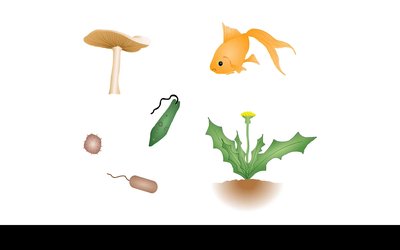
Organisms are classified into three domains:
Bacteria (prokaryotes)
Archaea (prokaryotes)
Eukarya (eukaryotes: plants, fungi, animals, protists)
Charles Darwin and Natural Selection
Charles Darwin proposed that species evolve through the process of natural selection. Key observations include:
Individuals vary in heritable traits.
More offspring are produced than survive, leading to competition.
Individuals best suited to their environment are more likely to survive and reproduce.
Over time, natural selection leads to adaptation and the evolution of new species.
Scientific Inquiry
The Scientific Method
Science is a process of inquiry involving observation, hypothesis formation, experimentation, and analysis. Hypotheses must be testable and falsifiable. Experiments often involve control and experimental groups, with independent and dependent variables.

Inductive and Deductive Reasoning
Inductive reasoning: Deriving general principles from specific observations.
Deductive reasoning: Making specific predictions based on general premises.
Theories in Science
A scientific theory is broader than a hypothesis, generates new hypotheses, and is supported by a large body of evidence.
Science, Technology, and Society
Interdependence of Science and Technology
Science seeks to understand natural phenomena, while technology applies scientific knowledge for practical purposes. Advances in one often drive progress in the other, but ethical, political, and cultural considerations are important in technological applications.
Diversity in Science
Science benefits from diverse viewpoints and backgrounds, which foster innovation and robust scientific exchange.
