 Back
Chapter 1: Evolution, Themes of Biology, and Scientific Inquiry
Study Guide - Smart Notes
 Tailored notes based on your materials, expanded with key definitions, examples, and context.
Introduction to Biology
What is Biology?
Biology is the scientific study of life. It encompasses the investigation of living organisms, their structure, function, growth, origin, evolution, and distribution. Life itself is complex and resists a simple, one-sentence definition, but biologists identify several key properties that distinguish living things from non-living matter.
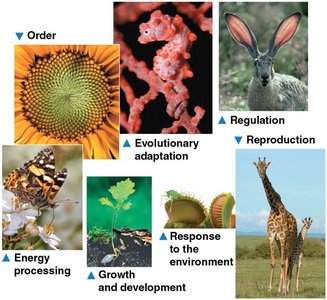
Order: Living things exhibit complex but ordered organization.
Evolutionary adaptation: Populations evolve over generations to adapt to their environments.
Regulation: Organisms regulate their internal environment to maintain homeostasis.
Reproduction: Living things reproduce their own kind.
Energy processing: Organisms obtain and use energy to power activities.
Growth and development: Organisms grow and develop according to inherited instructions.
Response to the environment: Living things respond to environmental stimuli.
Unifying Themes of Biology
The Five Unifying Themes
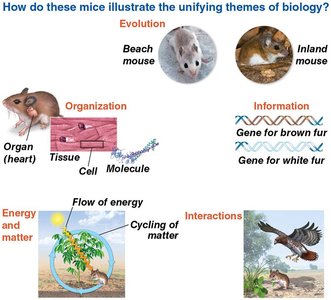
Biology is organized around five unifying themes that help explain the diversity and unity of life:
Organization: Life is structured in a hierarchical manner, from molecules to the biosphere.
Information: Genetic information (DNA) is inherited and used to direct cellular activities and responses to the environment.
Energy and Matter: Life requires the transfer and transformation of energy and matter, such as in photosynthesis and cellular respiration.
Interactions: Living systems interact at all levels, from molecules within cells to organisms within ecosystems.
Evolution: Evolution explains both the unity and diversity of life, as species change over time through natural selection.
Levels of Biological Organization
Hierarchy of Life
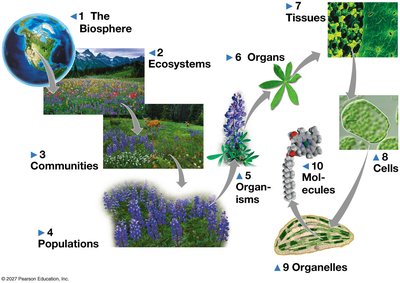
Biological systems are organized into a hierarchy, with each level building on the previous one. This organization allows for emergent properties—new characteristics that arise at each level due to the arrangement and interaction of parts.
Biosphere: All environments on Earth that support life.
Ecosystems: All living things in a particular area, along with the nonliving components.
Communities: All organisms in an ecosystem.
Populations: All individuals of a species within a specific area.
Organisms: Individual living things.
Organs and Organ Systems: Body parts that perform specific functions.
Tissues: Groups of similar cells performing a function.
Cells: The smallest unit of life.
Organelles: Functional components within cells.
Molecules: Chemical structures consisting of two or more atoms.
Emergent Properties
Emergent properties arise from the arrangement and interaction of parts within a system. For example, a functioning bicycle only emerges when all necessary parts are correctly assembled. In biology, emergent properties are observed at every level of organization, from molecules to ecosystems.
Structure and Function
At every level of the biological hierarchy, there is a close relationship between structure and function. Understanding the structure of a biological component provides insight into its function, and vice versa.
The Cell: The Basic Unit of Life
Cell Theory
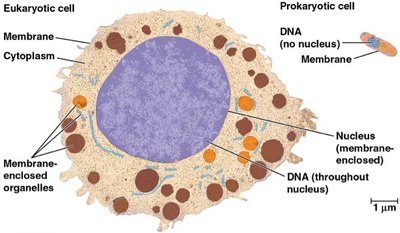
The cell is the smallest unit of organization that can perform all activities required for life. Cells are enclosed by membranes that regulate the passage of materials between the cell and its environment. There are two main types of cells:
Prokaryotic cells: Lack a nucleus and membrane-bound organelles (e.g., Bacteria and Archaea).
Eukaryotic cells: Have a nucleus and membrane-bound organelles (e.g., plants, animals, fungi, protists).
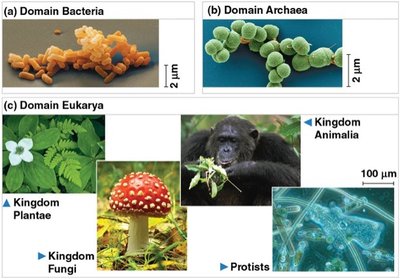
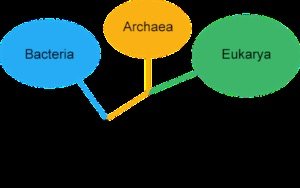
The Three Domains of Life
All living organisms are classified into three domains:
Bacteria: Prokaryotic, unicellular organisms.
Archaea: Prokaryotic, often found in extreme environments.
Eukarya: Eukaryotic organisms, including protists, fungi, plants, and animals.
Genetic Information and Gene Expression
DNA: The Molecule of Inheritance
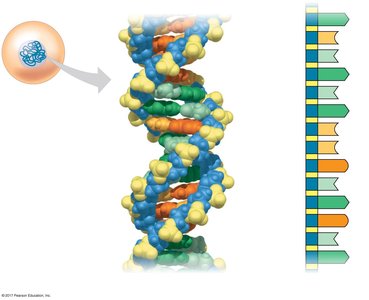
Life’s processes involve the expression and transmission of genetic information. Each chromosome contains one long DNA molecule with thousands of genes, which are the units of inheritance passed from parents to offspring. DNA is composed of four types of nucleotides: adenine (A), guanine (G), cytosine (C), and thymine (T).
Gene Expression
Gene expression is the process by which information from a gene is used to synthesize a functional product, usually a protein. The process involves two main steps:
Transcription: DNA is transcribed into messenger RNA (mRNA).
Translation: mRNA is translated into a chain of amino acids, forming a protein.
Evolution: The Core Theme of Biology
Unity and Diversity of Life
Evolution is the scientific explanation for both the unity and diversity of organisms. All living organisms are modified descendants of common ancestors. The unity of life is evident in the universal genetic code (DNA) and similar anatomical structures among different species.
Natural selection: Individuals with traits better suited to their environment are more likely to survive and reproduce, passing those traits to the next generation.
Descent with modification: Over generations, populations change as advantageous traits accumulate.
Scientific Inquiry and the Process of Science
The Scientific Method
Science is a way of knowing about the natural world. The process of scientific inquiry involves making observations, forming hypotheses, and testing them through experiments or further observations.
Observation: Careful observation is the foundation of scientific inquiry.
Data: Recorded observations, which can be qualitative (descriptions) or quantitative (numerical measurements).
Inductive reasoning: Deriving general principles from specific observations.
Deductive reasoning: Making specific predictions based on general premises.
Hypotheses and Experiments
A hypothesis is a testable explanation for an observation. Experiments are designed to test hypotheses under controlled conditions. Variables in experiments include:
Independent variable: The factor manipulated by the researcher.
Dependent variable: The factor measured in response to changes in the independent variable.
Control group: The group that does not receive the experimental treatment, used for comparison.
Theories in Science
In science, a theory is broader than a hypothesis, is supported by a large body of evidence, and can generate new hypotheses. Theories are not absolute truths but are accepted as the best explanations based on current evidence.
Case Study: Investigating Coat Coloration in Mouse Populations
Scientific Inquiry in Action
Researchers studied two populations of Peromyscus polionotus mice with different coat colors living in different habitats. The beach mouse has light coloration matching white sand dunes, while the inland mouse has darker fur matching the soil. The hypothesis was that coloration evolved as an adaptation to avoid predation.
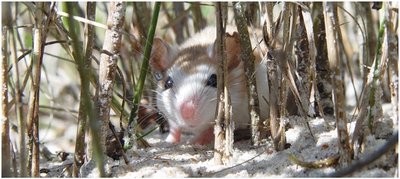
Experiments using model mice painted to match or contrast with their habitats showed that mice matching their environment were preyed upon less, supporting the camouflage hypothesis. This is an example of how scientific inquiry is used to test evolutionary hypotheses.
Summary Table: Unifying Themes of Biology
Theme | Description | Example |
|---|---|---|
Organization | Hierarchical structure of life from molecules to biosphere | Cells, tissues, organs, organisms |
Information | Genetic information stored and transmitted via DNA | Gene expression, inheritance |
Energy and Matter | Transfer and transformation of energy and matter | Photosynthesis, cellular respiration |
Interactions | Interactions within and between organisms and their environment | Predator-prey relationships, symbiosis |
Evolution | Change in species over time; unity and diversity of life | Natural selection, adaptation |
