 Back
Chapter 1: Evolution, Themes of Biology, and Scientific Inquiry – Study Notes
Study Guide - Smart Notes
 Tailored notes based on your materials, expanded with key definitions, examples, and context.
Evolution, the Themes of Biology, and Scientific Inquiry
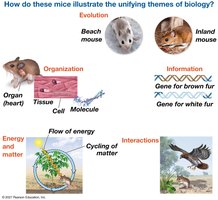
Unifying Themes in Biology
Biology is the scientific study of life, characterized by several unifying themes that help us understand living systems. These themes provide a framework for organizing biological knowledge and include:
Organization: Biological systems are structured hierarchically, from molecules to the biosphere.
Information: Genetic information is stored, transmitted, and expressed within organisms.
Energy and Matter: Life requires the transfer and transformation of energy and cycling of matter.
Interactions: Components of biological systems interact at all levels, from molecules to ecosystems.
Evolution: The diversity and unity of life are explained by evolutionary processes.
Properties of Life
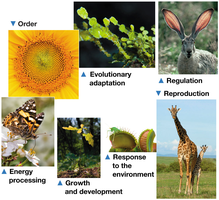
Living organisms share several fundamental properties that distinguish them from non-living matter:
Order: Highly ordered structure is a hallmark of life.
Evolutionary Adaptation: Organisms adapt to their environment through evolution.
Regulation: Internal conditions are regulated to maintain stability.
Reproduction: Organisms reproduce, passing genetic information to offspring.
Energy Processing: Life requires energy acquisition and transformation.
Growth and Development: Organisms grow and develop according to inherited instructions.
Response to Environment: Living things respond to environmental stimuli.
Levels of Biological Organization
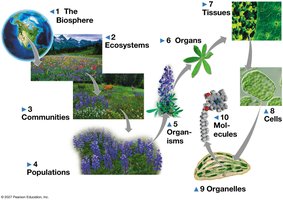
Biological organization is hierarchical, with each level exhibiting emergent properties not found in the preceding level. The main levels are:
Biosphere: All life on Earth and its environments.
Ecosystems: Communities of organisms and their physical environment.
Communities: All organisms in a particular ecosystem.
Populations: Individuals of the same species in a given area.
Organisms: Individual living entities.
Organs and Organ Systems: Body parts with specific functions.
Tissues: Groups of cells performing a function.
Cells: Basic unit of life.
Organelles: Functional components within cells.
Molecules: Chemical structures consisting of two or more atoms.
Structure and Function
There is a close relationship between structure and function at every level of biological organization. Understanding the structure of a biological component provides insight into its function, and vice versa.
Example: The shape of a bird's wing enables flight; the structure of enzymes allows them to catalyze specific reactions.
The Cell: Basic Unit of Structure and Function
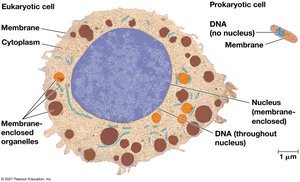
The cell is the fundamental unit of life, capable of performing all activities required for life. Cells are classified as prokaryotic or eukaryotic:
Prokaryotic Cells: Simpler, smaller, lack a nucleus and membrane-bound organelles (e.g., bacteria, archaea).
Eukaryotic Cells: Larger, more complex, contain a nucleus and membrane-bound organelles (e.g., plants, animals, fungi, protists).
Genetic Information: DNA and Chromosomes
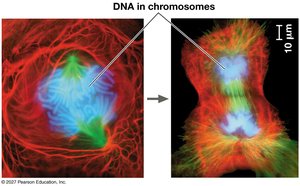
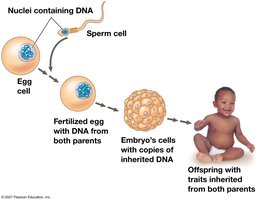
Within cells, genetic information is stored in DNA, which is organized into chromosomes. DNA directs the development and functioning of organisms by encoding instructions for building proteins.
Chromosomes: Structures containing DNA and genes.
Genes: Units of inheritance that encode information for protein synthesis.
Molecular Structure of DNA
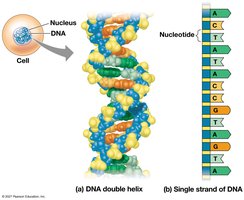
The double helix structure of DNA enables it to store and transmit genetic information. DNA is composed of four types of nucleotides: adenine (A), guanine (G), cytosine (C), and thymine (T).
Double Helix: Two strands twisted around each other.
Nucleotides: Building blocks of DNA, each containing a sugar, phosphate, and nitrogenous base.
Gene Expression
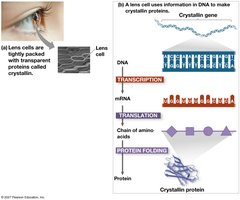
Gene expression is the process by which information from a gene is used to synthesize a functional product, typically a protein. This involves transcription (DNA to RNA) and translation (RNA to protein).
Transcription: DNA is copied into messenger RNA (mRNA).
Translation: mRNA is decoded to build a protein.
Energy and Matter in Biological Systems
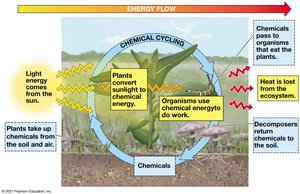
Life depends on the transfer and transformation of energy and the cycling of matter. Energy flows through ecosystems, entering as sunlight and exiting as heat, while matter cycles among organisms and the environment.
Producers: Organisms (e.g., plants) that convert sunlight to chemical energy.
Consumers: Organisms that feed on other organisms.
Decomposers: Organisms that recycle nutrients back to the environment.
Interactions and Feedback Regulation
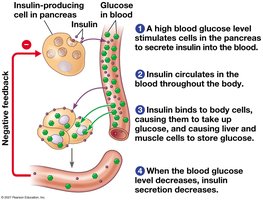
Biological systems are regulated by feedback mechanisms. Negative feedback reduces the initial stimulus, while positive feedback amplifies it. These mechanisms maintain homeostasis and ensure proper functioning.
Negative Feedback: The response counteracts the stimulus (e.g., regulation of blood glucose).
Positive Feedback: The response enhances the stimulus (e.g., blood clotting).
Domains and Kingdoms of Life
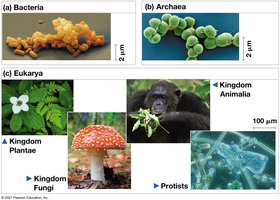
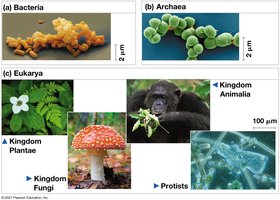
All life is classified into three domains: Bacteria, Archaea, and Eukarya. Eukarya includes four main kingdoms: Plantae, Fungi, Animalia, and Protists.
Bacteria: Prokaryotic, unicellular organisms.
Archaea: Prokaryotic, often found in extreme environments.
Eukarya: Eukaryotic organisms, including plants, fungi, animals, and protists.
Domain | Kingdoms/Subgroups | Characteristics |
|---|---|---|
Bacteria | — | Prokaryotic, unicellular |
Archaea | — | Prokaryotic, unicellular, extremophiles |
Eukarya | Plantae, Fungi, Animalia, Protists | Eukaryotic, multicellular or unicellular |
Evolution: Unity and Diversity of Life
Evolution explains both the unity and diversity of life. All organisms share common features due to descent from common ancestors, but diversity arises from adaptation to different environments.
Unity: Shared characteristics due to common ancestry.
Diversity: Differences due to evolutionary adaptation.
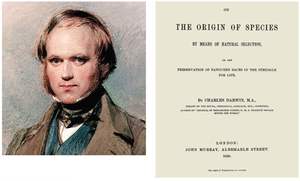
Charles Darwin and Natural Selection
Charles Darwin proposed that evolution occurs through natural selection, where individuals with advantageous traits are more likely to survive and reproduce. Over time, this leads to adaptation and speciation.
Descent with Modification: Species evolve from common ancestors.
Natural Selection: The environment selects for beneficial traits.
Tree of Life and Adaptive Radiation
Evolutionary relationships are depicted as treelike diagrams, showing how species diverge from common ancestors. Adaptive radiation, such as the finches of the Galápagos Islands, illustrates how species evolve to fill different ecological niches.
Example: Galápagos finches evolved from a common ancestor, adapting to different environments.
