 Back
Chapter 1: Exploring Life – Foundations of General Biology
Study Guide - Smart Notes
 Tailored notes based on your materials, expanded with key definitions, examples, and context.
Chapter 1: Exploring Life
Introduction to Biology
Biology is the scientific study of life, encompassing the structure, function, growth, origin, evolution, and distribution of living organisms. The field is unified by several core themes that help explain the diversity and complexity of life.
Biology: The study of living organisms and their interactions with the environment.
Scientific Method: The process by which scientists investigate questions about the natural world.
Unifying Themes: Concepts such as evolution, information flow, structure and function, energy transformations, and interactions.
Properties of Life
Emergent Properties and Characteristics of Life
Living organisms exhibit a set of emergent properties that distinguish them from nonliving matter. These properties arise from the complex organization and interaction of biological systems.
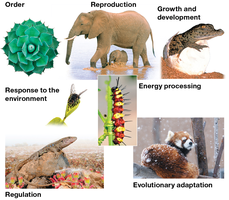
Order: Organisms display highly ordered structures.
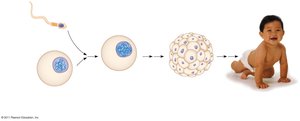
Reproduction: Life arises from pre-existing life; organisms reproduce their own kind.
Growth & Development: Organisms grow and develop according to inherited instructions.
Energy Processing: Organisms acquire and transform energy to maintain order and support growth.
Response to Environment: Organisms respond to environmental stimuli.
Regulation (Homeostasis): Organisms regulate internal conditions to maintain stability.
Evolutionary Adaptation: Populations evolve over generations, adapting to their environments.
Levels of Biological Organization
Hierarchy of Life
Biological systems are organized in a hierarchy, with each level building upon the previous one. This organization allows for emergent properties at each level.
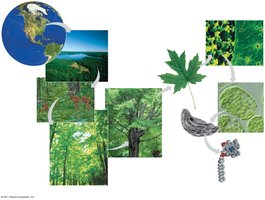
Biosphere: All life on Earth.
Ecosystems: Communities of organisms and their physical environment.
Communities: All organisms in a particular area.
Populations: Individuals of the same species in an area.
Organisms: Individual living entities.
Organ Systems & Organs: Groups of organs working together.
Tissues: Groups of similar cells.
Cells: Basic unit of life.
Organelles: Functional components within cells.
Molecules & Atoms: Chemical building blocks.
Reproduction and Growth
Biogenesis and Development
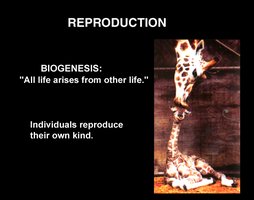
Reproduction is a fundamental property of life, ensuring the continuity of species. Growth and development follow genetic instructions passed from parent to offspring.
Biogenesis: All life arises from other life.
Inheritance: Offspring inherit DNA from both parents, guiding development.
Energy Processing
Acquisition and Transformation of Energy
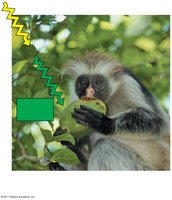
Organisms require energy to maintain order, grow, and reproduce. Energy is acquired from external sources and transformed within the organism.
Producers: Absorb light energy and convert it to chemical energy (photosynthesis).
Consumers: Obtain energy by eating other organisms.
Energy Transfer: Chemical energy in food is transferred from producers to consumers.
Response to Environment
Stimulus and Reaction
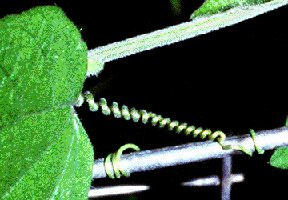
Organisms interact with their environment and respond to changes or stimuli to survive and thrive.
Response: Movement, growth, or physiological changes in reaction to environmental cues.
Regulation and Homeostasis
Maintaining Internal Stability
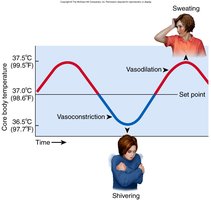
Homeostasis is the process by which organisms maintain stable internal conditions despite external changes. Regulation often involves negative feedback mechanisms.
Negative Feedback: Sensing a change and activating mechanisms to reverse it.
Example: Human thermoregulation—vasodilation and sweating when overheated, vasoconstriction and shivering when cold.
Diversity of Life: Domains and Kingdoms
Classification of Life
Life is categorized into three domains and several kingdoms based on evolutionary relationships and characteristics.
Domains: Bacteria, Archaea, Eukarya
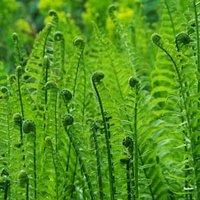
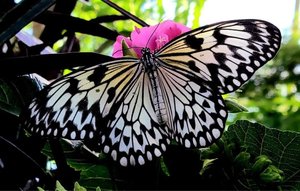
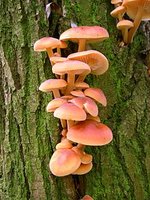
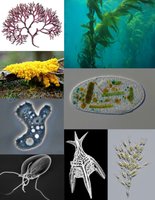
Kingdoms of Eukarya: Plantae (multicellular, photosynthetic), Animalia (multicellular, ingest organic matter), Fungi (multicellular, absorb organic matter), Protista (diverse, not fitting other kingdoms)
Taxonomy and Evolution
Unity and Diversity
Taxonomy is the science of classifying organisms. Evolution explains both the unity and diversity of life, as all species descend from common ancestors and adapt over time.
Descent with Modification: New species arise when populations become reproductively isolated.
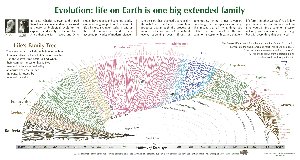
Branching Tree of Life: Similar species share recent common ancestors; distant species share more ancient ancestors.
Energy Acquisition in Multicellular Kingdoms
Comparative Strategies
Different kingdoms acquire energy in distinct ways, reflecting their evolutionary adaptations.
Kingdom | Energy Acquisition | Type |
|---|---|---|
Plantae | Capture light energy, make food from CO2 & H2O | Photosynthetic Autotrophs |
Fungi | Absorb organic matter | Chemo-Heterotrophs |
Animalia | Eat other organisms | Chemo-Heterotrophs |

Information Flow & Reproduction
Genetic Continuity
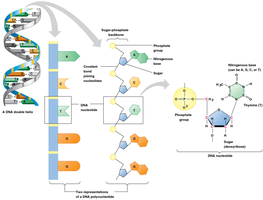
DNA is the heritable material that encodes instructions for structure and function. Information flows from DNA to RNA to proteins, guiding development and function.
Central Dogma: DNA → RNA → Protein
Inheritance: Genes are passed from parent to offspring.
Evolution: The Core Theme of Biology
Mechanisms and Principles
Evolution is the central theme in biology, explaining the genetic changes in populations over time. Natural selection drives adaptation and diversity.
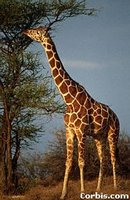
Natural Selection: Differential survival and reproduction favor advantageous traits.
Adaptation: Traits that enhance survival become more common in populations.
Energy Flow and Nutrient Cycling
Interactions in Ecosystems
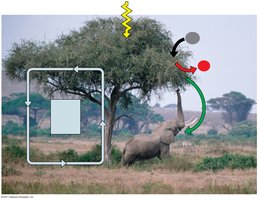
Energy flows through ecosystems, while nutrients cycle between organisms and the environment. Producers, consumers, and decomposers play key roles.
Energy Flow: Sunlight → Producers → Consumers → Decomposers
Nutrient Cycling: Elements like carbon and nitrogen are recycled.
Organisms and Their Environment
Interactions and Human Impact
Organisms interact with both living and nonliving components of their environment. Human activities have significantly altered ecosystems and the global climate.
Domestication: Plants and animals have been domesticated for agriculture.
Energy Use: Humans use plant, animal, and fossil energy.
Climate Change: Human-released CO2 affects the atmosphere.
The Scientific Method
Process of Scientific Inquiry
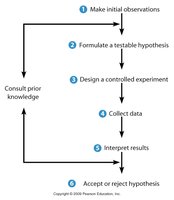
The scientific method is a systematic approach to investigating questions about the natural world. It involves observation, hypothesis formation, experimentation, and analysis.
Hypothesis: A testable and falsifiable statement.
Null Hypothesis: No effect or relationship.
Experimental Hypothesis: Predicts an effect or relationship.
Controlled Experiment: Only one variable is manipulated.
Hypothesis vs. Theory
Scientific Explanations
A hypothesis is a tentative explanation, while a theory is a well-supported explanation with predictive power, developed through extensive and reproducible observations.
Example: The Theory of Plate Tectonics explains geological phenomena and species distributions.
Discovery Science and Systems Biology
Data Collection and Modeling
Discovery science involves gathering data to expand knowledge, while systems biology constructs models to understand complex interactions within biological systems.
Model Organisms: Used to test effects of variables in well-known systems.
Databases: Genomics, proteomics, and phylogenies provide vast data for research.
Summary
Key Concepts
Properties of Life: Order, reproduction, growth, energy processing, response, regulation, adaptation.
Diversity of Life: Domains, kingdoms, taxonomy, evolution.
Scientific Process: Hypothesis, theory, experimentation, discovery science.
“Nothing in biology makes sense, except in the light of evolution.” – T. Dobzhansky
