Back
BackChapter 1: Introduction – Evolution and the Foundations of Biology (Campbell Biology in Focus, 3rd Edition)
Study Guide - Smart Notes
 Tailored notes based on your materials, expanded with key definitions, examples, and context.
Overview: Inquiring About Life
Biology is the scientific study of life and how living organisms function and interact.
Themes in the Study of Life
Unifying Themes in Biology
Organization: Life is structured in a hierarchy from molecules to the biosphere.
Information: Genetic information is stored, transmitted, and expressed in living systems.
Evolution: Evolution explains both the unity and diversity of life.
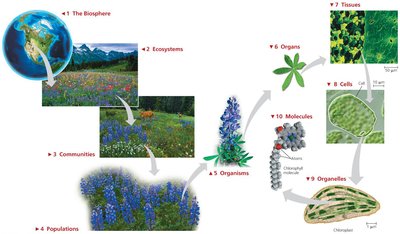
Levels of Biological Organization
Life can be studied at various levels, from molecules to the entire biosphere. Each level reveals emergent properties not present at lower levels.
Atom → Molecule → Organelle → Cell → Tissue → Organ → Organ System → Organism → Population → Community → Ecosystem → Biosphere
Each higher level displays emergent properties not found at lower levels.
Level | Definition |
|---|---|
Atom | Smallest unit of matter |
Molecule | Two or more atoms are bonded |
Organelle | Specialized structure inside cells |
Cell | Basic unit of life |
Tissue | Group of similar cells |
Organ | Structure made of tissues |
Organ System | A group of organs working together |
Organism | Individual living thing |
Population | Same species in one area |
Community | All populations in one area |
Ecosystem | Living and nonliving things are interacting |
Biosphere | All ecosystems on Earth |
Emergent Properties
Emergent properties
As biological organization increases, new properties emerge that are not present at lower levels.
Example:
Molecules are not alive
Cells ARE alive
KEY IDEA:
The whole is greater than the sum of its parts.
Theme 1: New Properties Emerge at Successive Levels of Biological Organization
Biological Hierarchy
Life can be studied at different levels, from molecules to the entire planet. Each level reveals emergent properties not present at lower levels.
Structure and Function: There is a correlation between structure and function at every level of biological organization. Analyzing structure provides clues to function.
The Cell: The Basic Unit of Life
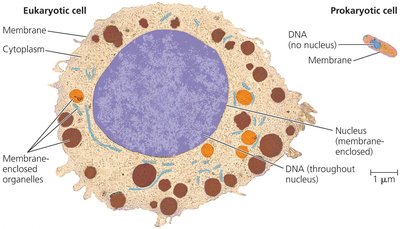
The cell is the smallest unit of life capable of performing all life functions. There are two main types of cells:
Prokaryotic cells: Lack a nucleus and membrane-bound organelles; generally smaller (e.g., Bacteria, Archaea).
Eukaryotic cells: Contain a nucleus and membrane-bound organelles; found in plants, animals, fungi, and protists.
Prokaryotic vs Eukaryotic Cells
Feature | Prokaryotic | Eukaryotic |
|---|---|---|
Nucleus | No | Yes |
Membrane-bound organelles | No | Yes |
Size | Smaller | Larger |
Examples | Bacteria, Archaea | Plants, animals, fungi, protists |
Genetic Material and Inheritance
DNA is the hereditary material in cells.
Genes are segments of DNA that carry inherited information.
DNA directs growth, development, and cell function.
The Core Theme: Evolution Accounts for the Unity and Diversity of Life
Evolution: Unity and Diversity of Life
Evolution explains both the unity and diversity of life.
Properties of Life
Definition of Life: Living organisms share common characteristics that distinguish them from nonliving things.
Summary Table:
Properties of Life Property | Description |
|---|---|
Organization/Order | complex but ordered structure; composed of cells |
Homeostasis | Maintaining stable internal conditions |
Metabolism | Obtaining and using energy; expelling waste |
Reproduction | Producing new offspring (sexual or asexual) |
Growth and Development | Genes control the pattern of growth |
Response to Stimuli | Sensing and responding to the environment |
Evolution | Populations change over generations through natural selection |
Classification of Life
Life is classified into three domains:
Bacteria (prokaryotes)
Archaea (prokaryotes)
Eukarya (eukaryotes: Plantae, Fungi, Animalia, and Protists)
Classification of Life
Three Domains: Bacteria, Archaea (both prokaryotic), and Eukarya (eukaryotic).
Domain Eukarya: Includes Plantae, Fungi, Animalia, and Protists.
Four Major Kingdoms
Kingdom | Main Traits |
|---|---|
Plantae | Photosynthetic, cell walls |
Fungi | Absorb nutrients, chitin cell walls |
Animalia | Consumers, no cell walls |
Protists | Diverse eukaryotes, mostly unicellular |
Charles Darwin and the Theory of Natural Selection
Individuals vary in traits
Traits are inherited
More offspring are produced than survive
Better-adapted organisms reproduce more
Advantageous traits become more common over generations
Natural selection is the mechanism of evolution.
The Process of Science
Scientific Inquiry and Hypotheses
Science is a process of inquiry involving observation, hypothesis formation, and experimental testing. Hypotheses must be testable and falsifiable.
Qualitative Data: Descriptive observations.
Quantitative Data: Numerical measurements, often displayed in tables or graphs.
Inductive Reasoning: Drawing generalizations from many observations.
Deductive Reasoning: Making specific predictions from general premises.
Hypothesis vs Theory
Hypothesis | Theory |
|---|---|
Testable explanation | Broad explanation supported by evidence |
Narrow scope | Broad scope |
Can be disproven | Generates new hypotheses |
Experimental Design
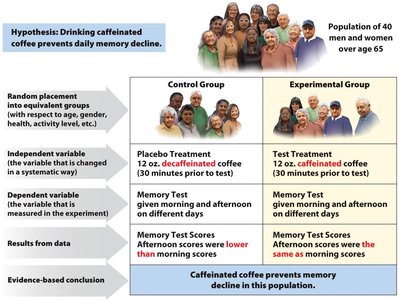
Experiments test hypotheses by manipulating variables and comparing experimental and control groups.
Term | Definition |
|---|---|
Independent Variable | Factor changed by the researcher |
Dependent Variable | Measured outcome |
Control Group | Normal comparison group |
Experimental Group | Receives treatment |
Example of a Controlled Experiment
Question: Does fertilizer increase plant growth?
Independent variable = amount of fertilizer
Dependent variable = plant height
Control group = plants without fertilizer
Experimental group = plants with fertilizer
Qualitative vs Quantitative Data
Qualitative | Quantitative |
|---|---|
Descriptive | Numerical |
Color, texture | Height, mass |
The Scientific Method
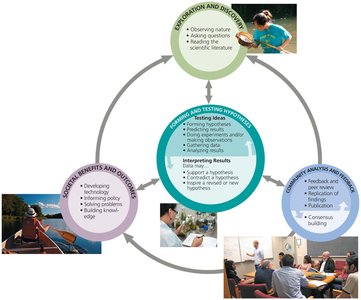
Make an observation
Ask a question
Study previous research
Form a hypothesis
Test the hypothesis with experiments
Analyze results
Conclude and repeat as necessary
Results must be reproducible by other scientists.
Science vs Other Ways of Knowing
Science:
Based on evidence
Testable
Repeatable
Peer-reviewed
Changes with new evidence