 Back
Chapter 1: Introduction to Biology – Key Themes and Foundations
Study Guide - Smart Notes
 Tailored notes based on your materials, expanded with key definitions, examples, and context.
Chapter 1: Biology – The Study of Life
Key Themes in Biology
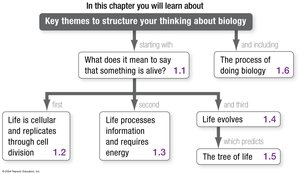
This chapter introduces the foundational concepts that structure biological thinking. It explores what it means for something to be alive, the cellular basis of life, information processing, energy requirements, evolution, and the scientific process.
What does it mean to say that something is alive? – Examines the properties that define living organisms.
Life is cellular and replicates through cell division – All life forms are composed of cells and reproduce by dividing.
Life processes information and requires energy – Organisms use genetic information and acquire energy to sustain life.
Life evolves – Populations change over time through evolution.
The tree of life – Depicts evolutionary relationships among organisms.
The process of doing biology – Science is driven by hypothesis testing and experimentation.
Properties of Life
Fundamental Characteristics of Living Organisms
All living organisms share five essential properties that distinguish them from non-living matter:
Cells: The basic unit of life; all organisms are made up of membrane-bound cells.
Replication: The ability to reproduce and generate offspring.
Information: Processing hereditary information encoded in genes and responding to environmental signals.
Energy: Acquisition and utilization of energy to maintain life processes.
Evolution: Populations of organisms change and adapt over time.
Example: Humans, plants, and bacteria all exhibit these properties, though in different ways.
The Scientific Method
Scientific Inquiry and Hypothesis Testing
The scientific method is a systematic approach to understanding natural phenomena. It involves observation, hypothesis formation, experimentation, and analysis.
Theory: A broad explanation supported by extensive evidence (e.g., cell theory, theory of evolution).
Hypothesis: A testable statement explaining an observation.
Experiment: A controlled test to determine the validity of a hypothesis.
Prediction: An expected outcome if the hypothesis is correct.
Example: Testing whether life can arise spontaneously (spontaneous generation) versus from preexisting life.
Experimental Example: Spontaneous Generation
Historical Experiments on the Origin of Life
Early scientists debated whether life could arise spontaneously from non-living matter. Key figures and experiments include:
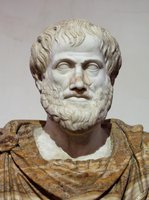
Aristotle: Proposed spontaneous generation based on observations of plants and animals.
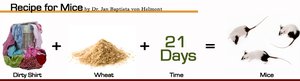
Jan Baptist van Helmont: Suggested a recipe for mice from wheat and dirty shirts.
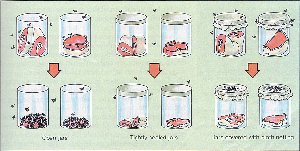
Francesco Redi: Demonstrated that maggots only appeared in meat when flies could access it, refuting spontaneous generation.
Louis Pasteur: Used swan-neck flasks to show that microbes do not spontaneously appear in sterilized broth, supporting biogenesis.
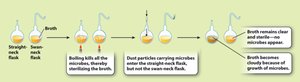
Additional info: These experiments established that life arises from preexisting life, not spontaneously from non-living material.
Life is Cellular and Replicates through Cell Division
Cell Theory and Early Microscopy
Cell theory states that all organisms are composed of cells and all cells come from preexisting cells. Early microscopy enabled scientists to observe cells and single-celled organisms.
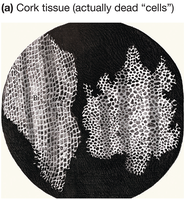
Robert Hooke: Observed cork tissue and coined the term "cells."
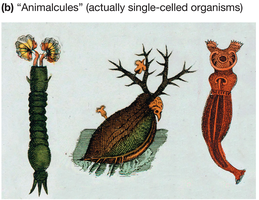
Anton van Leeuwenhoek: Observed "animalcules" (single-celled organisms).
Cell Theory: All living things are made of cells; all cells arise from other cells.
Example: Human blood cells, diatoms, and cells in the small intestine are all examples of cellular life.
Life Processes Information and Requires Energy
Genetic Information and the Central Dogma
Hereditary information is encoded in DNA, which is organized into genes located on chromosomes. The central dogma describes the flow of genetic information:
DNA: The hereditary material; composed of four nucleotides (A, T, C, G).
Central Dogma:
RNA: Messenger RNA (mRNA) is transcribed from DNA and translated into proteins.
Proteins: Perform structural and functional roles in cells.
Example: The sequence of DNA nucleotides determines the structure and function of proteins in an organism.
Energy: Organisms require energy (often in the form of ATP) and building blocks for growth and reproduction.
Life Evolves
Evolution and Natural Selection
Evolution is the change in characteristics of populations over time. Darwin and Wallace proposed that species are related by common ancestry and can change through descent with modification.
Population: A group of individuals of the same species living in the same area.
Natural Selection: Traits that are heritable and provide an advantage in a particular environment become more common.
Example: Giraffes may have evolved long necks due to advantages in competition or mating.
Taxonomy and the Tree of Life
Classification and Phylogeny
Taxonomy is the science of naming and classifying organisms. The tree of life depicts evolutionary relationships among all organisms.
Domain: The highest taxonomic level; includes Bacteria, Archaea, and Eukarya.
Phylogeny: The genealogical relationships among organisms.
Scientific Name: Binomial nomenclature (Genus species), e.g., Homo sapiens.
Example: Modern phylogenetic trees are constructed using genetic sequence data to reveal relationships.
Doing Biology: The Nature of Science
Hypothesis Testing and Scientific Studies
Biology relies on formulating hypotheses and testing them through observation and experimentation. Hypothesis testing involves stating predictions and designing studies to test them.
Hypothesis: Precise statement with testable predictions.
Experiment: Observational or experimental study to test predictions.
Data: Evidence that supports or refutes hypotheses.
Example: Studies on giraffe neck length tested competing hypotheses about its evolutionary origin.
Summary Table: Properties of Life
Property | Description | Example |
|---|---|---|
Cells | Basic unit of life | Human blood cell |
Replication | Ability to reproduce | Bacteria dividing |
Information | Genetic and environmental processing | DNA in chromosomes |
Energy | Acquisition and use of energy | ATP production |
Evolution | Change over time | Natural selection in giraffes |
