 Back
Chapter 1: Learning About Life – The Process and Themes of Biology
Study Guide - Smart Notes
 Tailored notes based on your materials, expanded with key definitions, examples, and context.
Learning About Life
Introduction to Biology
Biology is the scientific study of life, encompassing the structure, function, growth, origin, evolution, and distribution of living organisms. To study biology scientifically means to use systematic inquiry and evidence-based approaches to understand the natural world.
An Overview of the Process of Science
What is Science?
Science is an approach to understanding the natural world based on inquiry—a search for information, evidence, explanations, and answers to specific questions. Scientists seek natural causes for natural phenomena and focus on structures and processes that can be verifiably observed and measured.
Exploration in Science
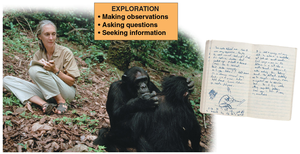
Scientific inquiry begins with exploration, which involves making observations, asking questions, and seeking information. Recorded observations are called data, which serve as the foundation for scientific inquiry.
Observation: Careful watching and recording of phenomena.
Data: Evidence collected from observations.
Testing Hypotheses
A hypothesis is a proposed explanation for a set of observations. For a hypothesis to be valid, it must be testable and falsifiable. Testing can involve controlled experiments or further observations, depending on the nature of the hypothesis.
Experiment: A scientific test, often under controlled conditions.
Observation-based Testing: Used when variables cannot be controlled (e.g., ecological studies).
Results: Support or do not support the hypothesis.
Communication in Science
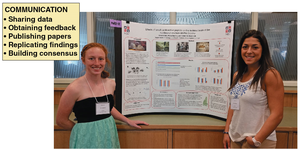
Communication is essential in science for sharing data, obtaining feedback, publishing results, replicating findings, and building consensus. Peer review, where impartial experts evaluate research before publication, ensures quality and reliability.
Hypotheses, Theories, and Facts
Theory: A comprehensive, well-substantiated explanation, broader than a hypothesis, supported by a large body of evidence. Theories can generate new hypotheses and must be refined or abandoned if new evidence contradicts them. Fact: Information considered objectively true based on current evidence. Facts can be verified and are distinct from opinions.
The primary goal of science is to develop explanations that apply to a wide variety of phenomena, not just to accumulate facts.
Controlled Experiments
Controlled experiments compare two or more groups that differ only in one variable. The control group does not receive the factor being tested, while the experimental group does. Variables are factors that change in an experiment.
Placebo: An inactive treatment used as a control in medical trials.
Double-blind experiment: Neither participants nor experimenters know who receives the treatment, reducing bias.
Evaluating Scientific Claims and Pseudoscience
Pseudoscience is any field falsely presented as having a scientific basis. It often relies on anecdotal evidence and lacks rigorous testing. Reliable scientific claims are typically peer-reviewed and reproducible.
Indicators of reliable sources include current information, primary sources, qualified authors, lack of conflicts of interest, cited references, reproducible experiments, peer review, unbiased presentation, and valid intent.
The Properties of Life
Characteristics of Living Things
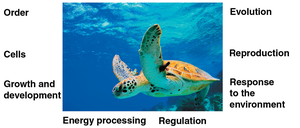
Living organisms share several key properties. An object is considered alive if it displays all of these characteristics simultaneously:
Order: Highly ordered structure
Cells: Composed of one or more cells
Growth and Development: Consistent growth and development controlled by inherited DNA
Energy Processing: Ability to obtain and use energy
Regulation: Ability to maintain internal stability (homeostasis)
Response to the Environment: Ability to respond to environmental stimuli
Reproduction: Ability to reproduce their own kind
Evolution: Populations evolve over generations
Diversity of Life
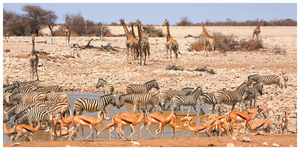
Life on Earth exhibits tremendous diversity, with millions of species adapted to various environments.
Major Themes in Biology
Five Unifying Themes
Biology is unified by several major themes that recur throughout the study of life:
Structure and Function: The form of biological structures is closely related to their function.
Information Flow: Life depends on the transmission and use of information, such as genetic information in DNA.
Pathways That Transform Energy and Matter: All living things require energy and matter to grow, develop, and maintain their structures.
Interactions Within Biological Systems: Life is organized into a hierarchy of levels, from molecules to the biosphere, with interactions at each level.
Evolution: The process that explains both the unity and diversity of life.
The Relationship of Structure to Function
At all levels of biological organization, structure and function are correlated. For example, the branched structure of the lungs provides a large surface area for gas exchange.
Information Flow
Information flow is essential for life. Genes, composed of DNA, carry hereditary information that is passed from one generation to the next. Cells use this information to regulate their activities and respond to the environment.
The four chemical building blocks of DNA are abbreviated as A, G, C, and T.
Pathways That Transform Energy and Matter
Living organisms obtain energy from their environment (often from the sun) and transform it to power life processes. Energy flows through ecosystems, while matter cycles within them. Some energy is always lost as heat.
Interactions Within Biological Systems
Biological systems are organized into a hierarchy, from molecules and cells to organisms, populations, communities, and the biosphere. At each level, new properties emerge due to the arrangement and interactions of parts.
Evolution
Evolution is the central, unifying principle of biology. It explains both the similarities (unity) and differences (diversity) among living organisms. The theory of evolution by natural selection, first articulated by Charles Darwin, describes how populations change over time as individuals with advantageous traits survive and reproduce more successfully.
Natural Selection: The process by which the environment "selects" for traits that enhance survival and reproduction.
Tree of Life: All species are related through common ancestry, forming a branching evolutionary tree.
