 Back
Chapter 1: Themes in Biology & Scientific Inquiry – Study Notes
Study Guide - Smart Notes
 Tailored notes based on your materials, expanded with key definitions, examples, and context.
Chapter 1: Themes in Biology & Scientific Inquiry
Introduction to Biology
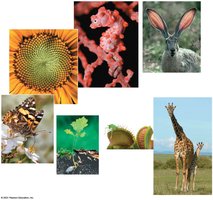
Biology is the scientific study of life. Life is recognized by a set of characteristics and behaviors, rather than a single definition. These characteristics include order, reproduction, growth and development, response to the environment, energy processing, regulation, and adaptation.
Order: Living things exhibit complex but ordered organization.
Reproduction: Organisms reproduce their own kind.
Growth & Development: Inherited information carried by genes controls the pattern of growth and development.
Response to Environment: All organisms respond to environmental stimuli.
Energy Processing: Organisms take in energy and use it to power activities.
Regulation: Organisms regulate their internal environment to maintain a stable, constant condition (homeostasis).
Adaptation: Evolutionary adaptation occurs over generations as individuals with traits best suited to their environments have greater reproductive success.
Themes in Biology
Theme 1: Organization
Biological organization is hierarchical, with new properties emerging at each level. Life can be studied from molecules to the entire biosphere. These levels include:
Molecules
Organelles
Cells
Tissues
Organs
Organisms
Populations
Communities
Ecosystems
Biosphere
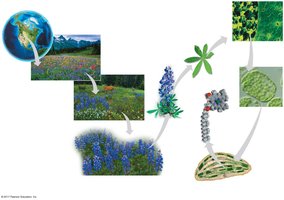
Emergent Properties: These are properties that arise from the arrangement and interaction of parts as complexity increases. For example, a functioning bicycle only works when all parts are correctly assembled.
Structure and Function: At each level, there is a correlation between structure and function. For example, the thin, flat shape of a leaf maximizes light capture for photosynthesis.
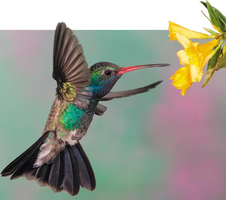
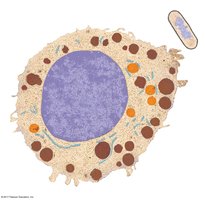
The Cell: The cell is the smallest unit of organization that can perform all activities required for life. There are two main types of cells:
Prokaryotic cells: Lack membrane-bound organelles and a nucleus (e.g., Bacteria, Archaea).
Eukaryotic cells: Have membrane-bound organelles and a nucleus (e.g., plants, animals, fungi, protists).
Theme 2: Information
Life’s processes involve the transmission and expression of genetic information. Genetic information is stored in DNA, which is organized into chromosomes. Genes are units of inheritance that encode instructions for building proteins and direct the development and functioning of organisms.
Gene transmission: Passing genetic code to offspring.
Gene expression: Using genetic code to produce cellular products (proteins).
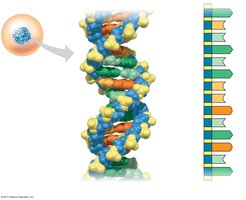
Genomics: The study of whole sets of genes and their interactions. Proteomics is the study of all proteins expressed by a cell, tissue, or organism. Bioinformatics uses computational tools to analyze large biological data sets.
Theme 3: Energy and Matter
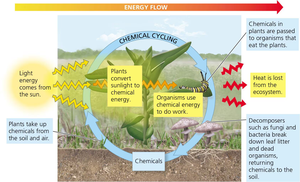
All living organisms require energy to carry out life’s activities. Energy flows through an ecosystem, while chemicals cycle within it. Producers (such as plants) convert energy from sunlight into chemical energy, which is then used by consumers (animals, fungi, etc.). Decomposers return chemicals to the environment.

Theme 4: Interactions
Interactions occur at all levels of biological organization. Within organisms, components interact through signaling, transport, and feedback mechanisms. In ecosystems, organisms interact with each other and with their environment.
Negative feedback: The accumulation of an end product slows or stops the process (e.g., insulin regulation of blood glucose).
Positive feedback: The accumulation of an end product speeds up its own production.
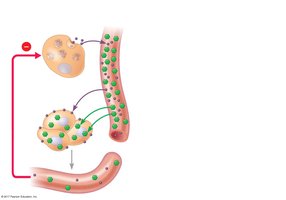
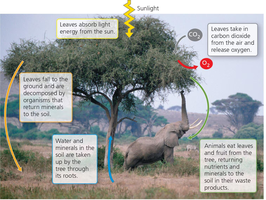
At the ecosystem level, interactions can be beneficial (symbiotic), harmful (parasitic or predatory), or neutral. Organisms also interact with physical factors such as sunlight, water, and minerals.
Taxonomy: Classifying the Diversity of Life
Taxonomy is the branch of biology that names and classifies species into groups. Each species is given a two-part name (genus and species). The current system divides life into three domains:
Bacteria (prokaryotes)
Archaea (prokaryotes)
Eukarya (eukaryotes: includes Kingdoms Plantae, Fungi, Animalia, and Protists)
Classification hierarchy: Species → Genus → Family → Order → Class → Phylum → Kingdom → Domain
Scientific Inquiry and the Process of Science
The goal of science is to understand natural phenomena through observation, hypothesis formation, and experimentation. Data can be qualitative (descriptions) or quantitative (numerical measurements).
Hypothesis: A testable and falsifiable explanation for an observation.
Deductive reasoning: General premises to specific predictions.
Inductive reasoning: Specific observations to general conclusions.
Experiments involve variables:
Independent variable: Manipulated by the researcher.
Dependent variable: Measured outcome.
Controlled variables: Kept constant.
Control group: Does not receive the experimental treatment.
Statistical analysis is used to determine the probability that results are due to chance (p-value < 0.05 is commonly accepted). Results must be repeatable and subject to peer review.
Theories in Science
A scientific theory is broader than a hypothesis, supported by a large body of evidence, and can generate new hypotheses. Theories can be modified or rejected if new evidence arises.
Key Terms and Concepts
Biology: The scientific study of life.
Emergent properties: New properties that arise with each step upward in the hierarchy of life.
Genomics: Study of whole sets of genes and their interactions.
Proteomics: Study of all proteins expressed by a cell, tissue, or organism.
Bioinformatics: Application of computational methods to analyze biological data.
Taxonomy: Science of naming and classifying organisms.
Producer: Organism that produces organic compounds from CO2 by harnessing light or chemical energy.
Consumer: Organism that feeds on producers or other consumers.
Negative feedback: End product reduces the process that created it.
Positive feedback: End product speeds up its own production.
Prokaryotic cell: Cell lacking a nucleus and membrane-bound organelles.
Eukaryotic cell: Cell with a nucleus and membrane-bound organelles.
DNA: Deoxyribonucleic acid, carrier of genetic information.
Gene: Unit of inheritance encoding information for building proteins.
Chromosome: Structure carrying genetic material.
Hypothesis: Testable explanation for an observation.
Theory: Broad explanation supported by evidence.
Summary Table: Major Themes in Biology
Theme | Description | Example |
|---|---|---|
Organization | Hierarchy of biological structure; emergent properties | Cells, tissues, organs, organisms |
Information | Transmission and expression of genetic information | DNA, gene expression |
Energy & Matter | Energy flow and chemical cycling in ecosystems | Photosynthesis, food webs |
Interactions | Interactions within and between organisms and their environment | Feedback regulation, symbiosis |
Additional info: These notes are based on the introductory chapter of a General Biology textbook and are designed to provide a comprehensive overview of the foundational themes and concepts in biology, including the scientific method and classification of life.
