 Back
Chapter 10: Photosynthesis – Harnessing Sunlight to Make Carbohydrates
Study Guide - Smart Notes
 Tailored notes based on your materials, expanded with key definitions, examples, and context.
Photosynthesis: Overview and Significance
Introduction to Photosynthesis
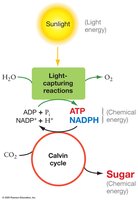
Photosynthesis is a fundamental biological process that converts solar energy into chemical energy, enabling life on Earth. It requires sunlight, carbon dioxide (CO2), and water (H2O), producing oxygen (O2) as a by-product and carbohydrates as the main energy storage molecules.
Key Point: The overall photosynthesis reaction is the reverse of cellular respiration.
Key Point: Photosynthesis consists of two linked sets of reactions: light-capturing reactions and the Calvin cycle.
Example: Plants, algae, and some bacteria perform photosynthesis, sustaining most ecosystems.
Photosynthesis Occurs in Chloroplasts
Structure and Function of Chloroplasts
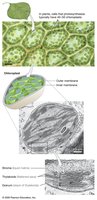
Chloroplasts are specialized organelles in plant cells where photosynthesis takes place. They are surrounded by double membranes and contain thylakoids, which are stacked into grana. The thylakoid lumen is the internal space, and the stroma is the fluid-filled area surrounding the thylakoids.
Key Point: Thylakoid membranes contain pigments that absorb light energy.
Key Point: Chlorophyll is the most common pigment, responsible for the green color of plants.
Light and Pigments in Photosynthesis
Electromagnetic Radiation and Light Absorption
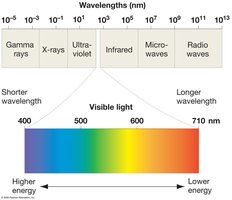
Light is a form of electromagnetic radiation, characterized by wavelength and energy. Pigments absorb specific wavelengths, and the energy of a photon is inversely proportional to its wavelength.
Key Point: Shorter wavelengths (e.g., blue light) have higher energy than longer wavelengths (e.g., red light).
Key Point: Visible light is the range used in photosynthesis.
Photosynthetic Pigments and Chromatography
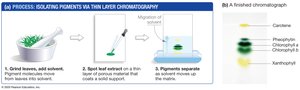
Pigments absorb only certain wavelengths of light. Thin layer chromatography is used to separate and identify plant pigments.
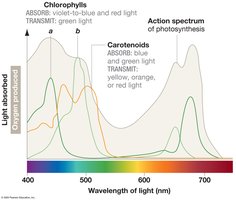
Key Point: Chlorophylls absorb red and blue light; carotenoids absorb blue and green light.
Key Point: Pigments appear colored because they reflect or transmit wavelengths not absorbed.
Absorption and Action Spectra
The absorption spectrum shows how much light is absorbed by pigments at different wavelengths. The action spectrum indicates which wavelengths are most effective for photosynthesis.
Key Point: Chlorophylls are most effective at driving photosynthesis, especially in blue and red regions.
Key Point: Carotenoids extend the range of light absorption and protect chlorophyll from damage.
Experimental Evidence for Effective Wavelengths
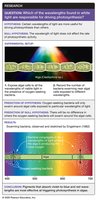
Engelmann's experiment demonstrated that violet-blue and red light are most effective for photosynthesis, as indicated by the congregation of aerobic bacteria near these regions.
Key Point: Oxygen production is highest where chlorophyll absorbs light most efficiently.
Structure of Photosynthetic Pigments
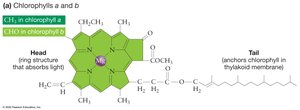
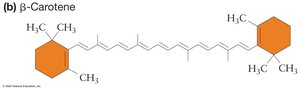
Chlorophyll molecules have a long hydrophobic tail and a head with a ring structure containing magnesium, which absorbs light. Carotenoids have a structure with alternating double bonds, allowing them to absorb light and stabilize free radicals.
Key Point: The head region of chlorophyll is where light absorption occurs.
Light Absorption and Electron Excitation
Excited States of Electrons
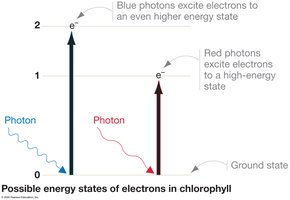
When chlorophyll absorbs photons, electrons are promoted to higher energy states. Red photons raise electrons one energy level, blue photons raise them two levels, and green photons are not absorbed.
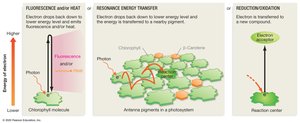
Key Point: Excited electrons can return to ground state, releasing energy as heat or light (fluorescence).
Key Point: Most absorbed energy drives photosynthesis, not fluorescence.
Photosystems and Energy Transfer
Organization of Photosystems
Photosystems are complexes of chlorophyll and accessory pigments in the thylakoid membrane. They consist of antenna pigments that gather light and a reaction center where energy is converted to chemical form.
Key Point: Energy is transferred between pigments by resonance energy transfer.
Key Point: The reaction center transfers excited electrons to electron acceptors in redox reactions.
Photosystem II and Electron Transport Chain
Electron Transport and ATP Production
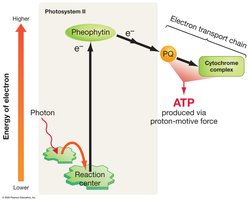
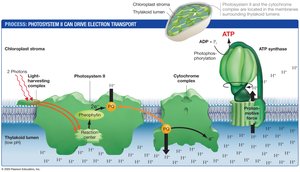
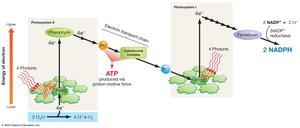
Photosystem II passes excited electrons to the electron transport chain (ETC), which includes plastoquinone (PQ) and cytochrome complexes. Redox reactions create a proton gradient across the thylakoid membrane, driving ATP synthesis via ATP synthase.
Key Point: ATP is produced by photophosphorylation, using energy from light.
Key Point: Photosystem II obtains electrons by oxidizing water, releasing O2.
Photosystem I and NADPH Production
Reduction of NADP+
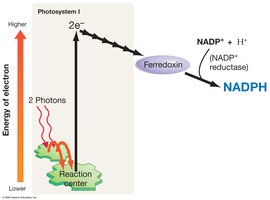
Photosystem I absorbs photons and passes excited electrons to NADP+ via ferredoxin and NADP+ reductase, forming NADPH. NADPH is used in the Calvin cycle for carbon fixation.
Key Point: Photosystem I produces NADPH, while Photosystem II produces ATP.
The Z Scheme and Electron Flow
Interaction of Photosystems I and II
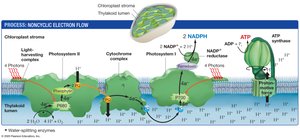
The Z scheme describes the linear flow of electrons from water (via Photosystem II) to NADP+ (via Photosystem I), producing ATP and NADPH. This process is called noncyclic electron flow.
Key Point: Electrons are passed from water to NADP+ in a linear pathway, generating both ATP and NADPH.
Key Point: The enhancement effect occurs when both photosystems are activated by different wavelengths, maximizing photosynthetic efficiency.
Cyclic Electron Flow
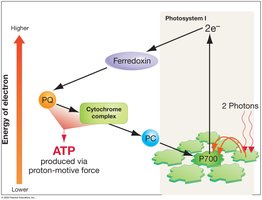
Cyclic electron flow involves only Photosystem I, recycling electrons to produce additional ATP without generating NADPH or O2. This process supplements ATP production when needed.
Key Point: Cyclic electron flow is important for balancing ATP and NADPH requirements in the chloroplast.
Carbon Dioxide Capture and the Calvin Cycle
Stomata and Gas Exchange
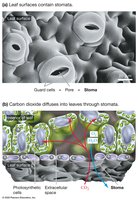
Plants have a waxy cuticle to prevent water loss, but this also restricts gas exchange. Stomata, pores formed by guard cells, allow CO2 to enter and O2 to exit the leaf, facilitating photosynthesis.
Key Point: Open stomata maintain a strong CO2 concentration gradient for efficient photosynthesis.
The Calvin Cycle: Carbon Fixation and Reduction
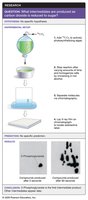
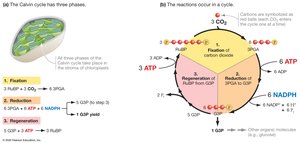
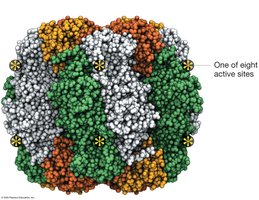
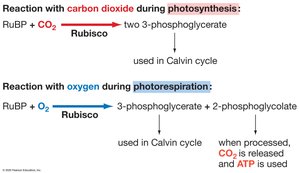
The Calvin cycle is the process by which CO2 is fixed and reduced to produce sugars. It consists of three phases: fixation, reduction, and regeneration. The enzyme Rubisco catalyzes the initial fixation of CO2 to ribulose biphosphate (RuBP).
Key Point: ATP and NADPH produced in light-capturing reactions are used in the Calvin cycle.
Key Point: One turn of the Calvin cycle fixes one molecule of CO2.
Rubisco and Photorespiration
Rubisco is the most abundant enzyme in photosynthetic organisms but is slow and inefficient. It can catalyze the addition of either CO2 or O2 to RuBP. When O2 is used, photorespiration occurs, which consumes O2 and releases CO2, reducing photosynthetic efficiency.
Key Point: Photorespiration "undoes" photosynthesis by consuming energy and releasing fixed carbon.
Mechanisms for Increasing CO2 Concentration
C4 Pathway
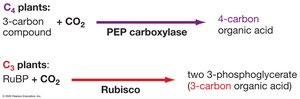
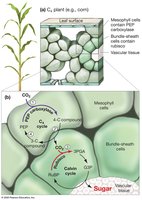
C4 plants use an additional pathway to concentrate CO2 and minimize photorespiration. PEP carboxylase fixes CO2 in mesophyll cells, producing a four-carbon compound that is transported to bundle-sheath cells, where CO2 is released for the Calvin cycle.
Key Point: C4 pathway spatially separates carbon fixation and the Calvin cycle.
CAM Pathway
Crassulacean acid metabolism (CAM) plants fix CO2 at night, storing it as a four-carbon acid. During the day, CO2 is released for the Calvin cycle. This temporal separation allows CAM plants to keep stomata closed during hot, dry days, minimizing water loss.
Key Point: CAM pathway temporally separates carbon fixation and the Calvin cycle.
Key Point: Both C4 and CAM pathways function as CO2 pumps, reducing photorespiration.
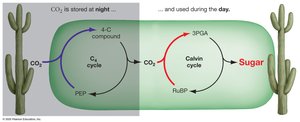
Pathway | Carbon Fixation Location | Calvin Cycle Location | Photorespiration Minimization |
|---|---|---|---|
C3 | Mesophyll cells | Mesophyll cells | None |
C4 | Mesophyll cells (PEP carboxylase) | Bundle-sheath cells (Rubisco) | Spatial separation |
CAM | Night (PEP carboxylase) | Day (Rubisco) | Temporal separation |
Summary
Photosynthesis is a complex, multi-step process essential for life on Earth. It involves the capture of light energy, electron transport, ATP and NADPH production, and carbon fixation via the Calvin cycle. Adaptations such as C4 and CAM pathways allow plants to thrive in diverse environments by minimizing photorespiration and maximizing efficiency.
