 Back
Chapter 10: Photosynthesis – Harnessing Sunlight to Make Carbohydrates
Study Guide - Smart Notes
 Tailored notes based on your materials, expanded with key definitions, examples, and context.
Photosynthesis: Overview and Significance
Introduction to Photosynthesis
Photosynthesis is a fundamental biological process that converts solar energy into chemical energy, enabling life on Earth. It requires sunlight, carbon dioxide (CO2), and water (H2), producing oxygen (O2) as a by-product and carbohydrates as the main energy source for living organisms.
Key Point: The overall photosynthesis reaction is the reverse of cellular respiration.
Key Point: Photosynthesis consists of two linked sets of reactions: light-capturing reactions and the Calvin cycle.
Example: Plants, algae, and some bacteria perform photosynthesis, sustaining most ecosystems.
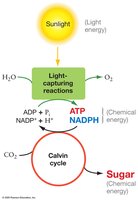
Photosynthesis: Two Linked Sets of Reactions
Light-Capturing Reactions and the Calvin Cycle
Photosynthesis is divided into two main stages: the light-capturing reactions and the Calvin cycle. Light-capturing reactions occur in the thylakoid membranes and produce ATP and NADPH, while the Calvin cycle uses these products to fix carbon and synthesize sugars.
Light-capturing reactions: Split water to release O2, excite electrons, and transfer them to NADP+ to form NADPH.
Calvin cycle: Uses ATP and NADPH to reduce CO2 and produce carbohydrates.
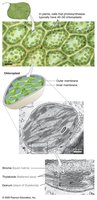
Photosynthesis Occurs in Chloroplasts
Structure and Function of Chloroplasts
Chloroplasts are the organelles where photosynthesis takes place. They are surrounded by double membranes and contain thylakoids, grana, stroma, and lumen, each playing a specific role in the process.
Thylakoids: Flattened membrane structures where light-capturing reactions occur.
Grana: Stacks of thylakoids.
Stroma: Fluid-filled space where the Calvin cycle occurs.
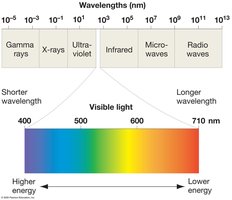
Light and Pigments in Photosynthesis
Electromagnetic Radiation and Pigment Function
Light is a form of electromagnetic radiation, characterized by wavelength and energy. Pigments in chloroplasts absorb specific wavelengths, enabling the capture of light energy for photosynthesis.
Photon: A discrete packet of light energy.
Energy: Shorter wavelengths have higher energy.
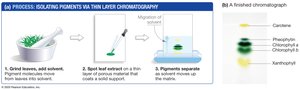
Photosynthetic Pigments and Chromatography
Chlorophylls and carotenoids are the main pigments involved in photosynthesis. Chromatography is used to separate and identify these pigments.
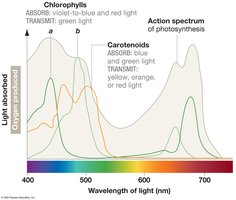
Chlorophylls: Absorb red and blue light, reflect green.
Carotenoids: Absorb blue and green light, reflect yellow, orange, and red.
Thin layer chromatography: Separates pigments based on their movement through a solid medium.
Absorption and Action Spectra
The absorption spectrum shows how pigments absorb different wavelengths, while the action spectrum indicates which wavelengths drive photosynthesis most effectively.
Chlorophylls: Most effective at absorbing violet-blue and red light.
Carotenoids: Extend the range of light absorption and protect chlorophylls.
Experimental Evidence for Effective Wavelengths
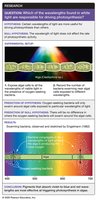
Engelmann's experiment demonstrated that violet-blue and red light are most effective for photosynthesis, as indicated by the congregation of aerobic bacteria near oxygen-producing regions of algae.
Key Point: Oxygen production correlates with light absorption by chlorophyll.
Structure of Photosynthetic Pigments
Chlorophyll and Carotenoid Structures
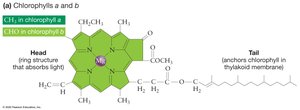
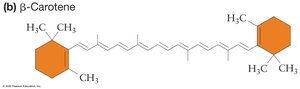
Chlorophyll molecules have a long hydrophobic tail and a head with a ring structure containing magnesium, which absorbs light. Carotenoids have a structure that allows them to absorb and transfer energy.
Chlorophyll: Head absorbs light; tail anchors in thylakoid membrane.
Carotenoids: Accessory pigments that protect and extend light absorption.
Light Absorption and Electron Excitation
Excited States of Electrons
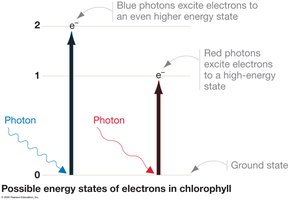
When chlorophyll absorbs photons, electrons are promoted to higher energy states. Red photons raise electrons one energy level, blue photons raise them two levels, and green photons are not absorbed.
Excited electron: Can return to ground state, releasing energy as heat or light (fluorescence).
Key Point: Most absorbed energy drives photosynthesis, not fluorescence.
Photosystems and Energy Transfer
Organization of Photosystems
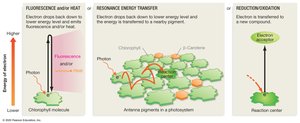
Photosystems are complexes of chlorophyll and accessory pigments that capture and transfer light energy. Antenna pigments transfer energy to the reaction center via resonance energy transfer.
Photosystem: Contains 200–300 pigment molecules.
Antenna pigments: Guide energy to the reaction center.
Fates of Excited Electrons
Excited electrons in photosynthetic pigments can follow four paths: fluorescence, heat, resonance energy transfer, or redox reactions.
Redox reaction: Electron transferred to an acceptor, initiating chemical energy conversion.
Photosystem II and Electron Transport Chain
Electron Transport and ATP Production
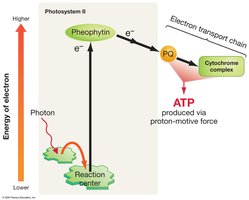
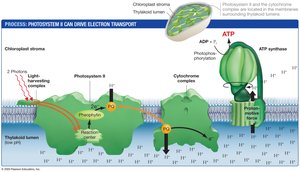
Photosystem II passes excited electrons to the electron transport chain (ETC), creating a proton gradient that drives ATP synthesis via ATP synthase.
Plastoquinone (PQ): Shuttles electrons and protons across the thylakoid membrane.
Proton-motive force: Drives ATP production.
Photosystem II: Water Oxidation and Oxygen Production
Oxygenic vs. Anoxygenic Photosynthesis
Photosystem II is unique in its ability to oxidize water, producing oxygen. Some bacteria perform anoxygenic photosynthesis, using other electron donors and not producing oxygen.
Oxygenic photosynthesis: Water is split, releasing O2.
Anoxygenic photosynthesis: Uses H2S or other donors, releases sulfur.
Photosystem I and NADPH Production
Electron Transfer to NADP+
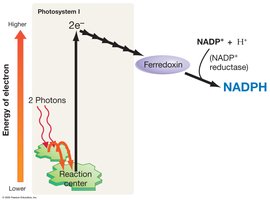
Photosystem I absorbs photons, excites electrons, and transfers them to NADP+ via ferredoxin, forming NADPH. This process is essential for the Calvin cycle.
NADPH: Electron carrier used in carbon fixation.
The Z Scheme: Integration of Photosystems II and I
Noncyclic Electron Flow
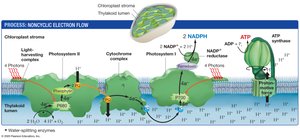
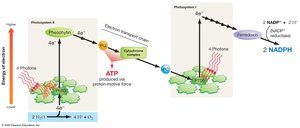
The Z scheme describes the linear flow of electrons from water through Photosystem II and I to NADP+. This process produces both ATP and NADPH.
Noncyclic electron flow: Electrons move in a linear path, producing ATP and NADPH.
Enhancement effect: Both photosystems operate at maximum efficiency when illuminated with both red and far-red light.
Cyclic Electron Flow
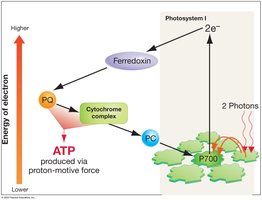
Cyclic electron flow occurs when Photosystem I recycles electrons, producing additional ATP but not NADPH. This process does not release oxygen and helps balance ATP/NADPH production.
Cyclic photophosphorylation: Only ATP is produced; electrons cycle back to Photosystem I.
Oxygenic Photosynthesis and Earth's Evolution
Impact of Oxygen Production
The release of oxygen from photosynthesis was crucial for the evolution of aerobic life and the formation of the ozone layer, which protects Earth from harmful UV radiation.
Ozone (O3): Formed from O2, provides a protective atmospheric layer.
Carbon Dioxide Capture and the Calvin Cycle
Stomata and Gas Exchange
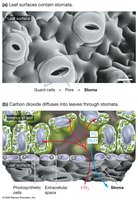
Plants regulate gas exchange through stomata, pores formed by guard cells. The waxy cuticle prevents water loss but also restricts gas movement, so stomata must open for CO2 uptake.
Stomata: Allow CO2 in and O2 out.
Cuticle: Prevents water evaporation.
The Calvin Cycle: Carbon Fixation and Reduction
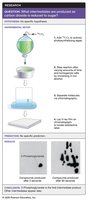
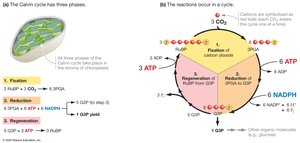
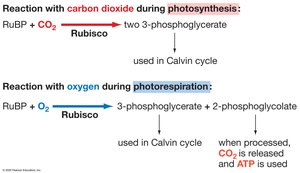
The Calvin cycle fixes carbon from CO2 into organic molecules. It consists of three phases: fixation, reduction, and regeneration. The enzyme Rubisco catalyzes the initial fixation step.
Fixation: CO2 reacts with RuBP to form 3-phosphoglycerate (3PGA).
Reduction: 3PGA is converted to glyceraldehyde-3-phosphate (G3P).
Regeneration: G3P is used to regenerate RuBP.
Rubisco: The Key Enzyme in Carbon Fixation
Structure and Function of Rubisco
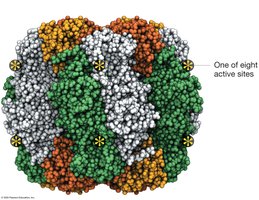
Rubisco (ribulose-1,5-bisphosphate carboxylase/oxygenase) is the most abundant enzyme in photosynthetic tissues. It catalyzes the addition of CO2 or O2 to RuBP, but is slow and inefficient.
Rubisco: Can react with either CO2 (photosynthesis) or O2 (photorespiration).
Photorespiration: Consumes O2 and releases CO2, reducing photosynthetic efficiency.
Mechanisms for Increasing CO2 Concentration
C4 and CAM Pathways
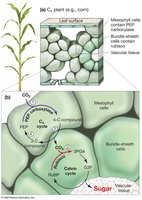
Plants have evolved mechanisms to increase CO2 concentration and minimize photorespiration, especially in hot and dry environments. C4 and CAM pathways are adaptations that enhance carbon fixation efficiency.
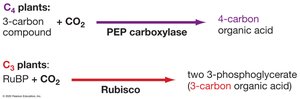
C4 pathway: Spatially separates initial carbon fixation (PEP carboxylase in mesophyll cells) and the Calvin cycle (Rubisco in bundle sheath cells).
CAM pathway: Temporally separates carbon fixation (at night) and the Calvin cycle (during the day).
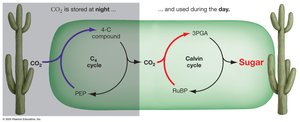
Summary Table: Comparison of Photosynthetic Pathways
Pathway | Initial Carbon Fixation | Location/Timing | Key Enzyme | Photorespiration Minimization |
|---|---|---|---|---|
C3 | CO2 + RuBP → 3PGA | Mesophyll cells (day) | Rubisco | None |
C4 | CO2 + 3-carbon compound → 4-carbon acid | Mesophyll (PEP carboxylase), Bundle sheath (Rubisco) | PEP carboxylase, Rubisco | Spatial separation |
CAM | CO2 + 3-carbon compound → 4-carbon acid | Night (carbon fixation), Day (Calvin cycle) | PEP carboxylase, Rubisco | Temporal separation |
Additional info: C4 and CAM pathways are evolutionary adaptations to reduce photorespiration and increase water-use efficiency in plants exposed to hot, dry climates.
