 Back
Chapter 10: Photosynthesis – Mechanisms and Significance
Study Guide - Smart Notes
 Tailored notes based on your materials, expanded with key definitions, examples, and context.
Photosynthesis: Overview and Importance
Definition and Role in Biology
Photosynthesis is the fundamental biological process by which autotrophic organisms convert sunlight into chemical energy, producing carbohydrates and oxygen. It is essential for sustaining life on Earth, as it forms the basis of most food webs and is responsible for atmospheric oxygen.
Autotrophs: Organisms that synthesize their own food from inorganic substances using sunlight (e.g., plants, algae, some bacteria).
Heterotrophs: Organisms that obtain energy by consuming other organisms.
Overall Reaction:
Photosynthesis vs. Cellular Respiration: Photosynthesis stores energy; cellular respiration releases it.

Photosynthesis: Two Linked Sets of Reactions
Light-Capturing Reactions and Calvin Cycle
Photosynthesis consists of two interconnected processes: light-capturing reactions and the Calvin cycle. These reactions occur in distinct regions of the chloroplast and together convert light energy into chemical energy stored in sugars.
Light-Capturing Reactions: Occur in thylakoid membranes; use sunlight to split water, releasing oxygen and generating ATP and NADPH.
Calvin Cycle: Occurs in the stroma; uses ATP and NADPH to fix carbon dioxide and produce sugars.
Oxygenic Photosynthesis: Water is split, producing oxygen as a by-product.
Anoxygenic Photosynthesis: Some bacteria use other electron donors (e.g., H2S) and do not produce oxygen.
Photosynthesis Occurs in Chloroplasts
Structure and Function of Chloroplasts
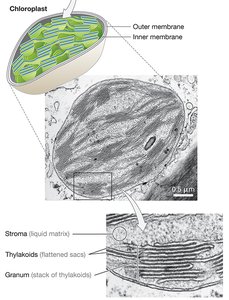
Chloroplasts are specialized organelles in plant and algal cells where photosynthesis takes place. Their internal structure is optimized for capturing light and facilitating the biochemical reactions of photosynthesis.
Outer and Inner Membranes: Enclose the chloroplast.
Thylakoids: Flattened sacs containing pigments; organized into stacks called grana.
Stroma: Fluid matrix surrounding thylakoids; site of the Calvin cycle.
Lumen: Internal space of thylakoids.

Pigments and Light Absorption
Types of Pigments and Their Functions
Pigments are molecules that absorb specific wavelengths of light, enabling photosynthetic organisms to capture energy from sunlight. The most important pigments are chlorophylls and carotenoids.
Chlorophylls (a and b): Absorb red and blue light; reflect green light, giving plants their color.
Carotenoids: Absorb blue and green light; reflect yellow, orange, and red. Act as accessory pigments and protect chlorophyll from damage.
Absorption Spectrum: Shows which wavelengths are absorbed by pigments.
Action Spectrum: Indicates which wavelengths are most effective for photosynthesis.



Photosystems and Energy Transfer
Organization and Function of Photosystems
Photosystems are complexes of pigments and proteins in the thylakoid membrane that work together to capture light energy and transfer it efficiently to reaction centers, where electron transfer begins.
Photosystem II: Initiates electron transport by splitting water and generating ATP.
Photosystem I: Transfers electrons to NADP+, forming NADPH.
Antenna Pigments: Gather light and transfer energy via resonance energy transfer.
Enhancement Effect: Photosynthesis is more efficient when both photosystems are activated by different wavelengths.



Electron Transport and ATP/NADPH Production
Mechanisms of Energy Conversion
Light energy is converted into chemical energy through electron transport chains in the thylakoid membrane, resulting in the synthesis of ATP and NADPH, which are used in the Calvin cycle.
Electron Transport Chain (ETC): Transfers electrons, creates proton gradient, and drives ATP synthesis via ATP synthase.
Photophosphorylation: ATP synthesis powered by light-induced proton gradient.
Noncyclic Electron Flow: Electrons move linearly from water to NADP+.
Z-Scheme: Model describing the cooperation between photosystems II and I.
Calvin Cycle and Carbon Fixation
Steps and Enzymes Involved
The Calvin cycle is the process by which carbon dioxide is fixed and reduced to produce sugars. It is a three-phase cycle involving key enzymes and intermediates.
Fixation Phase: CO2 reacts with ribulose biphosphate (RuBP) to form 3-phosphoglycerate (3PGA).
Reduction Phase: 3PGA is phosphorylated and reduced to glyceraldehyde-3-phosphate (G3P).
Regeneration Phase: G3P is used to regenerate RuBP, allowing the cycle to continue.
Rubisco: The enzyme responsible for CO2 fixation; most abundant protein in plants.
Phase | Key Reactants | Key Products |
|---|---|---|
Fixation | CO2, RuBP | 3PGA |
Reduction | 3PGA, ATP, NADPH | G3P |
Regeneration | G3P, ATP | RuBP |
Fate of Photosynthetic Products
Utilization of Sugars
Sugars produced by the Calvin cycle are used for various metabolic processes. Glucose and fructose can be combined to form sucrose or polymerized to form starch, which serves as energy storage.
Gluconeogenesis: Formation of glucose and fructose from G3P.
Sucrose: Transported throughout the plant; synthesized in the cytosol.
Starch: Stored in chloroplasts; used for energy during periods without light.
Ecological Importance: Virtually all organic carbon in living organisms originates from photosynthesis.
Additional info:
Oxygenic photosynthesis was crucial for the evolution of aerobic life and the formation of the ozone layer.
Stomata are specialized structures that regulate gas exchange in leaves, balancing CO2 intake and water loss.
