 Back
BackChapter 10: Photosynthesis – Mechanisms, Structure, and Regulation
Study Guide - Smart Notes
 Tailored notes based on your materials, expanded with key definitions, examples, and context.
Photosynthesis: Overview and Importance
Definition and Role in Biology
Photosynthesis is the process by which autotrophic organisms, such as plants and algae, convert sunlight into chemical energy, producing carbohydrates from carbon dioxide and water. This process is fundamental to life on Earth, as it provides the primary source of organic matter and oxygen for heterotrophic organisms.
Autotrophs: Organisms that synthesize their own food from inorganic substances using light or chemical energy.
Heterotrophs: Organisms that obtain their food by consuming other organisms.
Overall Reaction:
Photosynthesis vs. Cellular Respiration: Photosynthesis stores energy, while cellular respiration releases energy from organic molecules.
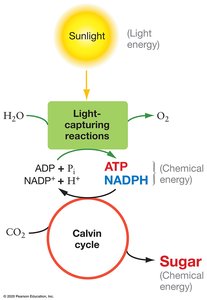
Photosynthesis: Two Linked Sets of Reactions
Light-Capturing Reactions and Calvin Cycle
Photosynthesis consists of two interconnected sets of reactions: the light-capturing reactions and the Calvin cycle.
Light-Capturing Reactions: Occur in the thylakoid membranes, where sunlight is used to split water, releasing oxygen and generating ATP and NADPH.
Calvin Cycle: Occurs in the stroma, using ATP and NADPH to fix carbon dioxide and produce sugars.
Key Products: Oxygen (O2), ATP, NADPH, and carbohydrates.

Photosynthesis Occurs in Chloroplasts
Chloroplast Structure and Function
Chloroplasts are specialized organelles in plant cells where photosynthesis takes place.
Outer and Inner Membranes: Enclose the chloroplast.
Thylakoids: Flattened sacs where light reactions occur; organized into stacks called grana.
Stroma: Fluid-filled space surrounding thylakoids; site of the Calvin cycle.
Lumen: Interior space of thylakoids.
Pigments and Light Absorption
Types of Pigments and Their Roles
Pigments are molecules that absorb specific wavelengths of light, enabling photosynthesis.
Chlorophylls (a and b): Absorb red and blue light, reflect green light, and are responsible for the green color of plants.
Carotenoids: Absorb blue and green light, reflect yellow, orange, and red; extend the range of light absorption and protect chlorophyll from damage.


Structure of Photosynthetic Pigments
Chlorophyll molecules have a long hydrophobic tail that anchors them in the thylakoid membrane and a head with a ring structure containing magnesium, which absorbs light.
Head: Ring structure that absorbs light.
Tail: Anchors chlorophyll in the membrane.


Photosystems and Energy Conversion
Organization and Function of Photosystems
Chlorophyll and accessory pigments are organized into photosystems within the thylakoid membrane.
Antenna Pigments: Collect and transfer light energy to the reaction center.
Reaction Center: Site where energy is converted into chemical energy via electron transfer.
Electron Transport Chain and ATP Synthesis
The electron transport chain (ETC) in thylakoids is similar to that in mitochondria, using redox reactions to create a proton gradient that drives ATP synthesis.
Photophosphorylation: ATP synthesis initiated by light energy.
Proton-Motive Force: Drives ATP production via ATP synthase.

Photosystem I and II
Photosystem II: Produces a proton-motive force for ATP synthesis.
Photosystem I: Produces NADPH.
Noncyclic Electron Flow: Electrons move linearly from water to NADP+, producing ATP and NADPH.
Cyclic Electron Flow: Electrons cycle back to the ETC, producing additional ATP but not NADPH.
Carbon Dioxide Capture and Fixation
Stomata and Gas Exchange
Plants are covered with a waxy cuticle that prevents water loss but also restricts gas exchange. Stomata, composed of guard cells and a central pore, regulate the entry of CO2 and exit of O2 and H2O.
Stomata: Openings that allow gas exchange in leaves.
Guard Cells: Control the opening and closing of stomata.


The Calvin Cycle
Carbon Fixation and Rubisco
The Calvin cycle fixes carbon dioxide into organic molecules. The enzyme Rubisco (ribulose-1,5-biphosphate carboxylase/oxygenase) catalyzes the addition of CO2 to ribulose biphosphate (RuBP), forming 3-phosphoglycerate.
Rubisco: Most abundant enzyme in photosynthetic tissues; catalyzes carbon fixation.
Carbon Fixation: Conversion of inorganic CO2 to organic compounds.

Photorespiration
Rubisco's Dual Activity
Rubisco can react with O2 instead of CO2, leading to photorespiration, which consumes oxygen and releases CO2, reducing photosynthetic efficiency.
Photorespiration: Competes with photosynthesis, wasting energy and fixed carbon.
Reaction with CO2: Produces two 3-phosphoglycerate molecules (used in Calvin cycle).
Reaction with O2: Produces 3-phosphoglycerate and 2-phosphoglycolate (requires processing, releases CO2).

Mechanisms for Increasing CO2 Concentration
C4 and CAM Pathways
In hot and dry environments, plants use alternative pathways to increase CO2 concentration and minimize photorespiration.
C4 Pathway: Initial carbon fixation produces a four-carbon compound; fixation and Calvin cycle occur in different cell types.
CAM Pathway: Carbon fixation occurs at night; Calvin cycle occurs during the day. Used by cacti and other plants adapted to arid conditions.
Fate of Sugar Produced by Photosynthesis
G3P Utilization and Storage
The Calvin cycle produces glyceraldehyde-3-phosphate (G3P), which is used to synthesize glucose and fructose via gluconeogenesis. Excess glucose is polymerized into starch for storage in chloroplasts, while sucrose is synthesized in the cytosol.
G3P: Intermediate used for carbohydrate synthesis.
Starch: Storage form of glucose in plants.
Sucrose: Transportable form of sugar in plants.
Photosynthesis: Source of virtually all organic carbon in living organisms.
Summary Table: Photosynthesis Components and Functions
Component | Function |
|---|---|
Chloroplast | Site of photosynthesis |
Thylakoid | Location of light reactions |
Stroma | Location of Calvin cycle |
Chlorophyll | Absorbs light energy |
Rubisco | Fixes CO2 in Calvin cycle |
Stomata | Regulates gas exchange |
C4/CAM Pathways | Increase CO2 concentration, reduce photorespiration |
Key Equations
Photosynthesis:
Calvin Cycle (simplified):
Additional info:
Photosynthesis is the foundation of most food webs and is essential for maintaining atmospheric oxygen levels.
Rubisco's inefficiency is a major target for genetic engineering to improve crop yields.
