 Back
Chapter 10: Photosynthesis – Mini-Textbook Study Notes
Study Guide - Smart Notes
 Tailored notes based on your materials, expanded with key definitions, examples, and context.
Photosynthesis: Harnessing Sunlight to Make Carbohydrates
Introduction to Photosynthesis
Photosynthesis is the process by which autotrophic organisms convert sunlight, carbon dioxide, and water into carbohydrates, producing oxygen as a by-product. This process is fundamental to life on Earth, as it provides the energy and organic molecules necessary for most living organisms.
Autotrophs: Organisms that produce their own food from inorganic substances (e.g., plants, algae).
Heterotrophs: Organisms that obtain food by consuming other organisms.
Overall Reaction: The general equation for photosynthesis is the reverse of cellular respiration:
Photosynthesis: Two Linked Sets of Reactions
Light-Capturing and Calvin Cycle Reactions
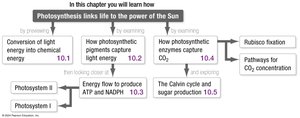
Photosynthesis consists of two main sets of reactions: light-capturing reactions and the Calvin cycle. These reactions are interconnected and essential for the conversion of solar energy into chemical energy.
Light-Capturing Reactions: Occur in the thylakoid membranes, where water is split and electrons are excited by light energy. High-energy electrons are transferred to NADP+, forming NADPH.
Calvin Cycle Reactions: Occur in the stroma, where ATP and NADPH are used to reduce carbon dioxide and produce sugars.
Photosynthesis Occurs in Chloroplasts
Structure and Function of Chloroplasts
Chloroplasts are the site of photosynthesis in plant cells. Their unique structure facilitates the efficient capture and conversion of light energy.
Thylakoids: Flattened, vesicle-like structures arranged in stacks called grana.
Stroma: Fluid-filled space between thylakoids and the inner membrane.
Pigments: Molecules such as chlorophyll that absorb specific wavelengths of light.
 3
How Do Pigments Capture Light Energy?
Electromagnetic Radiation and Pigments
Light is a form of electromagnetic radiation, characterized by wavelength and energy. Pigments absorb certain wavelengths, enabling the capture of light energy for photosynthesis.
Chlorophylls: Main pigments absorbing red and blue light, reflecting green.
Carotenoids: Accessory pigments absorbing blue and green light, reflecting yellow, orange, and red.
Photon Energy: Energy of a photon is inversely proportional to its wavelength.
Photosystems and Energy Transfer
Photosystem Structure and Function
Photosystems are complexes of chlorophyll and accessory pigments that work together to capture light energy and transfer it efficiently to the reaction center.
Antenna Pigments: Gather light and transfer energy via resonance energy transfer.
Reaction Center: Site where electromagnetic energy is converted to chemical energy through redox reactions.
The Discovery of Photosystems I and II
Enhancement Effect and Photosystem Cooperation
Photosynthesis is most efficient when both Photosystem I and Photosystem II operate together, as demonstrated by the enhancement effect.
Photosystem II: Splits water, produces oxygen, and drives ATP synthesis.
Photosystem I: Produces NADPH by transferring excited electrons to NADP+.
Converting Light Energy into Chemical Energy
Electron Transport Chain and Photophosphorylation
Excited electrons from photosystems are passed through an electron transport chain, creating a proton gradient that drives ATP synthesis.
Electron Transport Chain (ETC): Transfers electrons and pumps protons across the thylakoid membrane.
ATP Synthase: Uses the proton-motive force to synthesize ATP.
Photophosphorylation: ATP production driven by light energy.
Oxygenic Photosynthesis and Evolution
Impact of Oxygen Production
Oxygenic photosynthesis, which splits water and releases oxygen, was critical for the evolution of aerobic life and the formation of the ozone layer.
Anoxygenic Photosynthesis: Occurs in organisms with a single photosystem, using electron donors other than water and not producing oxygen.
Carbon Fixation: The Calvin Cycle
Mechanism and Regulation
The Calvin cycle fixes carbon dioxide into organic molecules using ATP and NADPH. The enzyme Rubisco catalyzes the initial step, but is slow and can react with oxygen, leading to photorespiration.
Rubisco: Ribulose-1,5-biphosphate carboxylase/oxygenase, most abundant enzyme in photosynthetic tissues.
Photorespiration: Process that consumes oxygen and releases fixed carbon, reducing photosynthetic efficiency.
Mechanisms for Increasing CO2 Concentration
C4 and CAM Pathways
Plants have evolved mechanisms to increase CO2 concentration and minimize photorespiration, especially in hot and dry environments.
C4 Pathway: Spatially separates initial carbon fixation (by PEP carboxylase in mesophyll cells) and the Calvin cycle (in bundle sheath cells).
CAM Pathway: Temporally separates carbon fixation (at night) and the Calvin cycle (during the day).
Regulation and Fate of Photosynthetic Products
Regulation of Photosynthesis
Photosynthesis is regulated by light, sugar levels, and the activity of Rubisco. The products of the Calvin cycle are used to synthesize glucose, fructose, sucrose, and starch.
G3P: Glyceraldehyde-3-phosphate, a product of the Calvin cycle, used to make sugars.
Gluconeogenesis: Process of synthesizing glucose and fructose from G3P.
Starch and Sucrose: Storage forms of carbohydrates in plants.
Human Angle: Artificial Photosynthetic Systems
Applications and Innovations
Research in artificial photosynthetic systems aims to mimic natural photosynthesis by coupling electricity from solar panels to catalyze the conversion of carbon dioxide and water into organic molecules for food production.
Example: Artificial systems replace high-energy molecules (such as ATP and NADPH) with electricity to drive the conversion of CO2 and water into sugars and other organic molecules.
Summary Table: Photosynthesis Components and Functions
Component | Function |
|---|---|
Chlorophyll | Absorbs light energy, reflects green |
Photosystem II | Splits water, produces oxygen, drives ATP synthesis |
Photosystem I | Produces NADPH |
Rubisco | Fixes CO2 in Calvin cycle |
ATP Synthase | Synthesizes ATP using proton gradient |
C4 Pathway | Increases CO2 concentration, minimizes photorespiration |
CAM Pathway | Separates carbon fixation and Calvin cycle temporally |
Additional info: These notes expand on the original content by providing definitions, examples, and context for each major topic, ensuring a comprehensive and self-contained study guide for exam preparation.
