 Back
Chapter 10: Photosynthesis - Mini-Textbook Study Notes
Study Guide - Smart Notes
 Tailored notes based on your materials, expanded with key definitions, examples, and context.
Photosynthesis: Overview
Definition and Importance
Photosynthesis is the process by which autotrophic organisms use sunlight to manufacture carbohydrates, converting electromagnetic energy into chemical energy. This process is fundamental to life on Earth, as it provides the primary source of organic matter and oxygen.
Autotrophs: Organisms that produce their own food from inorganic ions and molecules (e.g., plants, algae, some bacteria).
Heterotrophs: Organisms that must obtain sugars and organic molecules from other organisms.
Overall Reaction (in plants):
Photosynthesis vs. Cellular Respiration: Photosynthesis stores energy, while cellular respiration releases it.

Photosynthesis: Two Linked Sets of Reactions
Light-Capturing Reactions and Calvin Cycle
Photosynthesis consists of two interconnected sets of reactions:
Light-capturing reactions: Occur in the thylakoid membranes, split water to produce oxygen, and generate ATP and NADPH.
Calvin cycle reactions: Occur in the stroma, use ATP and NADPH to reduce CO2 and produce sugars.
Key electron carrier: NADP+ is reduced to NADPH during light reactions.
Photosynthesis Occurs in Chloroplasts
Structure and Function
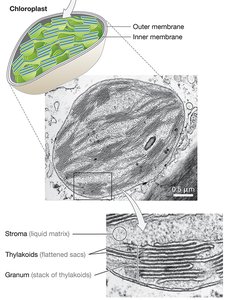
Chloroplasts are the site of photosynthesis in plants and algae. Their structure is specialized for efficient energy conversion.
Outer and inner membranes: Enclose the chloroplast.
Thylakoids: Flattened sacs where light reactions occur; organized into stacks called grana.
Stroma: Fluid-filled space between thylakoids and inner membrane; site of Calvin cycle.
Lumen: Interior space of thylakoid.

Pigments and Light Absorption
Types of Pigments
Pigments are molecules that absorb specific wavelengths of light, enabling photosynthesis.
Chlorophylls (a and b): Absorb red and blue light, reflect green light (responsible for plant color).
Carotenoids: Absorb blue and green light, reflect yellow, orange, and red; act as accessory pigments and protect chlorophyll from damage.

Electromagnetic Spectrum and Absorption
The electromagnetic spectrum includes all wavelengths of light. Photosynthetic pigments absorb visible light most efficiently.
Action spectrum: Wavelengths that drive photosynthesis most effectively (blue and red).
Absorption spectrum: Shows how much light is absorbed at each wavelength by a pigment.


Photosystems and Energy Transfer
Photosystem Structure and Function
Photosystems are complexes of chlorophyll and accessory pigments embedded in the thylakoid membrane. They capture light energy and transfer it efficiently.
Antenna pigments: Gather light and transfer energy to the reaction center via resonance energy transfer.
Reaction center: Site where excited electrons are transferred to electron carriers.

Photosystems I and II
There are two types of photosystems, each with a distinct role:
Photosystem II: Splits water, produces oxygen, and generates ATP via electron transport chain.
Photosystem I: Produces NADPH by transferring electrons to NADP+.
Enhancement effect: Photosynthesis is more efficient when both photosystems operate together, especially under combined red and far-red light.

Converting Light Energy into Chemical Energy
Electron Transport Chain and ATP Synthesis
Light energy is converted into chemical energy through a series of redox reactions and proton transport.
Electron transport chain (ETC): Transfers electrons from photosystem II to cytochrome complex, creating a proton gradient.
Plastoquinone (PQ): Shuttles electrons and protons across the thylakoid membrane.
ATP synthase: Uses proton-motive force to synthesize ATP (photophosphorylation).
Oxygenic Photosynthesis and Evolution
Water Splitting and Oxygen Production
Photosystem II oxidizes water, releasing oxygen as a by-product. This process, called oxygenic photosynthesis, was crucial for the evolution of aerobic life and the formation of the ozone layer.
Water splitting reaction:
Ozone formation: Ozone (O3) formed from O2 protects life from UV radiation.
Calvin Cycle: Carbon Fixation and Sugar Production
Carbon Dioxide Capture
Plants capture CO2 through stomata, pores regulated by guard cells. The cuticle prevents water loss but allows gas exchange.
Calvin Cycle Steps
The Calvin cycle is a three-phase process that fixes carbon and produces sugars:
Fixation: CO2 reacts with ribulose biphosphate (RuBP) to form two molecules of 3-phosphoglycerate (3PGA).
Reduction: 3PGA is phosphorylated by ATP and reduced by NADPH to produce glyceraldehyde-3-phosphate (G3P).
Regeneration: G3P is used to regenerate RuBP, allowing the cycle to continue.

Rubisco: The Key Enzyme
Rubisco (ribulose-1,5-biphosphate carboxylase/oxygenase) is the most abundant enzyme in photosynthetic tissues and catalyzes the fixation of CO2 in the Calvin cycle.
Rubisco can react with O2 as well as CO2, leading to photorespiration (less efficient).
Regulation: Plants regulate Rubisco activity to maximize carbon fixation.
Fate of Photosynthetic Sugars
Glucose, Sucrose, and Starch
G3P produced by the Calvin cycle is used to synthesize glucose and fructose, which combine to form sucrose. Excess glucose is polymerized into starch for storage.
Sucrose synthesis: Occurs in the cytosol.
Starch production: Occurs in the chloroplast.
Virtually all organic carbon in life originates from photosynthesis.
Summary Table: Photosynthesis Components
Component | Function |
|---|---|
Chlorophyll | Main pigment for light absorption |
Carotenoids | Accessory pigments, protect chlorophyll |
Photosystem II | Splits water, produces O2, generates ATP |
Photosystem I | Produces NADPH |
Calvin Cycle | Fixes CO2, produces sugars |
Rubisco | Enzyme for CO2 fixation |
Stroma | Site of Calvin cycle |
Thylakoid | Site of light reactions |
Big Picture: Photosynthesis is the foundation of life, providing energy and organic carbon for all living organisms.
