 Back
BackChapter 10: Photosynthesis – Structure, Function, and Mechanisms
Study Guide - Smart Notes
 Tailored notes based on your materials, expanded with key definitions, examples, and context.
Photosynthesis: Importance and Overview
Why Photosynthesis Matters
Photosynthesis is a fundamental biological process that sustains life on Earth by producing oxygen and organic molecules. It is essential for breathing and eating, as it forms the basis of most food chains.
Photosynthetic organisms include cyanobacteria, protists (e.g., Euglena), algae, seaweeds, and plants.
Photosynthesis occurs in both freshwater and marine environments, with diatoms and phytoplankton contributing significantly to global oxygen production.
Terrestrial plants are major contributors to photosynthesis.
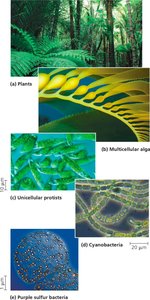
Autotrophs vs. Heterotrophs
Organisms are classified based on how they obtain energy and nutrients:
Autotrophs (producers): Synthesize their own food from inorganic sources using light or chemical energy.
Heterotrophs (consumers): Obtain energy by consuming other organisms.
Decomposers: Break down dead organic matter.
The Big Picture: Photosynthesis and Cellular Respiration
Photosynthesis converts solar energy into chemical energy, requiring carbon dioxide (CO2) and water (H2O). Cellular respiration, in turn, produces CO2 and H2O as byproducts.
Chloroplast Structure and Leaf Anatomy
Chloroplasts
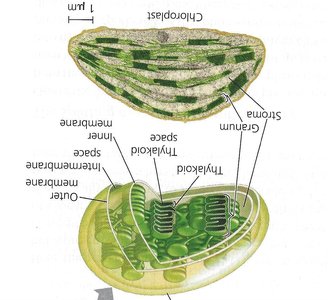
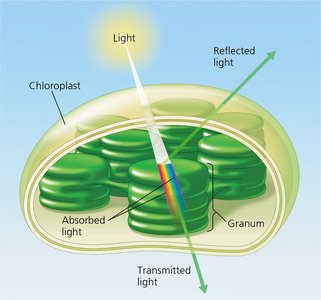
Chloroplasts are the organelles where photosynthesis occurs, mainly found in mesophyll cells of leaves.
Stroma: Fluid-filled space inside the chloroplast.
Thylakoids: Membranous sacs arranged in stacks called granum.
Chlorophyll: The primary pigment for capturing light energy.
Basic Leaf Structure
Leaves are specialized for photosynthesis and gas exchange.
Cuticle: Waxy, non-polar layer made of cutin that repels water.
Upper Epidermis: Produces the cuticle.
Mesophyll: Middle layer containing most chloroplasts; site of photosynthesis.
Xylem: Transports water.
Phloem: Transports sucrose.
Lower Epidermis: Contains stomata for gas exchange.
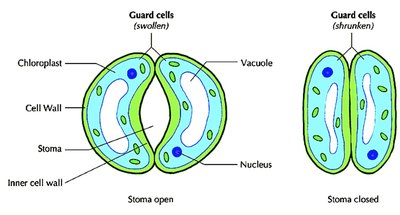
Stomata: Openings regulated by guard cells for gas exchange.
Stomata and Guard Cells
Stomata are pores on the leaf surface that allow gas exchange. Guard cells regulate the opening and closing of stomata.
When guard cells are swollen, stomata are open; when shrunken, stomata are closed.
Stomata facilitate the exchange of CO2 and O2.
Light and Plant Pigments
Electromagnetic Spectrum and Visible Light
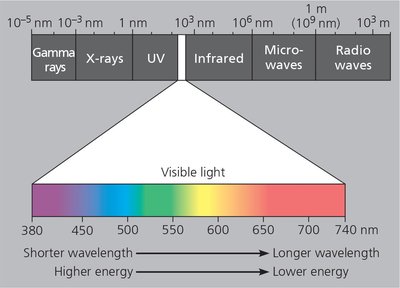
Photosynthesis utilizes visible light, which ranges from 380 nm to 740 nm in wavelength. Shorter wavelengths have higher energy, while longer wavelengths have lower energy.
Photons: Discrete units of light energy.
Plant Pigments
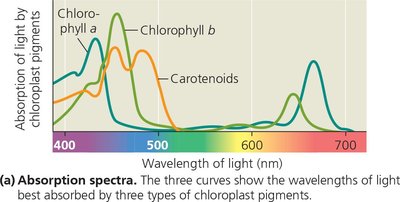
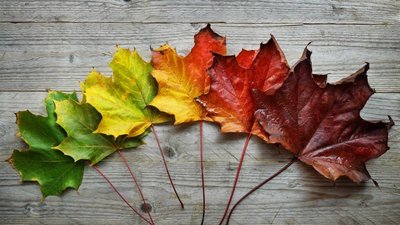
Plant pigments absorb specific wavelengths of light for photosynthesis.
Chlorophyll a: Main pigment.
Chlorophyll b and carotenoids: Accessory pigments that broaden the spectrum of light absorption.
Photosynthesis Overview and Equation
General Equation
The overall equation for photosynthesis is:
Energy + 6CO2 + 6H2O → C6H12O6 + 6O2
Photosynthesis consists of two main stages:
Light Reactions: Occur in the thylakoid membrane; produce O2, ATP, and NADPH.
Calvin Cycle: Occurs in the stroma; uses ATP and NADPH to produce glucose.
Light Reactions
Photosystems and Light Harvesting
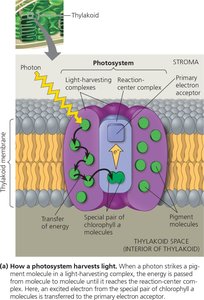
Light reactions occur on the thylakoid membrane and involve two photosystems (PS II and PS I).
Photosystem II (PS II): Contains P680 chlorophyll a molecules.
Photosystem I (PS I): Contains P700 chlorophyll a molecules.
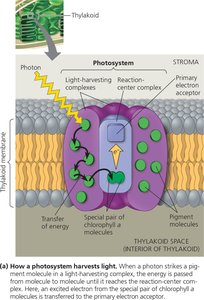
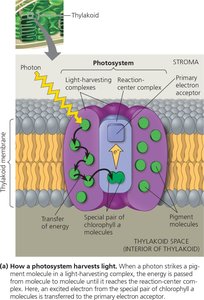
Light Harvesting Complex: Antenna pigments relay energy to the reaction center.
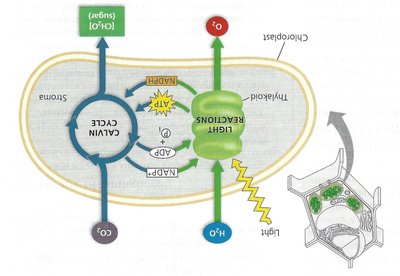
Mechanism of Light Reaction
When a photon strikes a pigment, energy is transferred to adjacent pigments until it reaches the reaction center, exciting electrons.
Excited electrons are passed to the primary electron acceptor.
Electron Transport Chain (ETC) follows, involving plastoquinone (Pq), cytochrome complex, and plastocyanin (Pc).
Energy released is used to pump protons (H+) into the thylakoid space, creating a gradient for ATP synthesis (chemiosmosis).
Photolysis: Splitting Water
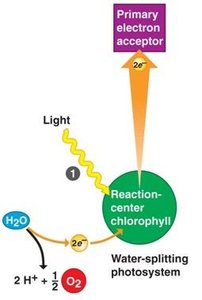
Water molecules are split to replace electrons lost by chlorophyll, producing hydrogen ions, electrons, and oxygen.
Equation: H2O → 2H+ + 2e- + ½ O2
Hydrogen ions contribute to the proton gradient; electrons replace those lost by chlorophyll; oxygen is released.
Products of Light Reaction
O2 (oxygen)
ATP (energy currency)
NADPH (reducing power for Calvin cycle)
Calvin Cycle
Overview and Requirements
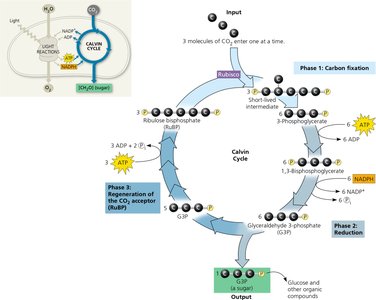
The Calvin cycle is an anabolic process occurring in the stroma. It takes six cycles to produce one glucose molecule, requiring 18 ATP, 12 NADPH, and 6 CO2.
Phase 1: Carbon Fixation
CO2 is fixed one at a time (often considered as three at a time).
Three CO2 molecules combine with three RuBP (ribulose bisphosphate, a 5-carbon compound), catalyzed by Rubisco.
Forms an unstable 6-carbon compound, which splits into six molecules of 3-phosphoglycerate (3-PGA).
Phase 2: Reduction
Six ATP are used to add phosphate to each 3-PGA, forming six 1,3-bisphosphoglycerate (1,3-BisPGA).
NADPH donates electrons, converting 1,3-BisPGA to six molecules of G3P (glyceraldehyde 3-phosphate).
Net gain: One G3P per three turns; the other five G3P continue in the cycle.
Phase 3: Regeneration
Five G3P undergo a complex pathway, requiring three more ATP, to regenerate RuBP.
The cycle restarts with new CO2 molecules.
G3P and Glucose Formation
G3P is the actual product of the Calvin cycle and serves as a building block for organic molecules such as glucose, sucrose, and fructose.
G3P is a 3-carbon compound; glucose is a 6-carbon compound.
G3P is used to synthesize various carbohydrates.
Alternative Photosynthetic Pathways
C4 Plants
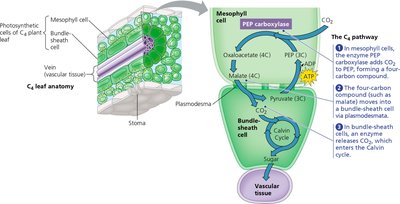
C4 plants utilize spatial separation of carbon fixation to minimize photorespiration.
PEP carboxylase fixes CO2 in mesophyll cells, forming a 4-carbon compound.
Costs 1 ATP per fixation.
CO2 is released in bundle sheath cells for the Calvin cycle.
CAM Plants
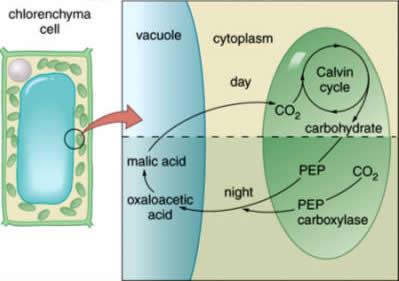
CAM (Crassulacean Acid Metabolism) plants use temporal separation of carbon fixation to conserve water.
CO2 is fixed at night and stored as malate in vacuoles.
During the day, malate is decarboxylated and CO2 enters the Calvin cycle.
Summary Table: Photosynthetic Pathways
Pathway | Separation Type | Key Enzyme | CO2 Storage | Adaptation |
|---|---|---|---|---|
C3 | None | Rubisco | Direct | Most plants |
C4 | Spatial | PEP Carboxylase | Bundle sheath cells | Hot, dry climates |
CAM | Temporal | PEP Carboxylase | Vacuoles (malate) | Arid environments |
Key Equations
Photosynthesis Equation
Photolysis of Water
ATP and NADPH Production
Calvin Cycle (Simplified)
Additional info: Academic context was added to clarify the mechanisms of photosynthesis, Calvin cycle, and alternative pathways. The summary table was inferred for completeness and exam preparation.
