 Back
BackChapter 10: Photosynthesis – Structure, Function, and Mechanisms
Study Guide - Smart Notes
 Tailored notes based on your materials, expanded with key definitions, examples, and context.
Photosynthesis: The Process That Feeds the Biosphere
Introduction to Photosynthesis
Photosynthesis is the process by which autotrophic organisms convert light energy into chemical energy, sustaining nearly all life on Earth. This process occurs primarily in plants, algae, and some bacteria, and is essential for the production of organic molecules and oxygen.
Autotrophs: Organisms that produce their own food from inorganic substances (e.g., plants, algae, cyanobacteria).
Heterotrophs: Organisms that obtain food by consuming other organisms (e.g., animals, fungi, many bacteria).
Photosynthesis Equation: The overall chemical reaction is:
Redox Reactions: Photosynthesis involves the reduction of carbon dioxide to glucose and the oxidation of water to oxygen.
Autotrophs vs. Heterotrophs
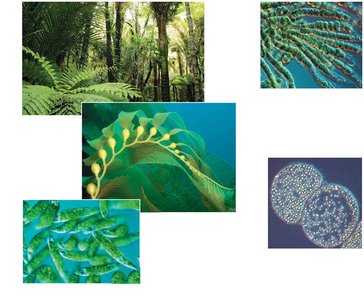
Autotrophs are self-feeders that use light or inorganic chemicals to produce organic molecules, while heterotrophs rely on consuming other organisms for nutrition.
Examples of Autotrophs: Plants, algae, cyanobacteria.
Examples of Heterotrophs: Animals, fungi, most bacteria.
Heterotrophs depend on autotrophs for both food and oxygen.
Chloroplast Structure and Function
Chloroplast Anatomy
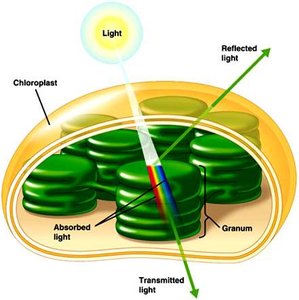
Chloroplasts are the organelles where photosynthesis takes place. They contain multiple membranes and compartments that facilitate the light-dependent and light-independent reactions.
Double Membrane: Outer and inner membranes enclose the chloroplast.
Thylakoids: Flattened sacs containing chlorophyll and other pigments; site of light reactions.
Grana: Stacks of thylakoids.
Stroma: Fluid-filled space surrounding thylakoids; site of the Calvin cycle.
The Two Main Stages of Photosynthesis
Light Reactions
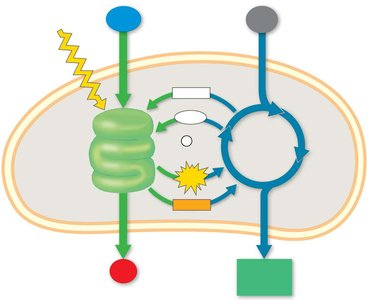
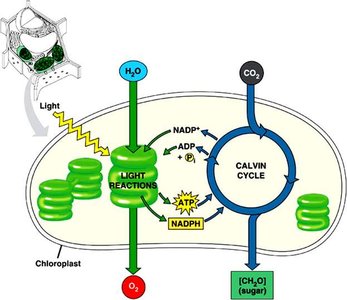
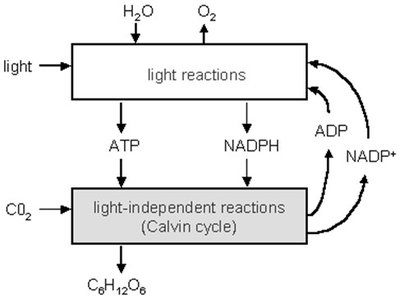
The light reactions occur in the thylakoid membranes and require light energy to produce ATP, NADPH, and O2. These products are then used in the Calvin cycle.
Inputs: H2O, light energy, NADP+, ADP + Pi
Outputs: O2, ATP, NADPH
Photophosphorylation: The process of generating ATP from ADP and Pi using light energy.
The Calvin Cycle (Light-Independent Reactions)
The Calvin cycle occurs in the stroma and does not require light directly. It uses ATP and NADPH from the light reactions to fix carbon dioxide and produce glucose.
Inputs: CO2, ATP, NADPH
Outputs: Glucose (C6H12O6), ADP, NADP+
Phases of the Calvin Cycle:
Carbon fixation
Reduction
Regeneration of CO2 acceptor (RuBP)
Photosynthetic Pigments and Light Absorption
Nature of Light
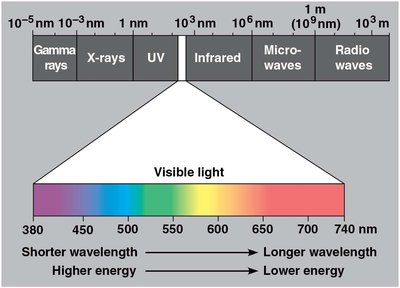
Light is a form of electromagnetic radiation, composed of photons that travel in waves. The visible spectrum (380–740 nm) is most important for photosynthesis.
Shorter wavelengths have higher energy; longer wavelengths have lower energy.
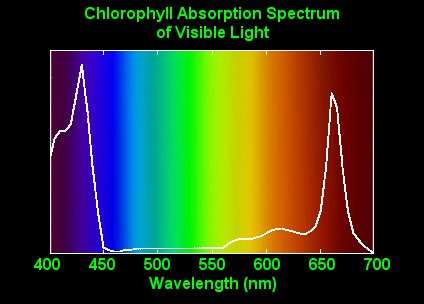
Photosynthetically active radiation is primarily in the blue (430–450 nm) and red (640–680 nm) regions.
Photosynthetic Pigments
Pigments are molecules that absorb specific wavelengths of light. The main pigment in plants is chlorophyll a, with accessory pigments including chlorophyll b and carotenoids.
Chlorophyll a: Main pigment; absorbs blue-violet and red light.
Chlorophyll b: Accessory pigment; broadens the spectrum of absorbed light.
Carotenoids: Accessory pigments; absorb excess light and protect chlorophyll.
Excitation of Chlorophyll by Light
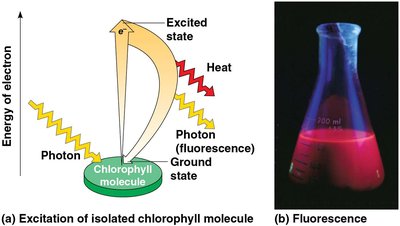
When chlorophyll absorbs a photon, an electron is elevated from a ground state to an excited state. In isolated chlorophyll, this energy is released as fluorescence and heat; in chloroplasts, it is used to drive photosynthesis.
Ground State: Electron in its lowest energy level.
Excited State: Electron has absorbed energy and moved to a higher energy level.
Photosystems and Electron Flow
Photosystems
Photosystems are complexes of proteins and pigments in the thylakoid membrane that capture light energy and initiate electron transport. There are two types: Photosystem II (PS II) and Photosystem I (PS I).
Photosystem II (PS II): Functions first; reaction center chlorophyll is P680.
Photosystem I (PS I): Functions second; reaction center chlorophyll is P700.
Each photosystem consists of a light-harvesting complex and a reaction-center complex.
Linear Electron Flow
Linear electron flow is the primary pathway during the light reactions, involving both photosystems. It results in the production of ATP and NADPH.
Electrons move from water to NADP+, forming NADPH.
Oxygen is released as a byproduct.
ATP is generated via chemiosmosis (photophosphorylation).
Cyclic Electron Flow
Cyclic electron flow involves only Photosystem I and produces ATP but not NADPH or O2. It helps balance the ATP/NADPH ratio required for the Calvin cycle.
Electrons cycle back to the photosystem instead of reducing NADP+.
Provides additional ATP for the Calvin cycle.
ATP Synthesis: Chemiosmosis in Chloroplasts and Mitochondria
Mechanism of Chemiosmosis
Both chloroplasts and mitochondria generate ATP using chemiosmosis, but the energy sources differ. In chloroplasts, light energy drives the process; in mitochondria, it is chemical energy from food.
Proton gradients are established across membranes (thylakoid membrane in chloroplasts, inner mitochondrial membrane in mitochondria).
ATP synthase uses the flow of protons (H+) down their gradient to synthesize ATP from ADP and Pi.
The Calvin Cycle: Synthesis of Carbohydrates
Overview of the Calvin Cycle
The Calvin cycle uses ATP and NADPH to convert CO2 into G3P (glyceraldehyde-3-phosphate), a three-carbon sugar. It is an anabolic pathway that regenerates its starting molecule, RuBP (ribulose bisphosphate).
Three Phases:
Carbon fixation (CO2 is attached to RuBP by the enzyme Rubisco)
Reduction (ATP and NADPH are used to reduce 3-phosphoglycerate to G3P)
Regeneration of RuBP (some G3P is used to regenerate RuBP, enabling the cycle to continue)
For one G3P molecule, the cycle must turn three times, consuming 9 ATP and 6 NADPH.
For one glucose molecule, six turns are required.
Summary Table: Comparison of Light Reactions and Calvin Cycle
Process | Location | Inputs | Outputs | Main Function |
|---|---|---|---|---|
Light Reactions | Thylakoid membrane | H2O, light, NADP+, ADP + Pi | O2, ATP, NADPH | Convert light energy to chemical energy |
Calvin Cycle | Stroma | CO2, ATP, NADPH | G3P (sugar), ADP, NADP+ | Fix carbon and synthesize carbohydrates |
