 Back
BackChapter 12: Mitosis and Regulation of the Eukaryotic Cell Cycle
Study Guide - Smart Notes
 Tailored notes based on your materials, expanded with key definitions, examples, and context.
Chapter 12: Mitosis and Regulation of the Eukaryotic Cell Cycle
Overview of Mitosis and the Cell Cycle
Mitosis is a fundamental process in eukaryotic cells that ensures the accurate distribution of duplicated genetic material into two daughter cells. The cell cycle is a highly regulated sequence of events that includes growth, DNA replication, and cell division. Proper regulation is essential for growth, repair, and maintenance of multicellular organisms.
The Cell Cycle: Phases and Checkpoints
Interphase: The longest phase, comprising G1 (cell growth), S (DNA synthesis), and G2 (preparation for mitosis).
Mitotic (M) Phase: Includes mitosis (nuclear division) and cytokinesis (cytoplasmic division).
Checkpoints: Control points (G1, G2, and M) ensure the cell only proceeds when conditions are optimal.
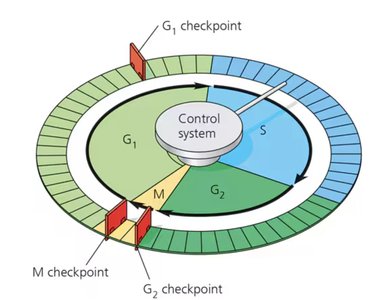
Key Point: Checkpoints monitor cell size, DNA integrity, and chromosome attachment to spindle fibers, preventing progression if errors are detected.
Structure and Function of Chromosomes
Chromosomes are highly organized structures composed of DNA and proteins. During cell division, chromosomes condense to facilitate accurate segregation.
Chromatin: DNA-protein complex that forms chromosomes.
Sister Chromatids: Identical copies of a chromosome, joined at the centromere after DNA replication.
Cohesins: Protein complexes that hold sister chromatids together.
Centromere: Region where chromatids are most tightly attached; site of kinetochore formation.
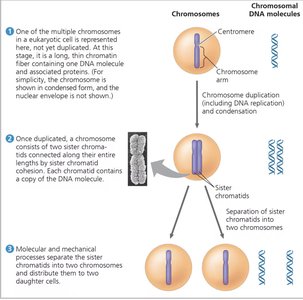
Example: Human somatic cells have 46 chromosomes (23 pairs); gametes have 23 chromosomes.
Phases of Mitosis
Mitosis is divided into five distinct stages, each with specific events that ensure equal distribution of genetic material:
Prophase: Chromosomes condense, spindle fibers begin to form.
Prometaphase: Nuclear envelope breaks down, spindle fibers attach to kinetochores.
Metaphase: Chromosomes align at the metaphase plate.
Anaphase: Sister chromatids separate and move toward opposite poles.
Telophase: Chromosomes decondense, nuclear envelopes reform.
Cytokinesis: Division of the cytoplasm, resulting in two daughter cells.
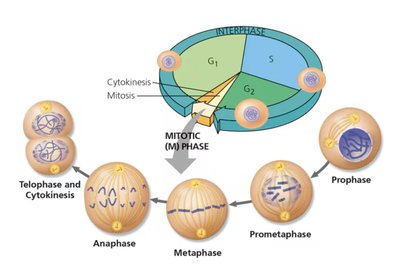
Key Point: Microtubules (spindle fibers) and motor proteins (e.g., dynein) are essential for chromosome movement and segregation.
Regulation of the Cell Cycle: Cyclins, Cdks, and Checkpoints
Progression through the cell cycle is controlled by cyclins and cyclin-dependent kinases (Cdks). These proteins act as molecular switches, ensuring that each phase is completed before the next begins.
Cyclins: Regulatory proteins whose concentrations fluctuate during the cell cycle.
Cyclin-dependent kinases (Cdks): Enzymes that, when bound to cyclins, phosphorylate target proteins to drive cell cycle transitions.
MPF (Maturation-Promoting Factor): A cyclin-Cdk complex that triggers entry into mitosis.
CAK (Cdk-activating kinase): Adds an activating phosphate to the cyclin-Cdk complex, making it fully active.
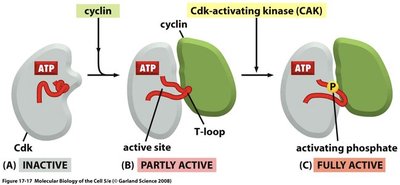
Example: If the CAK gene is non-functional, the cyclin-Cdk complex remains only partially active, preventing the cell from passing the G2 to M checkpoint and leading to cell cycle arrest.
Fluctuations of Cyclin and MPF Activity
The concentrations of cyclins and the activity of MPF rise and fall in a cyclical manner, tightly regulating cell cycle transitions.
During G2, cyclin accumulates and binds to Cdk, forming MPF.
MPF activity peaks at the onset of mitosis, promoting chromosome condensation and spindle formation.
After mitosis, cyclin is degraded, inactivating MPF and allowing the cell to exit mitosis.
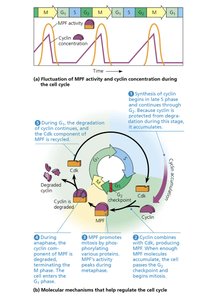
Key Point: The rise and fall of cyclin levels ensure that cell cycle events occur in the correct order and only once per cycle.
External and Internal Regulation: Growth Factors and Density-Dependent Inhibition
Cell division is regulated by both internal molecular signals and external environmental cues.
Growth Factors: Proteins that stimulate cell division by binding to cell-surface receptors and activating signaling pathways.
Density-Dependent Inhibition: Cells stop dividing when they contact neighboring cells, preventing overcrowding.
Example: Estrogen acts as a growth factor, promoting cyclin production and cell division in certain tissues.
Key Point: These mechanisms ensure that cell division occurs only when and where it is needed, maintaining tissue organization.
Relationship Between Cell Cycle Regulation and Cancer
Cancer arises from the breakdown of normal cell cycle regulation, leading to uncontrolled cell division and tumor formation.
Loss of Checkpoint Control: Cancer cells often bypass checkpoints, allowing division despite DNA damage or incomplete replication.
Defective Regulatory Proteins: Mutations in genes encoding cyclins, Cdks, or checkpoint proteins disrupt normal control.
Loss of Density-Dependent Inhibition: Cancer cells ignore signals to stop dividing, resulting in disorganized tissue growth.
Altered Growth Factor Signaling: Cancer cells may produce their own growth factors or overreact to external signals.
Key Point: The accumulation of mutations and loss of regulatory control underlie the development and progression of cancer.
Summary Table: Key Components of Cell Cycle Regulation
Component | Function | Role in Cell Cycle |
|---|---|---|
Cyclin | Regulatory protein | Activates Cdks; levels fluctuate |
Cdk | Protein kinase | Phosphorylates target proteins when bound to cyclin |
MPF | Cyclin-Cdk complex | Triggers entry into mitosis |
CAK | Cdk-activating kinase | Fully activates cyclin-Cdk complex |
Checkpoint | Control point | Monitors and regulates cell cycle progression |
Growth Factor | External signal | Stimulates cell division |
Density-Dependent Inhibition | External signal | Prevents overcrowding by inhibiting division |
