 Back
Chapter 13: Meiosis and Sexual Life Cycles – Study Notes
Study Guide - Smart Notes
 Tailored notes based on your materials, expanded with key definitions, examples, and context.
Meiosis and Reproduction
Overview of Meiosis
Meiosis is a specialized type of cell division that produces gametes (sperm and eggs) for sexual reproduction. Unlike mitosis, which results in two identical daughter cells, meiosis consists of two sequential divisions that produce four genetically unique cells, each with half the chromosome number of the original cell. This reduction and reshuffling of genetic material is essential for generating genetic variation, a central theme in sexual reproduction.
Meiosis: Two-part cell division process producing four haploid cells.
Genetic Variation: Result of chromosome reduction and recombination.
Gametes: Sperm and eggs, each with half the chromosome number.
Sexual vs. Asexual Reproduction
Modes of Reproduction
Organisms reproduce either sexually (involving two parents) or asexually (involving one parent). The mode of reproduction affects genetic diversity among offspring.
Sexual Reproduction: Fusion of two gametes (sperm and egg) forms a zygote. Offspring inherit a unique combination of genes from both parents, leading to genetic variation. Example: Humans, most animals.
Asexual Reproduction: A single parent produces genetically identical offspring (clones). Variation arises only from random mutations. Example: Bacteria (binary fission), strawberry plants (runners).
Chromosomes and the Human Genome
Chromosome Structure and Types
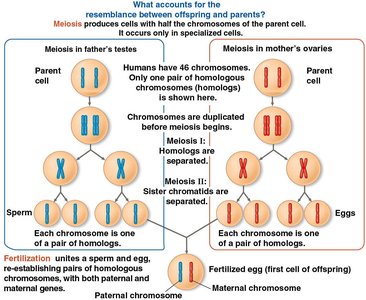
Chromosomes house genetic information in the genome. Humans have 46 chromosomes (23 pairs), including autosomes and sex chromosomes. Chromosomes exist in pairs called homologs, which carry genes for the same traits but may have different alleles.
Homologous Chromosomes: Pairs of chromosomes, one from each parent, similar in size and gene content but not identical.
Karyotype: Visual display of an individual's complete set of chromosomes, arranged in pairs.
Diploid (2n): Two complete sets of chromosomes (somatic cells), 2n = 46 in humans.
Haploid (n): One set of chromosomes (gametes), n = 23 in humans.
Autosomes: 22 pairs of chromosomes not involved in sex determination.
Sex Chromosomes: 1 pair (XX in females, XY in males); sperm determines offspring sex.
Life Cycles
Types of Life Cycles
Meiosis, fertilization, and mitosis maintain chromosome number across generations. Life cycles differ among animals, plants, algae, fungi, and protists.
Animal Life Cycle: Fertilization produces a diploid zygote, which undergoes mitosis to form a multicellular organism. Gametes are the only haploid cells.
Plant and Algae Life Cycle: Fertilization produces a diploid zygote (sporophyte), which undergoes meiosis to produce haploid spores. Spores undergo mitosis to form a multicellular haploid organism (gametophyte).
Fungi and Some Protists: Fertilization produces a diploid zygote, which undergoes meiosis to form haploid cells. Haploid cells undergo mitosis to form multicellular haploid organisms.
Key Question: Which life cycle has both multicellular haploid and multicellular diploid stages? Answer: Plants and some algae.
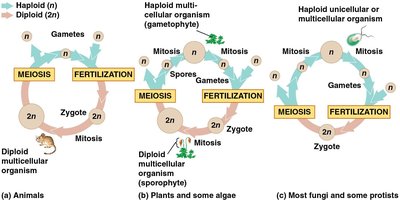
Meiosis Overview
Phases of Meiosis
Meiosis consists of two divisions: Meiosis I and Meiosis II. Each division has distinct stages, resulting in four haploid, genetically unique daughter cells.
Meiosis I: Separates homologous chromosomes, leaving sister chromatids attached.
Meiosis II: Separates sister chromatids, similar to mitosis.
Result: Four haploid cells, each genetically unique.
Meiosis I Stages
Prophase I: Homologous chromosomes pair up (synapsis), forming a synaptonemal complex. Crossing over occurs, exchanging genetic material between non-sister chromatids.
Metaphase I: Homologous pairs (tetrads) align at the metaphase plate. Independent assortment occurs, generating chromosome combinations.
Anaphase I: Homologous pairs are pulled apart; sister chromatids remain attached.
Telophase I & Cytokinesis: Cytoplasm divides, forming two haploid cells, each with two sister chromatids per chromosome.
Meiosis II Stages
Prophase II: New spindle forms.
Metaphase II: Chromosomes align at the metaphase plate; sister chromatids are no longer identical due to crossing over.
Anaphase II: Sister chromatids separate, moving to opposite poles.
Telophase II & Cytokinesis: Nuclei reform, cytoplasm divides, resulting in four haploid, genetically unique cells.
Comparison of Cohesins in Mitosis and Meiosis
Cohesin Function
Cohesins are proteins that hold sister chromatids together. Their cleavage differs between mitosis and meiosis.
Mitosis: Cohesins are cleaved at the centromere during anaphase, allowing chromatids to separate.
Meiosis: Cohesins are cleaved in two steps—first along chromosome arms in Anaphase I (separating homologs), then at the centromere in Anaphase II (separating sister chromatids).
Genetic Variation in Meiosis
Mechanisms of Variation
Meiosis generates genetic variation through three main mechanisms, ensuring offspring inherit traits from both parents and are not identical to either.
Independent Assortment: Random orientation of homologous pairs during Metaphase I. Number of possible combinations: , where n is the haploid number. For humans (n=23): million combinations.
Crossing Over: Exchange of genetic material between homologous chromosomes during Prophase I, creating recombinant chromosomes.
Random Fertilization: Any sperm can fertilize any egg, multiplying possible combinations to approximately 70 trillion.
Comparing Mitosis and Meiosis
Key Differences
Mitosis and meiosis differ in purpose, number of divisions, resulting cells, genetic identity, chromosome number, and unique events.
Feature | Mitosis | Meiosis |
|---|---|---|
Purpose | Growth, repair, asexual reproduction | Gamete formation (sexual reproduction) |
Divisions | One | Two |
Resulting Cells | Two diploid (2n) cells | Four haploid (n) cells |
Genetic Identity | Genetically identical to parent cell | Genetically unique |
Chromosome Number | Conserved | Reduced by half |
Unique Events | No synapsis or crossing over | Synapsis, crossing over, two divisions |
Homologous Chromosomes | Do not pair up | Pair up in Prophase I |
Summary Table: Genetic Variation Mechanisms
Mechanism | Description | Impact |
|---|---|---|
Independent Assortment | Random orientation of homologous pairs in Metaphase I | Millions of possible chromosome combinations |
Crossing Over | Exchange of genetic material between homologous chromosomes in Prophase I | New allele combinations, recombinant chromosomes |
Random Fertilization | Any sperm can fertilize any egg | Trillions of possible genetic outcomes in offspring |
Additional info: Academic context was added to clarify the stages of meiosis, the function of cohesins, and the mechanisms of genetic variation. The summary tables and explanations are expanded for exam preparation and self-contained understanding.
